
Historic Sites, Places of Scenic Beauty, and Natural Monuments of Iwate
岩 手 県 の 史 跡 名 勝 天 然 記 念 物Iwate · Historic Sites, Places of Scenic Beauty, and Natural Monuments
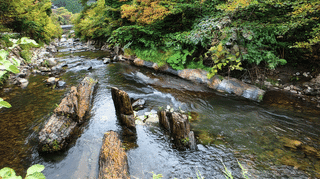
Petrified wood exposed in the beds of the Mabechi and its tributaries in Ichinohe, Iwate. Its species match those of the forest that grows there today.

The Ayaori Shinden Site in Tono City, Iwate Prefecture, is a National Historic Site preserving an early Jomon settlement from around 6,000 years ago. Designated in 2002, it features 17 large pit-dwellings arranged radially around a central plaza, fifty exquisite talc slit ear ornaments (one of the largest such finds in Japan), and a remarkable assemblage of Daigi-style pottery. Discover the site's archaeological significance, the artifacts now displayed at the Tono Machinaka Doki-Doki-kan museum, and the legendary cultural landscape of Tono.
Discover the seven natural wonders of Iwate that inspired beloved poet and storyteller Miyazawa Kenji — from the saddle-shaped Mt. Kurakake to the legendary 'English Coast' along the Kitakami River.
Ryūsendō Cave (Iwaizumi Yūketsu) in Iwate Prefecture is one of Japan's three great limestone caves, designated a National Natural Monument in 1938 along with its rare bat colonies. Discover the cave's famous Dragon Blue underground lakes and the five species of bats that share this protected subterranean world.
Hidden in the wooded hills of northern Iwate, surviving sections of the Oshu Kaido — one of Edo Japan's five great highways — remain almost exactly as 17th-century travelers knew them. With 8.86 km of unpaved roadway and four pristine ichirizuka milestone mounds protected as a National Historic Site since 2010 (the first time a Five Highways route itself received this designation), this 24 km corridor through Ichinohe and Iwate-machi offers a rare immersive walk through samurai-era Japan, complete with a Natural Monument cliff face and traces of the Meiji Emperor's tour.
Discover Ōsuzukami Site, a National Historic Site in Ōshū City, Iwate, where 62 large pit dwellings ring a central plaza in a 5,000-year-old Late Early Jōmon village. Saved during dam construction, this site reveals the origin of Japan's classic ring settlements and the daily life of prehistoric Tōhoku.
Located on a quiet hilltop overlooking Ōfunato Bay in Iwate Prefecture, the Ōbora Shell Mound is a Final Jōmon fishing village dating from roughly 3,000 to 2,200 years ago. The pottery excavated by Tohoku Imperial University in 1925 became the type sequence — Ōbora B, BC, C1, C2, A, and A' — that still anchors the chronology of Final Jōmon ceramics across Tohoku and southern Hokkaido. Designated a National Historic Site in 2001, the site invites travelers to walk the ria coast where Japanese archaeology came of age.
Within the wooded grounds of Kazuguri Inari Shrine in Hanamaki City, Iwate Prefecture, grows the Kazukuri—a mutant Japanese chestnut whose flower spikes are entirely female. Designated as a National Natural Monument in 1927, this is the only place on Earth where this unique strain still survives in its native habitat, preserved through the long-standing efforts of a local preservation society and the city of Hanamaki. A quiet spot where botany, faith, and conservation gently meet.
Adjacent to Mōtsū-ji Temple in Hiraizumi, Iwate, the Former Kanjizaiō-in Garden is the restored remains of a Pure Land garden founded in the 12th century by the wife of Fujiwara no Motohira. A National Place of Scenic Beauty and a UNESCO World Heritage component asset, it features Maizurugaike Pond, dramatic aramiso stone arrangements, and an exquisite cascade composition. The site is freely open to the public as a tranquil historical park.
Kunohe Castle Ruins in Ninohe City, Iwate Prefecture, was the site of the final battle in Toyotomi Hideyoshi's 1591 campaign that brought all of Japan under a single ruler and ended the Sengoku era. Naturally protected on three sides by rivers, the site preserves the oldest castle stonework in Tōhoku, vast dry moats, and Oda-Toyotomi-style gateways. Designated a National Historic Site in 1935 and selected as one of the Continued 100 Famous Castles of Japan, it offers a uniquely layered experience of medieval and early-modern Japanese castle history.
Located in Sumita Town, Iwate Prefecture, the Kuriki Iron Works Ruins preserve the remains of a private ironworks that operated from 1881 to 1920. Designated a National Historic Site in 2021, it is the only surviving example in Japan of a complete small-to-medium scale blast furnace ironworks compound from the Meiji and Taisho periods, holding exceptional industrial archaeological value. Two blast furnace bases, office ruins, water channels, and casting factory remains lie quietly in the Tane-ga-hara highlands beloved by author Miyazawa Kenji.
The Cross-Bedding of Namiuchi Pass, located along the historic Ōshū Kaidō highway in Ichinohe, Iwate Prefecture, features beautifully striped sandstone layers formed in a shallow sea approximately 15 million years ago. As Japan's only nationally designated Natural Monument for cross-lamination, it combines exceptional geological value—including abundant marine fossils—with literary connections to the famous poetic place-name Sue no Matsuyama and the history of Emperor Meiji's imperial visits.
At Hatten Site in Kitakami, Iwate, clay nose, mouth and ear fragments hint at Jomon ritual masks beside a circular hall rebuilt nearly ten times on the same plot.
Mt. Hayachine in Iwate harbors Sakhalin spruce 250 km south of its range. A glacial relict colony of 3,500 trees, designated a National Natural Monument in 1975.
Hideshima, an uninhabited cliff-walled island off Iwate, hosts the only Band-rumped Storm Petrel colony confirmed in the western Pacific. A 1935 Natural Monument.
A medieval manor for Chūson-ji's sutra repository in Iwate, Honedera preserves a rural landscape matching two 13th-century pictorial maps held at the temple.
A Special Natural Monument in Hachimantai, Iwate: a four-kilometer andesite plain from an 18th-century eruption of Mt. Iwate, still nearly bare of trees today.
A National Historic Site in Iwate. Yanaginogosho is the excavated seat of the Ōshū Fujiwara, identified with the Hiraizumi-no-tachi burned by Yoritomo in 1189.
More from Iwate
Iwate’s registered properties across designations, with featured heritage and travel notes.
The complete kokuhō catalogue — browse by prefecture, period, and category.
Nationwide jūyō bunkazai — architecture, sculpture, painting, crafts, and documents.