
Important Cultural Property of Iwate
岩 手 県 の 重 要 文 化 財Iwate’s Important Cultural Properties — designated for their value to the nation’s cultural history.
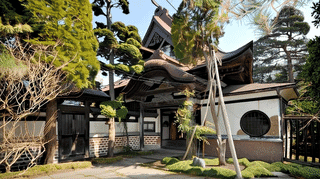
A residence in the former castle town of Mizusawa, Iwate, seven buildings in all. The main house of 1888 is finished with painted panels and shell-flecked plaster.

Late-Edo thatched farmhouse in the hills of Hanamaki, Iwate, returned to its straight plan in 1978 when a later stable was removed. Turf ridge, earthen walls.
The former Morioka Bank head office in Morioka, Iwate, a brick bank of 1911 by Tatsuno Kingo and Kasai Manji, is open as the Iwate Bank Red Brick Building.
1912 European-style wooden hall and octagonal gatehouse of Japan's first college of agriculture and forestry in Morioka, now a museum with Kenji Miyazawa exhibits.
Mid-18th-century thatched farmhouse in Hanamaki, Iwate, turned into an L-shaped Nanbu magariya when a stable was added in the 1850s. Open free, April to November.
The Ganjojuin Hoto Pagoda at Chusonji, Hiraizumi, is a 12th-century stone pagoda beside the Mine Yakushi Hall. Why it matters, its Shakuson-in twin, how to see it.
Built in 1728 with a thatched gate of 1720, the Former Kanno Family Residence in Kitakami's Michinoku Folklore Village is Iwate's oldest securely dated farmhouse.
At Denshoen in Tono, the Former Kikuchi Family Residence began as a straight farmhouse and gained its stable wing early, showing how the L-shaped magariya took form.
The former 90th Bank head office in Morioka, Iwate, a brick bank of 1910 by Yokohama Tsutomu, is Romanesque Revival outside and Secession within, now a museum.
The Former Hoonokidate Family Residence in Ichinohe, a 29.9-meter thatched farmhouse of about 1862, is closed until September 2030 (planned) for major restoration.
Twenty-one farm buildings at the foot of Mount Iwate, designated an Important Cultural Property in 2017 and mostly still in use. Nine can be seen up close.
A thatched farmhouse of about 1695, moved from Hirose to Mukaiyama Park in Esashi, Oshu. Its earthen-floored work area keeps an archaic double row of posts.
The Golden Hall Shelter Hall at Chusonji, Hiraizumi, sheltered the Golden Hall until 1965 and is called Japan's oldest surviving shelter hall. Its history and visit.
An L-shaped thatched farmhouse from Iwaizumi, rebuilt at Iwate Prefectural Museum. Its big stable wing shows how Nanbu farmers shared one roof with their horses.
A stone five-ringed pagoda in Chuson-ji's Shakuson-in cemetery, dated 1169 on its base and the oldest dated gorinto in Japan. It stands in a restricted area.
Shohoji Temple in Oshu, Iwate: an 1811 main hall under one of Japan's largest thatched roofs, an 1807 kuri and a 1665 gate, with visiting hours, fees and access.
The Tamonin Isawa Family Residence in Kitakami, Iwate, is the thatched home of a village mountain ascetic, with a chapel-like dojo and its village shrine.
The Chusonji Temple Sutra Repository in Hiraizumi, an Important Cultural Property since 1908, once held the Fujiwara gold sutras and keeps founding-era timbers.
Tendaiji Temple in Ninohe, Iwate: an Important Cultural Property pair, the 1657 Niomon Gate and 1658 Main Hall, now re-roofed in cedar. Hours, fee and bus access.
The Hakusan Shrine Noh Stage at Chusonji, Hiraizumi, completed in 1853, is the only complete early modern Noh theater in eastern Japan. Its design and performances.
More from Iwate
Iwate’s registered properties across designations, with featured heritage and travel notes.
The complete kokuhō catalogue — browse by prefecture, period, and category.
Nationwide jūyō bunkazai — architecture, sculpture, painting, crafts, and documents.