
Important Cultural Property of Iwate
岩 手 県 の 重 要 文 化 財Iwate’s Important Cultural Properties — designated for their value to the nation’s cultural history.
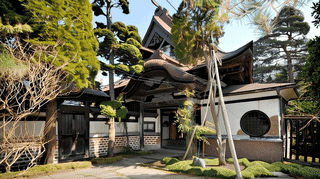
A residence in the former castle town of Mizusawa, Iwate, seven buildings in all. The main house of 1888 is finished with painted panels and shell-flecked plaster.

The Iwate Bank (Former Morioka Bank) Old Head Office Main Building is a magnificent Meiji-era banking hall completed in 1911 in central Morioka. Designed by Tatsuno Kingo, the architect of Tokyo Station, together with Kasai Manji, it is the only surviving Tatsuno work in Japan's Tohoku region. In 1994 it became the first active bank building in Japan to be designated a National Important Cultural Property. Now open to the public as the Bank of Iwate Red Brick Building, it showcases a stunning interior crafted with around 910,000 Iwate-made bricks and Aomori hiba wood, and features the iconic red brick and white granite Tatsuno style facade.
Tucked beside the Mine no Yakushidō at Chūsonji Temple in Hiraizumi, the Ganjōjuin Hōtō is a delicate andesite stone pagoda just 125.7 cm tall. Its cylindrical body carries Sanskrit seed-syllables of the Four Buddhas of the Vajra Realm, embodying the refined late Heian-period stone craftsmanship of the Ōshū Fujiwara golden age. Designated an Important Cultural Property of Japan in 1957.
Standing in the heart of Morioka City, Iwate Prefecture, the Former Ninetieth Bank Head Office Main Building is a two-story brick bank building completed in 1910 (Meiji 43), designed by young Morioka-born architect Tsutomu Yokohama. With its dignified Romanesque Revival exterior and a strikingly modern interior influenced by the Vienna Secession movement, the building is recognized as an early forerunner of Taisho-era Expressionist architecture and was designated an Important Cultural Property of Japan in 2004. Today it is open free of charge as the Morioka Takuboku & Kenji Museum of Youth, where visitors can explore the youthful years of two of Japan's most beloved writers, Takuboku Ishikawa and Kenji Miyazawa.
Twenty-one farm buildings at the foot of Mount Iwate, designated an Important Cultural Property in 2017 and mostly still in use. Nine can be seen up close.
The Old Protective Hall of Konjikidō (Konjikidō Ōidō) at Chūson-ji Temple in Hiraizumi, Iwate Prefecture, is a Muromachi-period wooden structure that shielded the National Treasure Konjikidō from the elements for approximately 600 years. Designated an Important Cultural Property, this humble yet historically significant building stands as a testament to Japan's enduring tradition of cultural heritage preservation.
Discover the Tamonin Izawa Family Residence, a thatched-roof Important Cultural Property in Kitakami, Iwate. This rare Edo-period dwelling of Shugendo mountain ascetics features a unique dojo hall with exquisite plaster carvings and rainbow beams.
Discover the Hakusan Shrine Noh Stage, an Important Cultural Property within the UNESCO World Heritage Site of Chusonji Temple in Hiraizumi, Iwate. Built in 1853, this thatched-roof outdoor Noh theater is the only fully equipped early-modern Noh stage surviving in eastern Japan, still hosting live performances during the Fujiwara Festivals.
Discover Bishamondo Hall, a nationally designated Important Cultural Property in Hanamaki, Iwate. This Muromachi-period Buddhist hall once housed Japan's largest single-tree carved Tobatsu Bishamonten statue, standing 4.73 meters tall, within the sacred grounds of Mikumano Shrine.
Discover Hidaka Shrine Main Hall, a nationally designated Important Cultural Property built in 1632 in Oshu City, Iwate Prefecture. Explore over 1,200 years of history, from the ancient Hitakami Province to samurai legends and the spectacular Hidaka Fire Prevention Festival.
At Tendai-ji in northern Iwate, this Heian-period Important Cultural Property — about 170 cm tall and carved from a single trunk of katsura wood — stands beside the temple's celebrated Sho-Kannon as a survival of Japan's northernmost ancient Buddhist sculpture.
Enshrined in Senju-do at Kannon-in, a sub-temple of Chuson-ji in Hiraizumi, Iwate Prefecture, this 171.2-centimeter wooden statue of Senju Kannon (the Thousand-Armed Bodhisattva of Compassion) is a celebrated late-Heian masterpiece. Carved in the joined-block technique with lacquer and gold-leaf finish, it features eleven faces above the main head and currently thirty-two arms. Designated an Important Cultural Property in 1929, it embodies the gentle Fujiwara-style aesthetic of the UNESCO World Heritage Site of Hiraizumi.
The Wooden Standing Statue of Tobatsu Bishamonten at Asai-Chifuku Atago Shrine (Fujisato Bishamondo) in Oshu, Iwate is a nationally designated Important Cultural Property. Carved from a single block of Japanese horse chestnut and standing 175 cm tall, it features an extraordinary horizontal round-chisel technique with very few parallels in Japan. It is one of the finest provincial Tobatsu Bishamonten figures of the Heian period preserved in Tohoku.
Housed at Kokuseki-ji Temple in Oshu City, Iwate, this seated statue of Yakushi Nyorai bears an ink inscription dated 862 CE inside its body, making it the oldest dated wooden Buddhist sculpture in Japan and a National Important Cultural Property. Carved from a single block of katsura wood and standing 126 cm tall, the statue features a striking, severe expression and a powerfully sculpted body, serving as a touchstone for the study of early Heian-period sculpture. Discover this rare witness to the meeting of imperial Buddhist culture and the ancient northern frontier.
Held by Chusonji Temple in Hiraizumi, Iwate, these four Important Cultural Property masks include the Wakajo, whose ink inscription on the reverse dates it to 1291—making it the oldest dated Noh mask known to survive in Japan. Together with two Okina masks and one Roujo mask, they are still worn each year by Chusonji's monks during Kojitsu Shikisanban, a medieval ennen performance offered on May 4–5 and November 3 at the Hakusan Shrine Noh stage.
More from Iwate
Iwate’s registered properties across designations, with featured heritage and travel notes.
The complete kokuhō catalogue — browse by prefecture, period, and category.
Nationwide jūyō bunkazai — architecture, sculpture, painting, crafts, and documents.