
Shōwa
Iwate · 昭和Browse Iwate’s cultural heritage from the Shōwa period (1926 – 1989). Filter by type and keyword, with concise stories, maps, and travel tips.
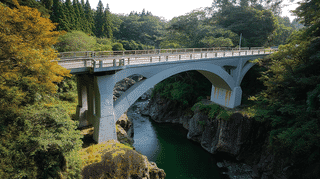
A bridge of 1939 over the Iwai River in Ichinoseki, Iwate, 61 metres long. The Agency records it as a concrete bridge with bamboo used as reinforcement.

Discover Allen Memorial Hall in Kuji, Iwate — a 1941 Western-style residence designed by renowned architect William Merrell Vories for American missionary Thomasine Allen. A Registered Tangible Cultural Property showcasing rare early Showa-era Western domestic architecture in the Tohoku region.
Discover the Iwate Prefectural Public Hall, a Registered Tangible Cultural Property in Morioka designed by renowned architect Sato Koichi. Explore its Art Deco interiors, Neo-Gothic tower, and nearly a century of civic history.
Built in 1931 to mark a father's seventieth birthday, this Takano parlor in Mizusawa has a carved hawk-and-pine transom and a garden veranda, linked to Choei's residence.
Built around 1941 on the Takano grounds in Mizusawa, this guest wing is prized for delicate kumiko glass screens and a coved plaster ceiling, linked to the Kokian.
Named for the pen name of scholar Takano Choei, this tiny 1932 earthen-walled library in Mizusawa has a copper door and iron grilles to guard his legacy.
A plank-walled storehouse of about 1929 in Kanegasaki, Iwate, its boards dropped into grooved posts without nails. Moved by hikiya in 1995 and registered in 2018.
Built in 1930 in Kanegasaki, Iwate, this two-story wooden house pairs a ten-mat zashiki and veranda with mortar walling and a round window. Registered 2018.
The Goto-Haku Memorial Community Hall in Oshu City, Iwate Prefecture, is recognized as Japan's first building to bear the name 'kominkan' (community hall). Built in 1941 by Shoriki Matsutaro as a tribute to statesman Goto Shinpei, this two-story wooden structure features distinctive half-timbered gable walls and layered rooflines. It was designated a Nationally Registered Tangible Cultural Property in 2019.
Bandaikan in Ichinohe, Iwate Prefecture is a National Registered Tangible Cultural Property that began as a puppet theater in 1909 and was rebuilt as a cinema in 1956. As the only surviving active cinema from Iwate's golden age of film, it now hosts cultural events including the Cassiopeia Film Festival and jazz concerts.