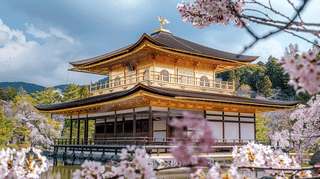
A Hall Built Out Over the Slope on Daigoji's Summit

Near the top of Daigo-yama, the Nyoirin-dō does something the ground would not otherwise allow. Rather than level the mountainside, its builders let the hall reach out over the slope, carrying the front of the structure on a lattice of tall posts. This is kake-zukuri, the "built-out" method used across Japan when a sacred hall has to occupy a site too steep to sit flat, and here it lets the Nyoirin-dō hold a commanding place just below the summit clearing.

The hall takes its name from its principal image, Nyoirin Kannon, a form of the Bodhisattva of Compassion who holds the wish-granting jewel, the cintāmaṇi, from which the name derives. On either side stand Bishamonten, the guardian king, and Kisshōten, goddess of fortune and beauty. The dedication reaches back to the very beginning of the temple: tradition holds that Shōbō, Daigoji's founder, raised the Nyoirin-dō together with the Juntei-dō as the first two halls when he opened the mountain, an event the temple's records place in 876.

The building you see today is a seventeenth-century reconstruction, but the line of worship it continues is among the oldest at Daigoji, older than the great pagoda and gardens that draw crowds to the lower temple.

Rebuilt by the Toyotomi, Preserved as It Was

The Nyoirin-dō is an Important Cultural Property, designated in 1954. The present hall was rebuilt in 1606 (Keichō 11) by Toyotomi Hideyori, in the same wave of construction that raised the neighbouring Kaisan-dō. It was the age when Daigoji, ruined in the fifteenth-century Ōnin and Bunmei wars, was being brought back building by building under the patronage of the Toyotomi house and the drive of the temple's eightieth abbot, Gien.

In form the hall is a single storey, five bays across the front and three deep, roofed in the irimoya hip-and-gable style with the gable turned to the front and finished in thin wood shingling. The kake-zukuri substructure is the feature to study: the way the posts and tie-beams step down the slope to bring the floor out to a level plane is a piece of practical carpentry raised to something close to grace. Standing beneath the projecting front, you can read directly how the weight is carried.

Because it was rebuilt in a single campaign and has stood undisturbed since, the Nyoirin-dō gives an unusually clean reading of early-seventeenth-century temple building, without the patchwork of later alterations that complicates many older halls.

The Last Stretch Before the Summit

Climbing from the Nyonin-dō trailhead, visitors pass the Yakushi-dō and the Godai-dō before the Nyoirin-dō comes into view, rising ahead as the path nears the summit. Just beyond it stands the Kaisan-dō, and the open ground between the two halls, one of the few flat clearings on the mountain, is where most walkers stop to catch their breath. A short way off is a small shrine, the Hakusan Daigongen, locally associated with matchmaking.

This is the highest cluster of buildings at Daigoji, at roughly 450 metres, and reaching it is the point of the whole climb. The upper precinct doubles as a Shugendō training ground, and the Nyoirin-dō, tied to the temple's foundation and perched over its slope, sits squarely within that older, ascetic layer of Daigoji that the lower temple's spring blossoms can make easy to forget.

The hall is viewed from the exterior. As with the rest of the upper precinct, mind the earlier closing time and aim to be back down by around 17:00.

📍 Plan Your Visit to Kyoto
Find tours, activities & transport passes near Daigoji Temple Nyoirindo
[ Kinkakuji Fushimi Inari & Kimono Rental ]

Q&A

QWhat does "kake-zukuri" mean?
AIt is a building method for steep sites, where the front of a hall is carried out over the slope on a framework of tall posts, bringing the floor to a level plane. The Nyoirin-dō uses it to hold its place just below the summit of Daigo-yama.
QWhich image is enshrined here?
AThe main image is Nyoirin Kannon, a form of the Bodhisattva of Compassion holding the wish-granting jewel. Bishamonten and Kisshōten are enshrined in the side bays.
QHow old is the foundation?
ABy temple tradition the Nyoirin-dō was one of the first two halls built when Shōbō opened the mountain, dated to 876. The present building is a 1606 reconstruction by Toyotomi Hideyori, but the line of worship it continues is among the oldest at Daigoji.
QWhere is it in relation to the other halls?
AIt stands near the summit, just below the Kaisan-dō, with an open clearing between the two. Coming up from the trailhead you reach it after the Yakushi-dō and Godai-dō.
QDo I need to climb to see it?
AYes. It is in the upper precinct, about an hour on foot from the Nyonin-dō trailhead. Allow two to three hours round trip, wear proper shoes, and plan to descend by around 17:00.

Basic Information

NameNyoirin-dō, Daigoji Temple
LocationDaigo-Daigosan, Fushimi-ku, Kyoto (Kami-Daigo, upper precinct)
DesignationImportant Cultural Property (building), designated 1954
Date of structureRebuilt 1606 (Keichō 11), Momoyama period, by Toyotomi Hideyori
FormOne building; kake-zukuri (built-out) construction, single storey, five bays by three bays, irimoya roof with front gable, wood shingling
Enshrined imageNyoirin Kannon, with Bishamonten and Kisshōten
OwnerDaigoji Temple
AccessAbout one hour on foot from the Nyonin-dō trailhead; separate admission and seasonal hours apply

References

Agency for Cultural Affairs, National Cultural Properties Database — Nyoirin-dō, Daigoji
https://kunishitei.bunka.go.jp/bsys/maindetails/102/1906
Daigoji Temple, official site — Kami-Daigo (upper precinct)
https://www.daigoji.or.jp/grounds/kamidaigo.html
Japan Travel Bureau Foundation — Daigoji tourism resource record
https://tabi.jtb.or.jp/res/260024-
Wikipedia — Daigoji (Japanese)
https://ja.wikipedia.org/wiki/醍醐寺

Last verified: 2026.07.05