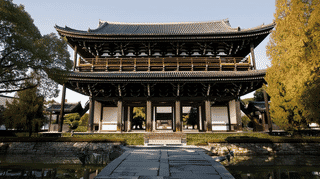
About the Tofukuji Niomon Gate
The Tofukuji Temple Niomon Gate (東福寺二王門, Tōfuku-ji Niō-mon) is a gate of 1597 at Tofukuji in Honmachi 15-chome, Higashiyama Ward, Kyoto City, designated an Important Cultural Property on April 15, 1924 (Agency for Cultural Affairs). Its designation number is 00789.
A Niomon is a gate built to house a pair of guardian kings, the Nio, one on each side of the passage. The Agency dates this one precisely to 1597, in the Momoyama period, which makes it, with the Engetsukyo Bridge of 1603, one of the later buildings among Tofukuji's Important Cultural Properties.
Structure of the Tofukuji Niomon Gate
The Agency for Cultural Affairs records the Niomon Gate as a Hakkyakumon, 3 bays wide with a single central passage, under a gabled roof of full ceramic tiles. Only the middle of its three front bays is an opening.
An eight-legged gate takes its name from the four supporting posts set before and four behind the line of main posts, eight in all, which give it a deeper and more imposing frame than a simple two-post gate. In a Niomon, the side bays are where the guardian figures stand.
Why the Tofukuji Niomon Gate Is an Important Cultural Property
The Tofukuji Niomon Gate is a securely dated eight-legged gate of the Momoyama period (Agency for Cultural Affairs). Designated in 1924, it was taken under national protection soon after the Meiji-era listings of the Zen Hall and the Tosu.
In grounds known for medieval Zen buildings, a late 16th-century gate shows that the complex continued to be built up in the early modern period.
What to Look For at the Tofukuji Niomon Gate
The Agency database map places the Tofukuji Niomon Gate about 500 meters north-northwest of the Sanmon Gate, toward the northern edge of the grounds and away from the main halls, so it is best seen when entering the precinct from the north.
From the front, read the three bays and the single passage; from the side, follow the main posts with the supporting posts before and behind. At the gable end the depth of the eight-legged frame is easiest to appreciate.
Visiting the Tofukuji Niomon Gate
The temple charges admission only for the Honbo Garden and for the Tsutenkyo Bridge with the Founder's Hall; the Tofukuji Niomon Gate is not part of either. The gate is seen from the paths through the grounds.
Tripods and eating or drinking are not allowed in the grounds, and visitors are asked not to bring pets (Tofukuji Temple).
Q&A
- When was the Tofukuji Niomon Gate built?
- In 1597, in the Momoyama period (Agency for Cultural Affairs).
- What type of gate is the Tofukuji Niomon Gate?
- An eight-legged gate, 3 bays wide with one central passage, under a gabled tiled roof (Agency for Cultural Affairs).
- Where is the Tofukuji Niomon Gate?
- The Agency database map puts it about 500 meters north-northwest of the Sanmon Gate, toward the northern edge of the grounds.
- Is there a fee to see the Tofukuji Niomon Gate?
- The temple charges only for the Honbo Garden and the Tsutenkyo Bridge with the Founder's Hall; the Niomon Gate is not part of either.
- When was the Tofukuji Niomon Gate designated an Important Cultural Property?
- On April 15, 1924 (Agency for Cultural Affairs).
Basic Information
| Name | Tofukuji Temple Niomon Gate (東福寺二王門) |
|---|---|
| Location | Honmachi 15-chome, Higashiyama Ward, Kyoto City, Kyoto Prefecture |
| Designation | Important Cultural Property (Structure) |
| Year Designated | Designated April 15, 1924 |
| Quantity | 1 building |
| Dimensions | 3 bays wide, 1 passage bay |
| Owner | Tofukuji Temple |
| Public Access | Visible from the paths through the grounds |
References
- Tofukuji Niomon Gate (Database of National Cultural Properties, Agency for Cultural Affairs)
- https://kunishitei.bunka.go.jp/bsys/maindetails/102/1760
- Tofukuji Engetsukyo Bridge (Database of National Cultural Properties, Agency for Cultural Affairs)
- https://kunishitei.bunka.go.jp/bsys/maindetails/102/1763
- Visitor information (Tofukuji Temple official website, Japanese)
- https://tofukuji.jp/guide/
Last verified: 2026.11.17