
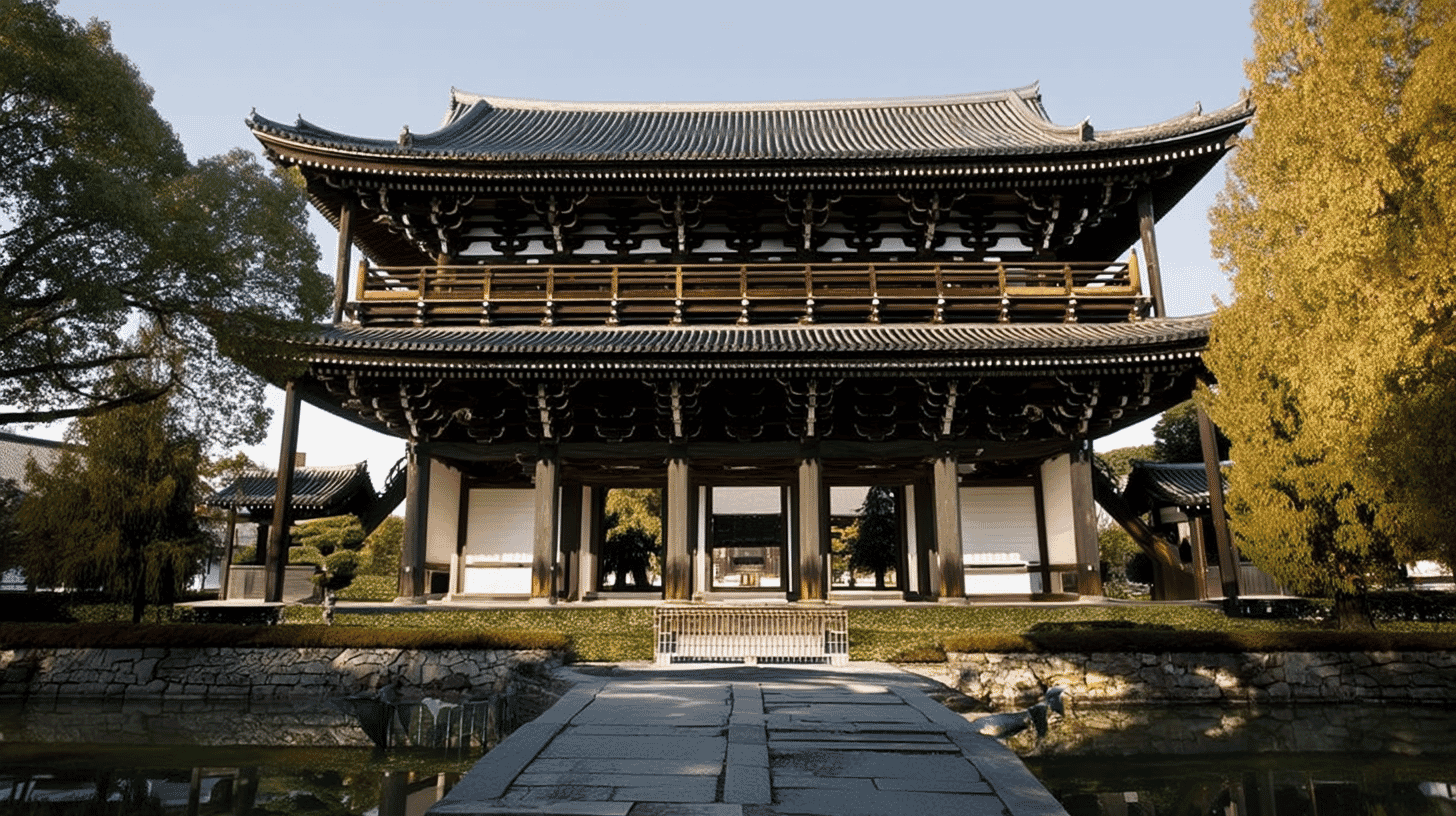
About the Tofukuji Sanmon Gate
The Tofukuji Temple Sanmon Gate (東福寺三門, Tōfuku-ji Sanmon) is a mid-Muromachi two-storey gate at Tofukuji in Honmachi 15-chome, Higashiyama Ward, Kyoto City, designated a National Treasure on March 29, 1952 (Agency for Cultural Affairs). It had been designated an Important Cultural Property earlier, on December 28, 1897. Its designation number is 00049.

The sanmon is the main gate standing at the front of a Zen monastery, and at Tofukuji it faces the Main Hall to the north. The temple credits its rebuilding to Ashikaga Yoshimochi, the fourth Muromachi shogun, and calls it the oldest sanmon in Japan and one of the largest of any Zen temple. The name board on the upper storey, reading Myounkaku, is also said to be in Yoshimochi's hand (Tofukuji Temple).
Structure of the Tofukuji Sanmon Gate
The Agency for Cultural Affairs records the Sanmon Gate as a two-storey gate 5 bays wide with 3 passages, under a hip-and-gable roof of full ceramic tiles. Stair halls are attached on both sides, each with a gabled tiled roof.
Of the 5 bays across the front, the middle 3 are open passages. As a two-storey gate with a roof over each level, it shows two tiers of roof from outside. The stair halls on either side hold the stairs up to the upper floor.
Why the Tofukuji Sanmon Gate Is a National Treasure
The Agency's commentary points out that, though it belongs to a Zen monastery, the Tofukuji Sanmon Gate is not built in the pure Zen style; structurally it is closer to the Daibutsu style. The earlier style seems to have been carried over when the gate was rebuilt, giving it heavy timber proportions and a sense of grandeur that make it unusual within Japanese architecture. The temple likewise says the gate recalls the Daibutsu, or Tenjiku, style (Tofukuji Temple).
Its date was fixed by ink inscriptions found during the dismantling repair of 1969 to 1977, which showed that the roof tiling and the work on the upper storey went on from 1405 until about 1413. After the gate was tilted by the earthquake of 1585, Toyotomi Hideyoshi had it repaired, and it was repaired again in 1792 (Agency for Cultural Affairs).
What to Look For at the Tofukuji Sanmon Gate
From outside, take in the two stacked hip-and-gable roofs and the long, wide front formed with the stair halls on each side. Looking at the thickness of the posts and beams shows the heavy proportions the Agency describes as grand.
Inside the upper storey, the ceiling and pillars are covered in brilliantly colored paintings by Mincho and his pupils, and a crowned Shaka Buddha sits with the Sixteen Arhats and other figures. At the center of the ceiling two celestial maidens fly toward each other, flanked by the kalavinka and the jivajiva, birds with human upper bodies (Tofukuji Temple).
Visiting the Tofukuji Sanmon Gate
The temple charges admission only for the Honbo Garden and for the Tsutenkyo Bridge with the Founder's Hall; the Tofukuji Sanmon Gate is not part of either. The exterior can be seen from the grounds.
The upper storey opens during special openings. In 2026 it is open for the autumn maple season from November 7 to December 6, 9:00 a.m. to 4:00 p.m. with last entry at 3:30 p.m., for 1,000 yen (adults) or 500 yen (elementary and junior high school students), with tickets sold at the gate (Tofukuji Temple, checked November 17, 2026). The temple's Nehan-e notice says the gate is also opened during the spring Nehan-e period. Tripods should not be used in the grounds (Tofukuji Temple).
Q&A
- When was the Tofukuji Sanmon Gate built?
- The Agency for Cultural Affairs dates it to 1405; inscriptions found in the repair of 1969 to 1977 show the roof and upper-storey work continued from 1405 until about 1413.
- Why is the Tofukuji Sanmon Gate a National Treasure?
- Though it stands in a Zen temple, it is built closer to the Daibutsu style, with heavy, grand proportions that the Agency calls unusual in Japanese architecture.
- Can you go up into the Tofukuji Sanmon Gate?
- Yes, during special openings. In 2026 the upper storey is open from November 7 to December 6 for 1,000 yen (adults) or 500 yen (children) (Tofukuji Temple).
- What is inside the upper storey of the Tofukuji Sanmon Gate?
- A crowned Shaka Buddha and the Sixteen Arhats, among other figures, with the ceiling and pillars painted in strong colors by Mincho and his pupils (Tofukuji Temple; Agency for Cultural Affairs).
- When was the Tofukuji Sanmon Gate designated a National Treasure?
- On March 29, 1952; it had been designated an Important Cultural Property on December 28, 1897 (Agency for Cultural Affairs).
Basic Information
| Name | Tofukuji Temple Sanmon Gate (東福寺三門) |
|---|---|
| Location | Honmachi 15-chome, Higashiyama Ward, Kyoto City, Kyoto Prefecture |
| Designation | National Treasure (Structure) |
| Year Designated | Designated March 29, 1952 |
| Quantity | 1 building |
| Dimensions | 5 bays wide, 3 passage bays |
| Owner | Tofukuji Temple |
| Public Access | Exterior visible from the grounds; upper storey during special openings (November 7 to December 6, 2026) |
References
- Tofukuji Sanmon Gate (Database of National Cultural Properties, Agency for Cultural Affairs)
- https://kunishitei.bunka.go.jp/bsys/maindetails/102/1753
- Sanmon Gate special opening (Tofukuji Temple official website, Japanese)
- https://tofukuji.jp/special_event/%e5%9b%bd%e5%ae%9d%e4%b8%89%e9%96%80%e3%80%80%e7%89%b9%e5%88%a5%e5%85%ac%e9%96%8b-3/
- Nehan-e (Tofukuji Temple official website, Japanese)
- https://tofukuji.jp/special_event/nehan-e/
- Visitor information (Tofukuji Temple official website, Japanese)
- https://tofukuji.jp/guide/
Last verified: 2026.11.17
