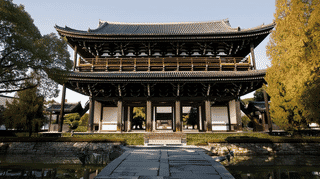
About the Tofukuji Rokuharamon Gate
The Tofukuji Temple Rokuharamon Gate (東福寺六波羅門, Tōfuku-ji Rokuhara-mon) is an early Kamakura-period gate at Tofukuji in Honmachi 15-chome, Higashiyama Ward, Kyoto City, designated an Important Cultural Property on March 31, 1953 (Agency for Cultural Affairs). Its designation number is 01206.
The Agency for Cultural Affairs dates the gate to the early Kamakura period, 1185 to 1274, a span that takes in the years 1236 to 1255 when Tofukuji itself was being built (Tofukuji Temple).
Structure of the Tofukuji Rokuharamon Gate
The Rokuharamon Gate is a Munamon, roofed with full ceramic tiles (Agency for Cultural Affairs). A munamon carries its gabled roof on just two main posts, a simpler frame than the four-legged and eight-legged gates, which add rows of supporting posts.
Full tile roofing alternates flat and round tiles, and on a gate this small the weight of the roof is plain to see. Look from the front and from the side at how the two posts take the load of the tiles.
Why the Tofukuji Rokuharamon Gate Is an Important Cultural Property
Most of Tofukuji was rebuilt after fires in the 14th century and again after 1881 (Tofukuji Temple). The Rokuharamon Gate, which the Agency dates to the early Kamakura period, reaches back further than most of what stands in the grounds.
It was designated in 1953, later than the Zen Hall, the Tosu and the Bathhouse, which were listed in the Meiji era. Small as it is, the gate was listed as a building reaching back to the early medieval period.
What to Look For at the Tofukuji Rokuharamon Gate
Rokuhara is the name of the district east of the Kamo River where warrior governments kept their Kyoto base from the late Heian into the Kamakura period. The Agency record does not explain how the Tofukuji Rokuharamon Gate came by the name.
On the Agency database map, the gate stands southwest of the Sanmon Gate. After the vast two-storey Sanmon, a visit to this two-post gate makes the range of gate types within one precinct easy to grasp.
Visiting the Tofukuji Rokuharamon Gate
The temple charges admission only for the Honbo Garden and for the Tsutenkyo Bridge with the Founder's Hall; the Tofukuji Rokuharamon Gate is not part of either. The gate is seen from the paths through the grounds.
Tofukuji asks visitors not to bring pets into the grounds or onto the approach roads, and firmly refuses anyone walking a pet, or letting it relieve itself, near listed buildings such as the Rokuharamon and Gekkamon gates (Tofukuji Temple).
Q&A
- How old is the Tofukuji Rokuharamon Gate?
- The Agency for Cultural Affairs dates it to the early Kamakura period, 1185 to 1274.
- What type of gate is the Tofukuji Rokuharamon Gate?
- A munamon, whose roof rests on two main posts, covered with full ceramic tiles (Agency for Cultural Affairs).
- Where is the Tofukuji Rokuharamon Gate in the temple grounds?
- The Agency database map places it southwest of the Sanmon Gate.
- Can I bring a dog to the Tofukuji Rokuharamon Gate?
- No. Tofukuji asks visitors not to bring pets and firmly refuses walking pets near listed buildings such as this gate (Tofukuji Temple).
- When was the Tofukuji Rokuharamon Gate designated an Important Cultural Property?
- On March 31, 1953 (Agency for Cultural Affairs).
Basic Information
| Name | Tofukuji Temple Rokuharamon Gate (東福寺六波羅門) |
|---|---|
| Location | Honmachi 15-chome, Higashiyama Ward, Kyoto City, Kyoto Prefecture |
| Designation | Important Cultural Property (Structure) |
| Year Designated | Designated March 31, 1953 |
| Quantity | 1 building |
| Dimensions | Unknown (not recorded by the Agency for Cultural Affairs) |
| Owner | Tofukuji Temple |
| Public Access | Visible from the paths through the grounds |
References
- Tofukuji Rokuharamon Gate (Database of National Cultural Properties, Agency for Cultural Affairs)
- https://kunishitei.bunka.go.jp/bsys/maindetails/102/1761
- Visitor information (Tofukuji Temple official website, Japanese)
- https://tofukuji.jp/guide/
- Frequently asked questions (Tofukuji Temple official website, Japanese)
- https://tofukuji.jp/contact/qanda/
- History (Tofukuji Temple official website, Japanese)
- https://tofukuji.jp/history/
- Honbo Garden (Tofukuji Temple official website, Japanese)
- https://tofukuji.jp/guide/honbo/
Last verified: 2026.11.17