
Shōwa
Mie · 昭和Browse Mie’s cultural heritage from the Shōwa period (1926 – 1989). Filter by type and keyword, with concise stories, maps, and travel tips.
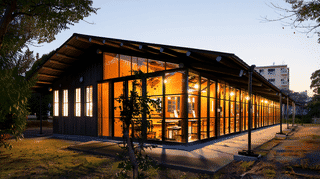
Discover Raymond Hall, a Registered Tangible Cultural Property at Mie University designed by legendary architect Antonin Raymond in 1951. This wooden masterpiece showcases the innovative "Raymond Style" with exposed log structures and pioneering modernist design that influenced generations of Japanese architects.

Discover Suehiro Bridge in Yokkaichi, Mie Prefecture — Japan's oldest and only operational bascule railway bridge. Completed in 1931, this Important Cultural Property still carries freight trains across the Chitose Canal. A must-visit for railway and industrial heritage enthusiasts.
Haiseiden in Iga, Mie is a 1942 Important Cultural Property marking poet Matsuo Basho's 300th birth anniversary, shaped to evoke the wandering poet in travel attire.
The Asahi Elementary School Round Building in Asahi Town, Mie Prefecture, is a four-story reinforced concrete circular school building designed by architect Kanao Sakamoto and completed in 1962. It is the only registered tangible cultural property among just five surviving active round school buildings in Japan, recognized as a masterpiece from the peak of Sakamoto's circular school designs.
Discover Anorisaki Lighthouse in Shima, Mie Prefecture — one of Japan's rare square lighthouses and a Registered Tangible Cultural Property. Learn about its history dating back to 1873, panoramic ocean views, and the nearby lighthouse café and museum.
Discover the Amikan Head Office, a Registered Tangible Cultural Property in Yokkaichi, Mie Prefecture. This early Showa-period Expressionist-style building with scratch tile facade and distinctive tower reflects the legacy of Japan's pioneering fishing net industry.
Discover the Amikan Head Office Main Gate, a nationally registered tangible cultural property in Yokkaichi, Mie Prefecture. Built in the early Showa period, this concrete gate with dome-topped pillars stands as a symbol of Japan's modern net-making industry heritage along the old Tokaido Road.
Discover the Amikan Head Office Brick Wall in Yokkaichi, Mie Prefecture — a registered tangible cultural property from the early Shōwa era. Explore the history of a fishing net manufacturer founded in 1794 and the striking brick wall that symbolizes Japan's modern industrial development along the old Tōkaidō road.
Discover the Ishiyakushi Bunko Reading Room, a 1932 Registered Tangible Cultural Property in Suzuka, Mie Prefecture. Gifted by legendary tanka poet Sasaki Nobutsuna on his 60th birthday, this charming library sits along the historic Tokaido highway at the 44th post station.
Discover the Ueno City Waterworks Source Pumping Station Room, a reinforced concrete pumping facility built in 1936 and registered as a national tangible cultural property. Located in Iga City, Mie Prefecture, this early Showa-era industrial heritage showcases understated yet charming architectural details.
A 1929 rest house in Iga's Kagiya-no-tsuji park recreating the teahouse of the 1634 vendetta. Sukiya detailing, split-bamboo ceiling, registered 2024, repaired 2026.
The Katsuo no Tenpaku Main House in Nakiri, Shima City, Mie Prefecture, is a katsuobushi (dried bonito) manufacturer's residence registered as a National Tangible Cultural Property in 2022. Standing on the dramatic cliffs of Cape Daio overlooking the Pacific, this fourth-generation producer preserves the ancient tebiyama smoking method from the Edo period. Discover a living cultural heritage that embodies the Ise-Shima region's sacred food traditions and its deep connection to Ise Grand Shrine.
The Katsuo no Tenpaku Workshop, perched on the cliffs of Cape Daio in Shima City, Mie Prefecture, is an active katsuobushi (dried bonito) production facility registered as a National Tangible Cultural Property in 2022. Using the tebiyama smoking method established in the mid-Edo period — practiced by only about ten workshops nationwide — it produces premium honkarebushi. Guided tours offer tastings of ichiban dashi and freshly shaved bonito over rice.
A two-storey reinforced concrete post office of 1932 on the Wakayama Kaido in Matsusaka, Mie. Built as the Kakino Post Office, it was registered in 2011.
A single-storey timber post office of 1931 in Tsu, Mie. Its L-shaped plan sets the working space east and the night duty rooms west. Registered in 2019.
A detached tatami parlour of around 1955 at the Former Ito Denshichi Villa in Yokkaichi, Mie. Ten and six mat rooms, alcove joinery; registered in 2010.
Built in 1934 above Ago Bay for a retired insurance manager, this Shima City house sets formal Japanese reception rooms beside a lacquered coffered-ceiling study.
Just 7.2 square metres, this early Showa tool store in Matsusaka, Mie, was registered in 2013 for the way it closes a former medicine dealer's walled compound.
Built around 1935 at Juryoji temple in Kuwana, Mie, this 16-square-metre concrete hall sets a vaulted roof above a Japanese cusped gable carried on fluted columns.
A one-bay concrete bell tower of about 1935 at Juryoji temple in Kuwana, Mie. Arches span its posts below a pyramidal roof, and washed aggregate patterns its faces.