
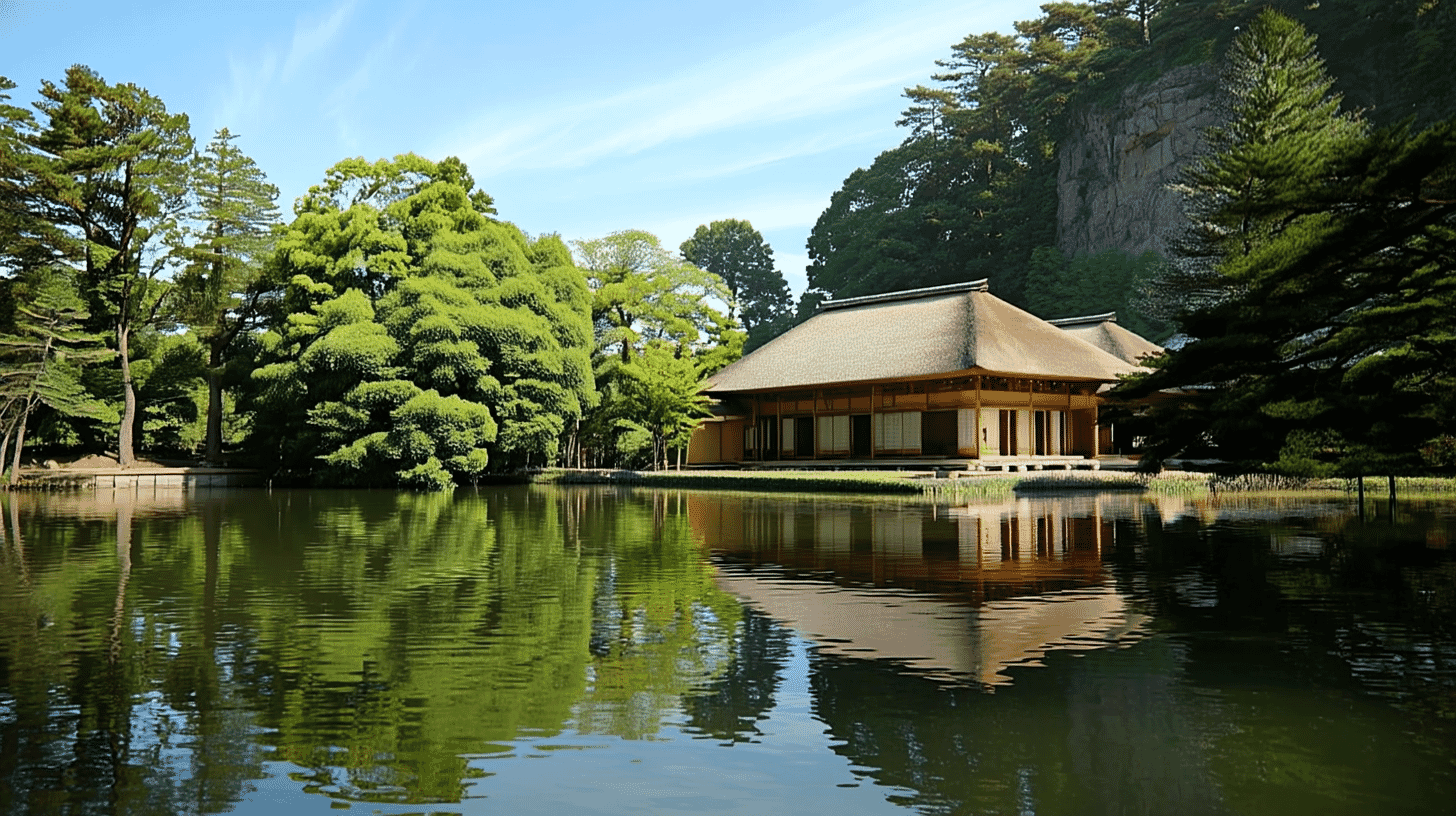
An Edo-Period School, Designated in 1933
Former Yubikan and Gardens (旧有備館および庭園, Kyu Yubikan oyobi Teien) is a school building with its garden at Iwadeyama, Osaki City, Miyagi Prefecture, designated a national Historic Site and Place of Scenic Beauty on 28 February 1933.
The Agency for Cultural Affairs gives its assessment in one sentence: it is the oldest surviving building of an Edo-period school.
Of an Edo-period school is the limit set on the claim. It is the oldest within that class, not among schools in general. Accounts elsewhere call it the oldest school building in Japan; the Agency's wording is narrower.
The Sources Disagree Sharply on Its Founding
Two accounts of how the place began differ considerably.
The Agency writes that the retirement residence of Munechika, the third lord of Iwadeyama Castle of the Date family, was turned by the fourth lord Murayasu into a school called the Shungakukan; it was later moved to the present site at the northern foot of the castle and named the Yubikan.
Osaki City writes instead that the main building is generally held to have been built around 1677, in the Enpo era, as the retirement residence of Munetoshi, the second lord, and that the Yubikan was founded around 1850, when Kuninao, the tenth lord, held the house.
Whether the retirement residence belonged to the third lord Munechika or the second lord Munetoshi differs in both generation and name, and whether the school began under the fourth lord Murayasu or the tenth lord Kuninao differs by six generations. In years that is 1715 against 1850, a gap of more than 130 years.
This article does not choose between them and records that both accounts exist.
The Building Was Moved
The Agency records that it was later moved to the present site at the northern foot of the castle and named the Yubikan. Where it stands now is not where it was built.
Osaki City records a further transfer: in 1970 it passed from the Iwadeyama Date family to the former town of Iwadeyama. Ownership moved from a family to a local authority.
Of the garden, Osaki City writes that it is held to have been laid out around 1715, in the time of the fourth lord Murayasu, by Shimizu Dokan the third of the Sekishu school, tea master to the Sendai domain.
It is a stroll garden around a pond with an island, taking the cliff below the castle keep as borrowed scenery, and holds trees more than 300 years old. Borrowed scenery means drawing the view beyond the garden into the garden itself.
The Main Building Collapsed and Was Rebuilt
Osaki City sets out the damage and the repair.
In the Great East Japan Earthquake of 11 March 2011 the main building collapsed, the annexe suffered damage to walls and roof, and the garden cracked and subsided in several places.
The designated building itself came down. The damage was not confined to the buildings but reached the ground of the garden.
The course of the repair is recorded too. Disaster repair works on the main building, the annexe and other structures ran from November 2013 to March 2015, and repair of the main gate was completed in March 2016, when the site reopened to visitors.
Five years passed between the collapse and the reopening. The main building seen today is the one that came through those works.
Visiting
The Former Yubikan and its garden are open to visitors, having reopened in 2016 after the repair works.
Opening hours and admission may change, so check the site's information before travelling.
What there is to see is the main building and the garden. Because the garden takes the cliff below the castle keep as borrowed scenery, the ground behind it is worth taking in along with the garden itself. It is a stroll garden around a pond with an island, holding trees more than 300 years old.
The site is at Iwadeyama, Osaki City, Miyagi Prefecture, nearest to Yubikan Station on the JR Rikuu East Line.
Q&A
- When was the site designated?
- On 28 February 1933, as a national Historic Site and Place of Scenic Beauty. It stands at Iwadeyama, Osaki City, Miyagi Prefecture. Osaki City records that in 1970 it passed from the Iwadeyama Date family to the former town of Iwadeyama.
- Is it the oldest school building in Japan?
- The Agency for Cultural Affairs writes that it is the oldest surviving building of an Edo-period school. The limit is set by that phrase: oldest within that class, not among schools in general.
- Why do the accounts of its founding differ?
- The Agency says the retirement residence of the third lord Munechika was turned into a school by the fourth lord Murayasu; Osaki City says the building was raised around 1677 for the second lord Munetoshi and the school founded around 1850 under the tenth lord Kuninao. Generation, name and year all differ, and this article records both.
- What is the garden like?
- Osaki City records it as laid out around 1715 in the time of the fourth lord Murayasu by Shimizu Dokan the third of the Sekishu school, tea master to the Sendai domain. It is a stroll garden around a pond with an island, taking the cliff below the castle keep as borrowed scenery, and holds trees more than 300 years old.
- What damage did the 2011 earthquake cause?
- Osaki City records that the main building collapsed, the annexe suffered damage to walls and roof, and the garden cracked and subsided in several places. Disaster repair works ran from November 2013 to March 2015, the main gate was repaired by March 2016, and the site then reopened.
Basic Information
| Name | Former Yubikan and Gardens (旧有備館および庭園, Kyu Yubikan oyobi Teien) |
|---|---|
| Location | Iwadeyama, Osaki City, Miyagi Prefecture |
| Designation | Historic Site and Place of Scenic Beauty (monuments) |
| Year Designated | 1933 (28 February), Historic Site and Place of Scenic Beauty |
| Quantity | The Agency's quantity field is blank |
| Dimensions | The main building and an annexe stand in a stroll garden around a pond with an island, taking the cliff below the castle keep as borrowed scenery. Trees more than 300 years old grow in the garden. Edo period |
| Owner | The Agency's managing body field is blank; Osaki City records a transfer in 1970 from the Iwadeyama Date family to the former town of Iwadeyama |
| Public Access | Open to visitors, having reopened in 2016 after repair of earthquake damage |
References
- Cultural Heritage Online: Former Yubikan and Gardens
- https://bunka.nii.ac.jp/heritages/detail/160538
- Osaki City: Former Yubikan and Gardens
- https://www.city.osaki.miyagi.jp/shisei/soshikikarasagasu/kyoikuiinkaijimukyoku/bunkazaika/oosakinotakara/1973.html
- Former Yubikan and Gardens official site
- https://yubikan.jp/top.html
- Agency for Cultural Affairs, National Cultural Properties Database
- https://kunishitei.bunka.go.jp/
Last verified: 2026.09.28