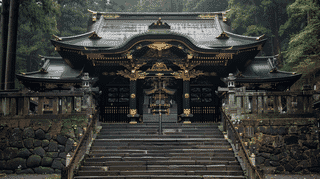
Osaki Hachimangu Shrine
Osaki Hachimangu Shrine (大崎八幡宮, Ōsaki Hachimangū, also called Osaki Hachiman Shrine) in Hachiman 4-chome, Aoba Ward, Sendai City, Miyagi Prefecture, keeps the shrine buildings that Date Masamune raised in 1607, a main sanctuary, stone room and worship hall designated a National Treasure on November 22, 1952 (Agency for Cultural Affairs). In the same precinct the Nagatoko was designated an Important Cultural Property in 1966, and the shrine office, the former chief priest's residence and the sacred horse stable were registered as Registered Tangible Cultural Properties (structures) on July 25, 2011 (Agency for Cultural Affairs; Sendai City).

The shrine traces itself to a Hachiman shrine said to have been founded at Mizusawa, in present-day Iwate Prefecture, by the general Sakanoue no Tamuramaro, who prayed there for victory. In the Muromachi period the Osaki clan, the shogunate's deputies for the northeast, moved it to Tajiri in their own domain as their guardian shrine, and it came to be called Osaki Hachiman (Osaki Hachimangu Shrine).
After the Osaki clan fell, Date Masamune moved the sacred object to a small shrine inside his Iwadeyama Castle, and once he had founded Sendai he enshrined it on the present site, to the northwest of Sendai Castle. Called Osaki Hachiman Jinja from the Meiji era, the shrine took back the name Osaki Hachimangu in June 1997 (Osaki Hachimangu Shrine).
Five Listed Buildings in One Precinct
The National Treasure buildings join the main sanctuary and the worship hall with a low-floored stone room in the Gongen-zukuri manner, dressed in black lacquer, bright polychrome and gilt metal fittings in the Momoyama taste (Agency for Cultural Affairs; Sendai City). Directly in front stands the Nagatoko, a plain unpainted hall with a passage through its center. It appears on a plan in a domain survey with a postscript of 1686, so it was built before that year (Sendai City).

Along the approach stand three buildings of the Taisho era. The shrine office sits on the west side of the approach facing east, and Sendai City dates it to between April 1923 and May 1924. The former chief priest's residence joins it to the south by a covered corridor, and the sacred horse stable stands across the approach to the east (Agency for Cultural Affairs).
At Osaki Hachimangu Shrine, then, a Momoyama sanctuary, an Edo-period hall and a group of Taisho buildings share one precinct. Each building has its own page with its structure and details.
Festivals and Kagura
The annual festival of Osaki Hachimangu Shrine falls in mid-September. Noh kagura is performed in the kagura hall at the west end of the Nagatoko, a great portable shrine is carried through the neighborhood, and mounted archery is held on the shrine's riding ground (Osaki Hachimangu Shrine; Sendai City). In the 2026 schedule the kagura was set for September 12 and the procession and archery for September 13.
The Noh kagura, a form of hoin kagura, was selected in 1973 as an intangible folk cultural property for which the national government should make records (Agency for Cultural Affairs). Eight pieces survive, among them Shinpai and Koyumi Asobi.
On the night of January 14 the Matsutaki festival burns New Year decorations and old talismans, and its fire draws the hadaka mairi, a procession of worshippers in white cloth. Sendai City designated the festival an intangible folk cultural property in fiscal 2005 (Osaki Hachimangu Shrine).
Visiting
Osaki Hachimangu Shrine takes requests for prayers without a booking at the ritual building to the right of the main sanctuary, from 9:00 a.m. to 4:00 p.m.; prayers may not be possible on festival days (Osaki Hachimangu Shrine). No information was found on regular public access to the interiors of the shrine buildings, the Nagatoko or the three Taisho buildings.
Visitors may take photographs as long as they do not disturb other worshippers. Shoots with a hired photographer need an application and fee at the prayer desk in the ritual building, and commercial or promotional use should be cleared with the shrine office (Osaki Hachimangu Shrine).
From the West Exit bus terminal at Sendai Station, Sendai City buses from platforms 13 and 14 stop at Osaki Hachimangu-mae. Another route is the Namboku subway line to Kita-Yobancho Station, then a city bus from the Futsukamachi Kita-Yobancho stop. On the JR Senzan Line, the shrine is a 15-minute walk from Kunimi Station or Tohoku Fukushi Daimae Station (Osaki Hachimangu Shrine).
References
- Osaki Hachimangu (Database of National Cultural Properties, Agency for Cultural Affairs)
- https://kunishitei.bunka.go.jp/bsys/maindetails/102/116
- Osaki Hachimangu Nagatoko (Database of National Cultural Properties, Agency for Cultural Affairs)
- https://kunishitei.bunka.go.jp/bsys/maindetails/102/117
- Osaki Hachimangu Shrine Office (Database of National Cultural Properties, Agency for Cultural Affairs)
- https://kunishitei.bunka.go.jp/heritage/detail/101/00008609
- Osaki Hachimangu Former Chief Priest's Residence (Database of National Cultural Properties, Agency for Cultural Affairs)
- https://kunishitei.bunka.go.jp/heritage/detail/101/00008610
- Osaki Hachimangu Sacred Horse Stable (Database of National Cultural Properties, Agency for Cultural Affairs)
- https://kunishitei.bunka.go.jp/heritage/detail/101/00008611
- Noh Kagura of Osaki Hachiman Shrine (Database of National Cultural Properties, Agency for Cultural Affairs)
- https://kunishitei.bunka.go.jp/heritage/detail/312/207
- Osaki Hachimangu (Sendai City designated and registered cultural properties)
- https://bunkazai.city.sendai.jp/shiteidb/c00001.html
- Osaki Hachimangu Nagatoko (Sendai City designated and registered cultural properties)
- https://bunkazai.city.sendai.jp/shiteidb/c00002.html
- Osaki Hachimangu Shrine Office (Sendai City designated and registered cultural properties)
- https://bunkazai.city.sendai.jp/shiteidb/c03025.html
- History (Osaki Hachimangu Shrine, Japanese)
- https://www.oosaki-hachiman.or.jp/origin/
- Annual Festival (Osaki Hachimangu Shrine, Japanese)
- https://www.oosaki-hachiman.or.jp/festival/reitai/
- Matsutaki Festival (Osaki Hachimangu Shrine, Japanese)
- https://www.oosaki-hachiman.or.jp/festival/matsutaki/
- Prayers and Photography (Osaki Hachimangu Shrine, Japanese)
- https://www.oosaki-hachiman.or.jp/guidance/
- Access (Osaki Hachimangu Shrine, Japanese)
- https://www.oosaki-hachiman.or.jp/traffic/
Last verified: 2026.11.19
Basic Information
| Name | Osaki Hachimangu Shrine |
|---|---|
| Location | Hachiman 4-chome, Aoba Ward, Sendai City, Miyagi Prefecture |
| Owner | Osaki Hachimangu Shrine (religious corporation) |
| Designation | National Treasure (1) · Important Cultural Property (1) · Registered Tangible Cultural Properties (3) |
| Coordinates | 38.27190, 140.84484 |