
Important Cultural Property of Miyagi
宮 城 県 の 重 要 文 化 財Miyagi’s Important Cultural Properties — designated for their value to the nation’s cultural history.
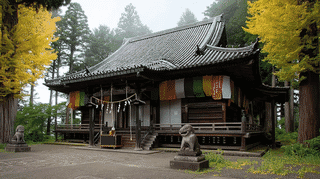
A Buddhist hall of 1607 in Wakabayashi Ward, Sendai, five bays square. Bare timber at the gable ends, and a richly ornamented shrine standing inside it.

Discover Kōzōji Amida Hall in Kakuda, Miyagi Prefecture — an Important Cultural Property built in 1177 by the wife of Fujiwara Hidehira. As the oldest wooden building in Miyagi and one of only three surviving Heian-period structures in Tōhoku, this thatched-roof Buddhist hall offers a rare glimpse into the spiritual world of the Northern Fujiwara clan.
Discover the Former Sato Family Residence in Kakuda, Miyagi Prefecture — a nationally designated Important Cultural Property showcasing a mid-18th century Tohoku farmhouse with thatched roof, torii-date pillars, and authentic Edo-period rural living.
Perched on Ichimoriyama overlooking Matsushima Bay in Miyagi Prefecture, Shiogama Shrine has been revered as the first-ranked shrine of ancient Mutsu Province for over a thousand years. Begun in 1695 by the fourth Sendai lord Date Tsunamura and completed in 1704 under his successor Date Yoshimura, fourteen halls and a stone torii were designated Important Cultural Properties in 2002. The shrine is celebrated for its rare layout enshrining three deities in three sanctuaries and for the masterful contrast between its restrained main halls and ornate gates—an outstanding example of mid-Edo shrine architecture.
Built around 1887 for missionaries and designated an Important Cultural Property in 2016, this colonial timber house in Sendai is a rare early foreign residence.
Completed in 1888 to a design by Yamazoe Kisaburo, this wooden schoolhouse in Tome City became an Important Cultural Property in 1981 and now houses a museum.
A late Edo thatched farmhouse designated an Important Cultural Property in 1974, the Former Nakazawa Residence in Natori keeps the local four-room plan.
Horaguchi Family Residence in Natori, Miyagi: a Horeki-era farmhouse ringed by a ditch and igune windbreak, designated in 1971, with named posts in its earth floor.
The Matsumoto Family Residence in Kami, Miyagi, housed retainers to the Date lords' vassals. Its living and kitchen blocks stand apart beneath one thatched roof.
Cast in 1326 for Enpuku-ji Temple in Matsushima, the Unpan at Zuiganji is a rare Kamakura-period bronze gong shaped like a cloud, used to summon Zen monks. Discover this Important Cultural Property at the Seiryuden Treasure Hall.
Standing at the southern tip of Oshima Island in Matsushima, Miyagi Prefecture, the Oshu Mishima Raiken Stele is a slate monument over three meters tall, erected in 1307 by more than thirty disciples to honor the monk Raiken, who never left the island during twenty-two years of solitary practice. Its 643 characters of cursive script were both composed and brushed by the celebrated Chinese émigré monk Issan Ichinei. Designated an Important Cultural Property in 1955, it is one of the finest dated cursive stone inscriptions surviving from the late Kamakura period.
A complete polished jadeite axe from the Kamegaoka Site in Aomori, now housed at Miyagi's Tōhoku History Museum. Designated an Important Cultural Property in 1973, this 9 cm masterpiece reveals Jōmon-era craftsmanship and the vast trade network that carried Itoigawa jadeite across ancient Japan.
Originally preserved as a sacred treasure in an Ainu household in Hidaka, Hokkaido, this silver-mounted Kamakura-period tachi survives as a rare early example of Ezo-style ceremonial swords. Held by the Tohoku History Museum in Tagajo, Miyagi.
More from Miyagi
Miyagi’s registered properties across designations, with featured heritage and travel notes.
The complete kokuhō catalogue — browse by prefecture, period, and category.
Nationwide jūyō bunkazai — architecture, sculpture, painting, crafts, and documents.