
Edo
Nagano · 江戸Browse Nagano’s cultural heritage from the Edo period (1603 – 1868). Filter by type and keyword, with concise stories, maps, and travel tips.
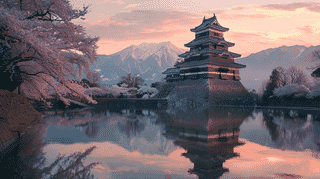
The keep of Matsumoto Castle in Nagano, built between 1594 and 1599, rises five tiers on gently sloped walling. Five buildings of differing dates make it up.
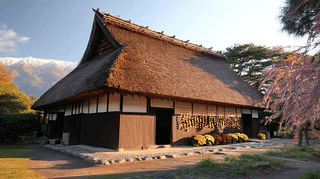
Discover the Former Takahashi Family Residence in Azumino, a registered Tangible Cultural Property featuring an authentic Edo-period farmhouse and three Meiji-era storehouses. Birthplace of renowned lacquer artist Takahashi Setsuro, this hidden gem offers a rare glimpse into traditional Japanese rural architecture amid the stunning North Alps landscape.

Nestled in the farmland of Shiojiri City, Nagano Prefecture, the Komatsu Family Residence is one of eastern Japan's oldest surviving farmhouses, built by the early 18th century. Its earthen-floor dozā and single wooden-plank room embody the archetypal form of early modern farmhouse architecture. Designated a national Important Cultural Property in 1973, this thatched hipped-roof home offers a rare glimpse into the life of an Edo-period village headman.
The Sanayama Family Residence in Mochizuki-juku, Saku City, Nagano Prefecture, is an Edo-period inn and shipping agency rebuilt in 1766. Its main house and traditional storehouse are designated as Important Cultural Properties of Japan, preserving the elegant degeta-zukuri facade, white plaster walls, and lattice windows that evoke life along the historic Nakasendo highway.
Built in the Kyoho era (1716-1735), the Shimazaki Family Residence in Shiojiri, Nagano is the oldest known fully formed honmune-zukuri farmhouse in Japan.
The Kuri (priests' kitchen and quarters) of Joshoji Temple in Okuwa Village, deep in Nagano's Kiso Valley, is a magnificent early Edo-period building completed in 1654 and designated an Important Cultural Property of Japan. With its 21.9-meter frontage and dramatic exposed-beam interior, it stands together with the temple's main hall and gate as one of central Japan's most complete surviving 17th-century Zen temple compositions, on the historic Nakasendo highway.
Joshoji's Sanmon in Okuwa, Nagano is a 1661 cypress-bark four-legged gate and Important Cultural Property, at a Kiso temple with Japan's oldest record of cut soba.
Jōshō-ji's main hall, a Rinzai temple in Suhara on the Nakasendō, became an Important Cultural Property in 1952. A 1574 record names Japan's oldest cut soba.
Shinmeisha, commonly known as Omi Shinmeigu, is a historic Shinto shrine in Omi Village, Nagano Prefecture, founded in the late Heian period to protect the Omi Mikuriya estate of Ise Grand Shrine. Its five buildings—including the grand Shinmei-zukuri main hall built in 1684—are designated as Important Cultural Properties of Japan, representing one of the finest and oldest ensembles of Shinmei-style shrine architecture in the country.
The Sunohara Family Residence in Tōmi City, Nagano Prefecture, is a nationally designated Important Cultural Property farmhouse dating from the late 17th-century Genroku era. Featuring a magnificent thatched hip roof, expansive earthen-floor workspace, and archaic dense-pillar construction, this article explores the history, architectural significance, highlights, and nearby attractions of this exceptional example of southeastern Nagano's rural heritage.
Finished in 1759 and an Important Cultural Property since 1965, Zenkoji Kyozo centres on a six-metre revolving case holding 6,771 volumes of the Buddhist canon.
Dating from 1750 and protected as an Important Cultural Property since 1965, Zenkoji Sanmon has been climbable again since 2008. Monju waits on the upper floor.
Rebuilt in 1707 and made a National Treasure in 1953, Zenkoji Hondo runs fourteen bays deep against five wide. A pitch-dark passage circles beneath its altar.
Built around the mid-1600s in Azumino, Nagano, this farmhouse belongs to the honmune-zukuri type but opens on its eaves side, showing the style before it settled.
A boarded-roof honmune farmhouse on a terrace above the Tenryu River in Takamori, Nagano. A ridge tablet fixes its date to 1799; it was listed in 1973.
The Tezuka Family Residence at Narai in Shiojiri, Nagano, comprises a main house and reception wing of 1840 and a storehouse of 1863, designated in 2007.
Discover Nishina Shinmeigu in Omachi, Nagano — the only surviving medieval Shinmei-zukuri shrine in Japan. Designated a National Treasure, this sacred site preserves centuries of Shikinen Sengu tradition amid the stunning Japanese Alps.
Discover the Horiuchi Family Residence, an Important Cultural Property in Shiojiri, Nagano. This 18th-century honmune-zukuri farmhouse features striking suzume-odori ridge ornaments and showcases the finest rural architectural traditions of central Japan.
Seven Takashima Domain lords lie beneath 3-meter stone markers above Lake Suwa, the founder in a vermilion mausoleum nearby. National Historic Site, 2017.
Visit the Iwadare Family Residence Main Building in Shiojiri, Nagano — a registered cultural property built in 1836, with a special upper-level reception room added in 1861 for attendants of Princess Kazunomiya's historic Nakasendō procession to Edo.