
Meiji
Nagano · 明治Browse Nagano’s cultural heritage from the Meiji period (1868 – 1912). Filter by type and keyword, with concise stories, maps, and travel tips.
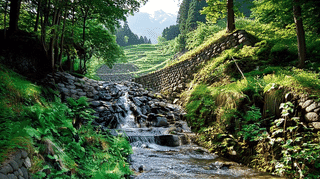
Meiji-period stone waterway works in Ogawa, Nagano Prefecture, Japan. Its own date field over there carries both the building and the two repairs now.

The lowest of four 1887 dry-stone sabo dams on the Ashizawa stream in Omi, Nagano: 10 metres long and 4.2 metres high, built of boulders up to a metre across.
Built in 1887 on the Ashizawa stream in Omi, Nagano, this 16-metre dry-stone sabo dam is one of four low, gently battered dams still guarding the valley today.
Second of four 1887 dry-stone sabo dams on the Ashizawa stream in Omi, Nagano: 12 metres long, 3.8 metres high and almost symmetrical, with a crisp central spillway.
Uppermost and largest of four 1887 dry-stone sabo dams on the Ashizawa stream in Omi, Nagano: 15 metres long and 6.8 metres high, an early Home Ministry public work.
A cocoon warehouse of about 1894, twenty bays long and three storeys high, this plastered timber building beside Iijima Shoten's shop in Ueda is now its workshop.
Built around 1894 by the Ueda Soko warehouse company, this three-storey plastered cocoon warehouse on a corner near Ueda Station is now Iijima Shoten's office.
A late Meiji munamon gate in Azumino, Nagano, opening from the main house forecourt into the garden, its gently curved roof ridge decorated with a circle pattern.
An early Meiji pawn storehouse in Azumino, Nagano, with a pair of black-plastered earthen doors on its west front, namako tiling and a separate roof set above.
An early Meiji brewing hall in Azumino, Nagano, 16 bays long under a low wagoya-framed roof, whose chimney marks the east side of the Iida sake brewer's estate.
An 1875 earthen storehouse in Azumino, Nagano, whose southern end served as retirement quarters with its own privy, finished in tortoiseshell-pattern namako tiling.
A 63-meter late Meiji earthen wall in Azumino, Nagano, built on a stone base with posts every 1 ken and white plaster, enclosing the garden of the Iida estate.
The smallest building on the Iida estate in Azumino, Nagano: a Meiji miso storehouse of 20 square meters, its rafters sealed in white plaster above board-clad walls.
A late Meiji gatekeeper's lodge in Azumino, Nagano, topped by a smoke-vent roof and registered together with the earthen wall and kabukimon gate beside it.
A dry-stone check dam of c.1884 in Kuwabara, Chikuma, Nagano. Just 3.8 m high, it leans back at a 1:1.6 slope and runs a 7.2 m stone apron below to steady the bed.
The widest of four Meiji check dams on the Izawa River in Chikuma, Nagano. Only 3.7 m high but 35 m across, its spillway uses big blocks and its wings small ones.
The lowest and smallest of four Meiji check dams on the Izawa River in Chikuma, Nagano. Built under Home Ministry works, its crest sags like a slack rope.
Built in the early Meiji era north of the rice store at Imai in Okaya, this 46 square metre timber store has two-bay doors on both floors and an open canopy.
Backed by woodland at the north of the estate in Okaya, this Meiji sawing shed of 40 square metres braces three sides and leaves its south front wholly open.
Set along the channel on the western edge of the estate at Imai in Okaya, this Meiji watermill hut of 7.3 square metres rises two boarded storeys under a gable.