
Meiji
Nagano · 明治Browse Nagano’s cultural heritage from the Meiji period (1868 – 1912). Filter by type and keyword, with concise stories, maps, and travel tips.
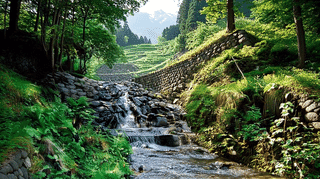
Discover Yakushizawa Stone-lined Waterway in Ogawa Village, Nagano - a Registered Tangible Cultural Property showcasing 19th-century stone masonry erosion control near the Fossa Magna. Perfect for hiking enthusiasts seeking authentic Japanese heritage.

Discover the Ashizawa No. 3 Stone Masonry Check Dam in Omi Village, Nagano Prefecture — a Registered Tangible Cultural Property built in 1887 using traditional dry stone masonry techniques, still protecting the valley after over 135 years.
A dry-stone check dam of c.1884 in Kuwabara, Chikuma, Nagano. Just 3.8 m high, it leans back at a 1:1.6 slope and runs a 7.2 m stone apron below to steady the bed.
The widest of four Meiji check dams on the Izawa River in Chikuma, Nagano. Only 3.7 m high but 35 m across, its spillway uses big blocks and its wings small ones.
The lowest and smallest of four Meiji check dams on the Izawa River in Chikuma, Nagano. Built under Home Ministry works, its crest sags like a slack rope.
A Meiji-era stone masonry erosion control dam built on the Ai-shimizu-zawa tributary of the Ushibuse River in Matsumoto, Nagano. Registered as a National Tangible Cultural Property in 2021, this 7.8-meter-tall, 17.5-meter-long structure features an elegantly curved spillway and is a still-functioning relic of the Meiji-era Ministry of Home Affairs sabō (erosion control) project.
On the west edge of the Ozawa compound in Matsumoto's Hofukuji town, this 1908 storehouse shows rafter shapes through its eave plaster, its plan shaped wholly by storage.
Built in 1905 at the southern edge of the old post town of Ono in Tatsuno, Nagano, this timber village hall holds a tatami-floored assembly chamber upstairs.
Built about 1908 to hold food and fodder for the Matsumoto 50th Infantry Regiment, this 36.3-metre brick warehouse in English bond now serves Shinshu University.
Discover the Former Reischauer Family Villa, a Registered Tangible Cultural Property in Karuizawa, Nagano. Built in the late Meiji era for Presbyterian missionary August Karl Reischauer, father of U.S. Ambassador Edwin O. Reischauer, this rustic cedar-bark cottage embodies the spirit of early foreign summer retreats in Japan's most celebrated highland resort.
A small storehouse built for fumigation beside the gate of the former Kobayashi headman's residence near Nagano, registered for its unusual Western-style eaves.
In Motoyama post town on the old Nakasendō, the Kobayashi inn lifts its upper floor on two rare tiers of projecting beams, rebuilt after the 1869 great fire.
A small early-Meiji wooden hall in Nagano City, the Gomyo Family Detached Parlor has a full shoin set and a high hexagonal coffered ceiling. Registered in 2010.
A tiny Meiji archive storehouse on the Gomyō family's Nagano estate, with white-plaster walls and cloud-carved brackets over its east door. Registered 2010.
A Registered Tangible Cultural Property in Ueda. This small earthen granary, built in 1897, served a Sato silkworm-egg household in a famed egg-card village.
A mid-Meiji silkworm room in Kamishiojiri near Ueda, its full-length monitor roof built to ventilate the rearing rooms. A private residence, seen from the street.
West of the main house in Saku, Nagano: a slender 6.6-by-3.7m earthen storehouse, boarded floor, with a miso room attached beneath an offset roof. Registered 2011.
Squeezed between two neighbours on a stone wall in Saku, Nagano: an earth floor, exposed roof timbers, a built-in rice bin, and a roof with no gable ends. Meiji era.
The smallest of four registered buildings on a Saku farmstead in Nagano: a near-square timber box of 21 square metres, throwing out a lattice and a bay window.
Shimaki Akahiko's Former Residence is a rare late-Edo to early-Meiji hontō-zukuri farmhouse in Shiojiri, Nagano, where the celebrated Araragi-school tanka poet lived from 1909 to 1911. Now relocated beside the Shiojiri Tanka Museum, it offers visitors a quiet window into Japan's modern poetic heritage.