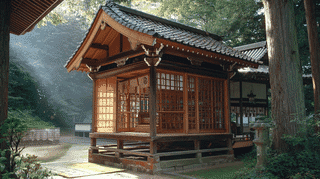
About Mikasayama Kasuga Shrine
Mikasayama Kasuga Shrine (三笠山春日神社, Mikasayama Kasuga Jinja) in Kusaji, Bungotakada City, Oita Prefecture, is a Shinto shrine said to have been founded in 809, and 13 of its halls, gates and torii were each registered as a Registered Tangible Cultural Property on October 28, 2011. Locally it is simply Kasuga Shrine; the prefix Mikasayama is the name of the wooded hill it occupies. It enshrines the four Kasuga deities: Takemikazuchi, Futsunushi, Amenokoyane and Himegami.
The founding legend is vivid. In 809, the shrine says, a flashing light like lightning hovered over the hill night after night. An official who went to investigate saw a white-haired old man riding a white deer appear beneath a great oak, announce that he lived on Mount Mikasa, and fly off to the southeast. Taking this as a manifestation of the Kasuga deity of Nara, the official built a sanctuary for the four gods, named the hill Mikasayama after Nara's sacred mountain and made the oak its sacred tree. Bungotakada City's tourism office describes it as the oldest Kasuga shrine in Oita Prefecture.
Burned, Rebuilt and Rebuilt Again
In the medieval period Mikasayama Kasuga Shrine enjoyed the patronage of the Otomo, the warrior house that governed Bungo. Shrine records say that after Otomo Yoshinao became military governor in 1196, shrine fields were donated, and in 1208 a pair of guardian lions and an okina mask were offered. A resting place for the portable shrine was set up in 1253, and the first procession to it took place in 1255.
The break came in the 16th century. Under Otomo Sorin, who took over the clan in 1550, the four side-by-side sanctuaries and every other building inside and outside the precinct were burned, the shrine lands were confiscated and the processions stopped. In 1577 villagers rebuilt a single sanctuary on the old site and enshrined all four deities together. That is why the present main hall is a three-bay building housing four gods under one roof.
New halls, a kagura stage and gates followed in 1604, with another rebuilding recorded in 1632. From 1669 the area was an outlying possession of the Shimabara domain, and in 1855 the autumn procession was restored in full. The shrine was ranked a district shrine in 1873, and in 1907 the governor of Oita allowed the village to adopt the place name Mikasayama, the same name as the hill behind Kasuga Taisha in Nara. A major restoration funded by parishioners in 2002 re-roofed the worship hall and three other buildings and replaced two structures that had become unsafe.
Thirteen Registrations and Why the Set Matters
The registration covers all 11 timber buildings on Mikasayama and at the Ozono resting place, apart from the two replaced in 2002, plus the two stone torii. Their registration numbers run consecutively from 44-0183 to 44-0195, and their dates span roughly 230 years, from the approach torii of 1720 to the entertainment stage of 1952.
- Edo period: approach torii (1720), bell tower (1830), kagura hall (1835), Shinmon gate (1845), Yasaka subsidiary shrine and west gate (late Edo), main hall (last decades of the Edo period)
- Meiji period: Itsukushima subsidiary shrine (Meiji era), offering hall (1905)
- Taisho and Showa periods: worship hall (1921), komoriya retreat hall (1927), west approach torii (1934), entertainment stage (1952)
The survey behind the registration was carried out in October 2010 by the architectural history laboratory of Kumamoto University's graduate school under Professor Ito Ryuichi, and its report went to the Agency for Cultural Affairs in January 2011. What impressed the surveyors was less the age of any one building than the way they fit together. The worship hall, offering hall and main hall stand in a single north-south line with a stone stair and a gate on the west, the same arrangement as at Usa Jingu, the great shrine that dominates this region. The main hall is flanked by two small subsidiary shrines, echoing the east and west treasure halls beside the sanctuary of Yusuhara Hachimangu, a shrine closely tied to Usa.
Many shrines between Usa and the Kunisaki Peninsula share this pattern of main hall, offering hall and a long, open worship hall that people here call a kairo, or corridor. What sets Mikasayama Kasuga Shrine apart is that the gate, bell tower and other secondary buildings have been repaired and kept alongside the core halls, so the whole ensemble survives.
How the Grounds Are Laid Out
The precinct sits inside dense old-growth woodland, with a straight approach running from south to north. Past the approach torii at the southern edge, the Shinmon gate, a four-legged gateway with low walls extending to either side, marks the threshold. Beyond it the bell tower stands on the left (west) and the kagura hall on the right (east), facing each other across the path, with the komoriya retreat hall joined to the kagura hall by a covered bridge.
Straight ahead is the long worship hall, and behind it, on a raised terrace, the offering hall and main hall. The Itsukushima subsidiary shrine sits to the west of the main hall and the Yasaka subsidiary shrine to the east. West of the worship hall, the red-painted west gate opens onto the west approach, whose torii stands at the far end. The storehouse for the portable shrine, south of the west gate, is a 2002 replacement and is not registered.
Only one of the 13 lies outside the precinct. The entertainment stage stands at the Ozono resting place, about 1 kilometre from Mikasayama, on the same ground as the hall where the portable shrine spends a night during the autumn festival.
The Festival Year
On New Year's Day, drumming at midnight opens the year and the first rite of the year follows, with lucky draws and charms handed out in the grounds. At the New Year archery rite, a large target inscribed with the character for oni, or demon, is hung upside down and the chief priest and each parish representative loose three arrows at it; the pierced target is then hung in the worship hall. For the Ryujin rite, seawater is drawn at dawn from the mouth of the Hirose River, offered at the altar and scattered over the grounds as a prayer for rain in the right measure.
A far larger seawater procession was once held only in years of severe drought. It lapsed after 1931 and was staged again in 2009, after a gap of 78 years, for the twelve-hundredth anniversary of the shrine's founding. The shrine keeps a handscroll depicting the procession as it was performed in 1825.
The shrine's most important rite is the Kasuga festival, which includes a blessing for children starting school and a performance of Shonai kagura. The autumn festival begins with the hanging of sacred ropes on the third Sunday of October; on the fourth Saturday the portable shrine goes down to the Ozono resting place for the night and returns to Mikasayama the next day.
Visiting and Getting There
The nearest station to Mikasayama Kasuga Shrine is Usa on the JR Nippo Line, about 9 kilometres away by road, or roughly 15 minutes by car or taxi. Drivers leave National Route 213 after the Kuresaki community centre, cross the Hirose River and turn right, continuing for about 2.2 kilometres. From the Showa Roman Gura museum in central Bungotakada the drive takes about 10 minutes.
The grounds are open and there is no admission fee. The building interiors are normally closed, but from January 1 to 3 each year the shrine moves its image of the Kasuga deity into the worship hall so that New Year visitors can pray before it directly. The Ozono resting place with the entertainment stage is some distance from the main grounds, so allow extra time if you plan to see both. Enquiries go to the shrine office (tel. 0978-24-2529).
References
- Agency for Cultural Affairs, Database of National Cultural Properties: Kasuga Shrine Main Hall
- https://kunishitei.bunka.go.jp/bsys/maindetails/101/00009084
- Agency for Cultural Affairs, Database of National Cultural Properties: Kasuga Shrine Entertainment Stage
- https://kunishitei.bunka.go.jp/bsys/maindetails/101/00009094
- Cultural Heritage Online: Kasuga Shrine Main Hall
- https://online.bunka.go.jp/heritages/detail/174334
- Mikasayama Kasuga Shrine official site: History
- https://www.mikasayama-kasuga.com/history.html
- Mikasayama Kasuga Shrine official site: Registered buildings
- https://www.mikasayama-kasuga.com/bunkazai.html
- Mikasayama Kasuga Shrine official site: Annual festivals
- https://www.mikasayama-kasuga.com/koureisai.html
- Mikasayama Kasuga Shrine official site: Treasures and grounds
- https://www.mikasayama-kasuga.com/treasure.html
- Bungotakada City official tourism site: Mikasayama Kasuga Shrine
- https://www.city.bungotakada.oita.jp/site/showanomachi/1236.html
- i-Navi Oita: Kasuga Shrine
- https://i-oita.net/bungotakada/spot/1966/
Last verified: 2026.09.26
Basic Information
| Name | Mikasayama Kasuga Shrine |
|---|---|
| Location | 5206 Mikasayama, Kusaji, Bungotakada City, Oita Prefecture |
| Owner | Kasuga Shrine (religious corporation) |
| Designation | Registered Tangible Cultural Properties (13) |
| Coordinates | 33.57685, 131.46782 |