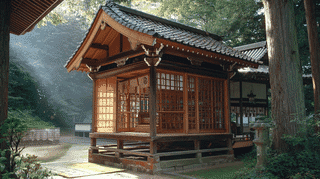
What the Kasuga Shrine Kagura Hall Is
Kasuga Shrine Kagura Hall (春日神社神楽殿, Kasuga Jinja Kaguraden) is an 1835 stage for sacred dance in the grounds of Mikasayama Kasuga Shrine in Bungotakada City, Oita Prefecture, registered as a Registered Tangible Cultural Property on October 28, 2011. It stands southeast of the worship hall and faces west, onto the approach path.
Kagura, the music and dance offered to Shinto deities, needs a raised platform, and this one is compact: a single-storey timber building with a tiled roof and a footprint of 32 square metres. The stage is 2 bays wide and 1 bay deep, under a hip-and-gable roof (Irimoya-zukuri) turned gable-end to the front (Tsumairi) and covered in heavy round-and-flat tiles (Hongawarabuki). A raised veranda (Kirime-en) runs along the front and both sides.
From the rear of the north side, a covered bridge runs off at an angle. It is 3 bays long and 1 bay wide, roofed in lighter pantiles (Sangawara-buki), and leads to the komoriya retreat hall, which serves as the dressing room on performance days. Shrine records mention kagura halls being built here in 1604 and 1632; the present building is their successor.
Why It Was Registered
Like the other buildings of the shrine, the Kasuga Shrine Kagura Hall was registered as a structure that contributes to the historic landscape of the country. The Agency for Cultural Affairs calls it a good example of a kagura hall surviving within a shrine precinct.
Its date makes more sense alongside its neighbours. The bell tower across the path went up in 1830 and the Shinmon gate at the entrance in 1845, so the three buildings that frame the approach were all put up within about 15 years of one another. The dates show when the shape of this precinct was settled, late in the Edo period.
The bridge is the other thing to notice. Angled off the back of the stage like the bridgeway of a Noh theatre, it lets performers walk straight from the dressing room onto the boards. Stage, passage and dressing room survive as one working unit.
What to Look For
Start at the tops of the square pillars. Each carries only a simple boat-shaped bracket, and in the gaps between posts the builders set short struts topped with carved bracket arms. On a building this plain, those carved scrolls are nearly the only ornament.
Then compare the roofs. The stage wears formal round-and-flat tiles and the bridge cheaper pantiles, so the difference in rank shows in the tiles themselves. From the approach you see the gable end of the hip-and-gable roof face-on; it is, in effect, the facade of the stage.
During the twelve-hundredth anniversary celebrations in 2009, the Kasuga Shrine Kagura Hall hosted offerings of poetry chanting, gagaku court music and Kusaji odori, the local folk dance, along with a children's performance of Shonai kagura. An Edo-period stage is still where the community performs for its gods.
Visiting the Kagura Hall
The hall stands beside the main approach, and its exterior can be seen freely whenever you visit the shrine. The stage is reserved for rites and performances, so on ordinary days you view it from the path. Walk round to the north side to see how the bridge links the stage to the retreat hall. If you want to photograph a ceremony in progress, ask at the shrine office first. Directions and general visiting information are on the Mikasayama Kasuga Shrine page.
- 📍 Plan Your Visit to Oita
- Find tours, activities & transport passes near Kasuga Shrine Kagura Hall
- [ Beppu Hell Tour & Yufuin Onsen Hot Springs ]
Q&A
- When was the Kasuga Shrine Kagura Hall built?
- In 1835. It was registered as a Registered Tangible Cultural Property on October 28, 2011.
- Where is the Kasuga Shrine Kagura Hall, and which way does it face?
- It stands southeast of the worship hall at Mikasayama Kasuga Shrine and faces west onto the approach, directly across the path from the bell tower.
- What is the bridge attached to the Kasuga Shrine Kagura Hall?
- A covered passage 3 bays long and 1 bay wide that angles off the north side of the stage and leads to the komoriya retreat hall, used as the performers' dressing room.
- Can I see kagura performed at the Kasuga Shrine Kagura Hall?
- Shonai kagura is offered at the shrine's Kasuga festival, and the hall hosted performances during the 2009 anniversary celebrations, including children's kagura. Check dates with the shrine office (0978-24-2529).
- Can visitors go up onto the Kasuga Shrine Kagura Hall stage?
- No. The stage is used for rites and performances, and ordinary visitors view it from the approach. Ask the shrine office before photographing a ceremony.
Basic Information
| Name | Kasuga Shrine Kagura Hall (春日神社神楽殿) |
|---|---|
| Location | 5206 Mikasayama, Kusaji, Bungotakada City, Oita Prefecture |
| Designation | Registered Tangible Cultural Property (Building), No. 44-0189 |
| Year Designated | Registered 2011/10/28 (Heisei 23) |
| Quantity | 1 building |
| Dimensions | Single-storey timber building, tiled roof, building area 32 square metres; stage 2 by 1 bays, bridge 3 by 1 bays |
| Owner | Kasuga Shrine (religious corporation) |
| Public Access | Grounds open; exterior viewing only |
References
- Agency for Cultural Affairs, Database of National Cultural Properties: 春日神社神楽殿
- https://kunishitei.bunka.go.jp/bsys/maindetails/101/00009090
- Cultural Heritage Online: 春日神社神楽殿
- https://online.bunka.go.jp/heritages/detail/246190
- Mikasayama Kasuga Shrine official site: Registered buildings
- https://www.mikasayama-kasuga.com/bunkazai.html
- Mikasayama Kasuga Shrine official site: Twelve-hundredth anniversary festival
- https://www.mikasayama-kasuga.com/1200.html
Last verified: 2026.09.26