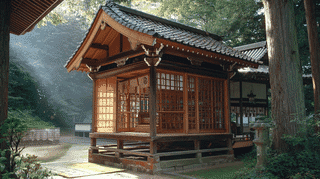
What the Kasuga Shrine Worship Hall Is
Kasuga Shrine Worship Hall (春日神社拝殿, Kasuga Jinja Haiden) is a 1921 worship hall at Mikasayama Kasuga Shrine in Bungotakada City, Oita Prefecture, registered as a Registered Tangible Cultural Property on October 28, 2011. It stretches east to west in front of the offering hall and takes the long, open form that people in this region call a kairo, or corridor.
The single-storey timber hall has a footprint of 103 square metres. It is 9 bays long under a hip-and-gable roof (Irimoya-zukuri) of round-and-flat tiles (Hongawarabuki), with a one-bay porch (Kōhai) under its own small hip-and-gable roof at the centre of the front. Square posts stand on a cut-stone base, tied with through-beams. Inside is a single boarded room with a coffered ceiling (Gō-tenjō). Only the two end walls are plastered; elsewhere the bays between posts are open windows framed by sill and lintel.
Why It Was Registered
Shrines between Usa and the Kunisaki Peninsula often pair a main hall and offering hall with a long worship hall of this kind. The Kumamoto University survey that preceded the registration singled out such kairo-type halls as strong evidence of Usa Jingu's influence, and the Kasuga Shrine Worship Hall is a textbook example.
Its date comes from a ridge tag (Munafuda) recording the building of the kairo in 1921. The carved frog-leg struts (Kaerumata) across the front are another matter: they are painted and show celestial beings and scenes from the Twenty-Four Paragons of Filial Piety, a Chinese moral tale, and the surveyors judged them to be Edo-period pieces reused from the earlier hall. Edo carving in a Taisho building is part of the interest.
The records differ on the hall's depth. The Agency for Cultural Affairs gives 9 by 4 bays, while the Kumamoto report gives 9 by 2 bays. Whether the difference comes from how the bays were counted has not been confirmed.
What to Look For
From the front, look along the frieze for the carved struts. The traces of colour and the figures of celestial beings and filial sons mark them as survivors from the older building.
Then look at the porch. The projecting beam ends are carved as a lion on the front and a baku, a mythical dream-eating beast, on the sides, and the porch posts are square with fine chamfers.
Inside, a great rainbow beam (Kōryō) crosses beneath the coffered ceiling three bays in from each end. With open windows along both long sides, the whole length of the room can be taken in at a glance.
Visiting the Worship Hall
The Kasuga Shrine Worship Hall is where visitors pray, and you can see its exterior and look into the room through the open windows. During the first three days of the New Year, the shrine's image of the Kasuga deity is moved into the hall so that visitors can pray before it directly. Ask at the shrine office before photographing a ceremony. Directions and general visiting information are on the Mikasayama Kasuga Shrine page.
Q&A
- When was the Kasuga Shrine Worship Hall built?
- A ridge tag records its construction in 1921. It was registered as a Registered Tangible Cultural Property on October 28, 2011.
- Why is the Kasuga Shrine Worship Hall called a kairo, or corridor?
- In this region long, open worship halls are often called kairo, and the shrine's own ridge tag uses the word.
- What are the architectural features of the Kasuga Shrine Worship Hall?
- It is 9 bays long with a hip-and-gable roof of round-and-flat tiles and a one-bay central porch. It covers 103 square metres and is a single boarded room with a coffered ceiling, open on all sides except the two ends.
- What carvings are on the Kasuga Shrine Worship Hall?
- Painted frog-leg struts across the front show celestial beings and the Twenty-Four Paragons of Filial Piety. They are thought to be reused from the Edo-period hall that stood before it.
- Can I go inside the Kasuga Shrine Worship Hall?
- It is used for worship; visitors pray from outside and can look into the room through the open windows. On January 1 to 3 the image of the Kasuga deity is placed inside for New Year visitors.
Basic Information
| Name | Kasuga Shrine Worship Hall (春日神社拝殿) |
|---|---|
| Location | 5206 Mikasayama, Kusaji, Bungotakada City, Oita Prefecture |
| Designation | Registered Tangible Cultural Property (Building), No. 44-0187 |
| Year Designated | Registered 2011/10/28 (Heisei 23) |
| Quantity | 1 building |
| Dimensions | Single-storey timber building, tiled roof, building area 103 square metres, 9 bays long |
| Owner | Kasuga Shrine (religious corporation) |
| Public Access | Grounds open; exterior and interior through open windows |
References
- Agency for Cultural Affairs, Database of National Cultural Properties: 春日神社拝殿
- https://kunishitei.bunka.go.jp/bsys/maindetails/101/00009088
- Cultural Heritage Online: 春日神社拝殿
- https://online.bunka.go.jp/heritages/detail/197228
- Mikasayama Kasuga Shrine official site: Registered buildings
- https://www.mikasayama-kasuga.com/bunkazai.html
Last verified: 2026.09.26