
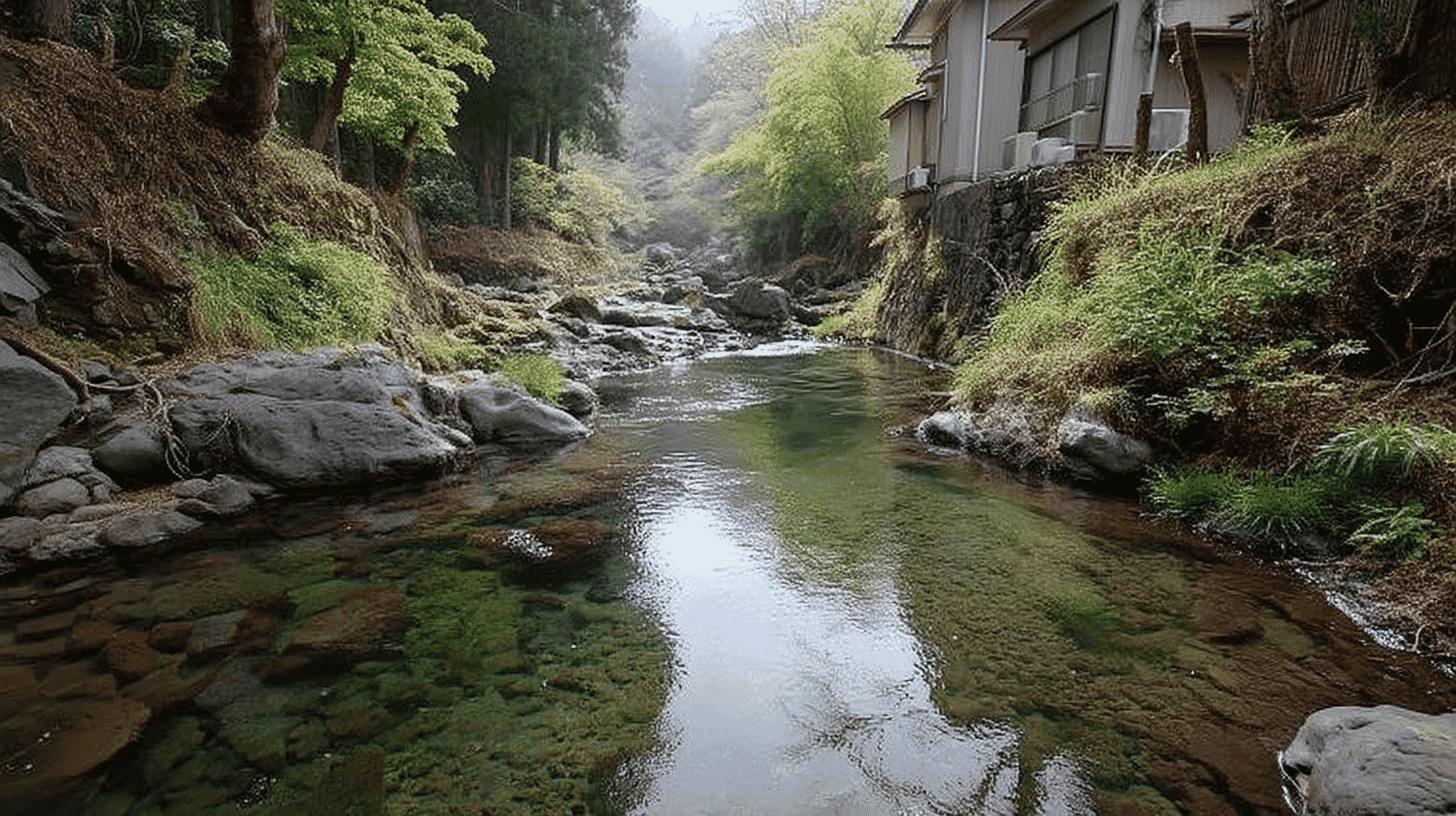
A Habitat, Designated a Natural Monument in 1959
Okichimozuku Habitat in Shizugawa (志津川のオキチモズク発生地, Shizugawa no Okichimozuku Hasseichi) is a natural monument at Minamioguni Town, Aso District, Kumamoto Prefecture, designated on 1 July 1959. Its category is historic site, place of scenic beauty and natural monument.
What is designated is not the organism but the place where it appears. The name itself says habitat.
The field for a managing body reads Minamioguni Town, with the date 18 May 1962. With Sashiki Castle Ruins and the Aso cultural landscape that field stood empty; here both the body and the date of its appointment are recorded.
The 1944 Record Is Written in Literary Japanese
A companion record exists: another habitat of the same alga at Yoshihisa, Toon City, Ehime Prefecture, designated on 26 June 1944.
Its commentary reads very differently from this one. It states, in the older written language, that the alga is a rare freshwater red seaweed, that this is where it was first discovered in Japan, and that the site marks the northern limit of its distribution.
The grammar is literary: forms belonging to classical written Japanese rather than to speech.
The commentary here reads plainly: the alga is a freshwater red seaweed of Japan whose habitats are extremely limited.
Fifteen years separate 1944 from 1959. Within one system of records, the period of designation changes the very register of the writing. Fuller records for later listings has been a pattern here; not only the fullness but the manner of writing differs.
The Organism Named after the Place It Was Found
The Ehime record notes that the site is where the alga was first discovered in Japan.
This record refers to it too, mentioning the habitat at Okichi Spring in Ehime where it was first found. A place name appears.
The Japanese name of the alga comes from that place name. The organism carries the name of the spot where it was first seen.
And that spot is itself designated a natural monument. The place that gave the name is protected on account of the organism that bears it.
The Soranjo takes its title from the opening words of its text, and the Wakan Roeishu on cloud paper from the paper it is written on. Here a place name works twice over, through the name of a living thing.
Two Habitats Citing Each Other
The relation between the two records repays attention.
This record closes by saying that, together with the habitat at Okichi Spring in Ehime where the alga was first discovered, the site is of scholarly value as a place where the alga occurs. It cites the Ehime record in stating its own value.
The Ehime record notes the first discovery and the northern limit of distribution, and says nothing of Kumamoto. In 1944 the Kumamoto site had not yet been designated.
The later listing cites the earlier. The wall paintings of the five-storey pagoda were compared with those of the Phoenix Hall, and the landscape scroll at the Kyoto National Museum was explained against the long landscape scroll: the same pattern.
Accounts elsewhere say there are only three such habitats in Japan. The Agency's record gives no number, saying only that they are extremely limited, and this article does not repeat the figure.
Visiting
The site lies at Minamioguni Town, Aso District, Kumamoto Prefecture. The Agency sets its extent as the stretch of the Shizugawa below the Manganji hot spring.
The alga grows attached to stones on the riverbed.
Since the subject is a living alga, how it looks changes with the season and the water level. There is no distinction between open and closed as there would be for a building or an artwork.
It is a river, with hot springs and places where people live nearby, so entry calls for care. Check the town's information before travelling.
Q&A
- When was the habitat designated?
- On 1 July 1959, as a natural monument. It lies at Minamioguni Town, Aso District, Kumamoto Prefecture, and the managing body is recorded as the town, appointed on 18 May 1962.
- Where does the alga's name come from?
- From Okichi Spring in Ehime Prefecture, where it was first found. The Agency's commentary refers to that habitat, and that place is itself designated a natural monument.
- Does the Ehime record read differently?
- Yes. Designated in 1944, it is written in the older literary language, while this record of 1959 is in plain modern prose. The period of designation changes the register of the writing.
- How many habitats are there?
- The Agency gives no number, saying only that habitats are extremely limited. Accounts elsewhere give three in Japan, but this article does not repeat that figure.
- Where can it be seen?
- The Agency sets the extent as the stretch of the Shizugawa below the Manganji hot spring, where the alga grows attached to stones on the riverbed. Its appearance changes with season and water level.
Basic Information
| Name | Okichimozuku Habitat in Shizugawa (志津川のオキチモズク発生地, Shizugawa no Okichimozuku Hasseichi); the habitat at Toon City, Ehime, is a separate property |
|---|---|
| Location | Minamioguni Town, Aso District, Kumamoto Prefecture |
| Designation | Historic site, place of scenic beauty and natural monument (natural monument) |
| Year Designated | 1959 (1 July), designated |
| Quantity | No quantity field |
| Dimensions | The Agency records no dimensions. The extent is the stretch of the Shizugawa below the Manganji hot spring, where the alga grows attached to stones on the riverbed |
| Owner | The Agency's owner field is empty; the managing body is Minamioguni Town, appointed on 18 May 1962 |
| Public Access | A river, with no distinction between open and closed; hot springs and places where people live are nearby, so entry calls for care |
References
- Cultural Heritage Online: the Okichimozuku habitat in Shizugawa
- https://bunka.nii.ac.jp/heritages/detail/139684
- Cultural Heritage Online: the Okichimozuku habitat at Toon, Ehime
- https://bunka.nii.ac.jp/heritages/detail/139434
- Minamioguni Town: the Shizugawa
- https://www.town.minamioguni.lg.jp/kankou/manganji-ougi/shizugawa.html
- Agency for Cultural Affairs, National Cultural Properties Database
- https://kunishitei.bunka.go.jp/
Last verified: 2026.09.05