
Important Cultural Property of Okayama
岡 山 県 の 重 要 文 化 財Okayama’s Important Cultural Properties — designated for their value to the nation’s cultural history.
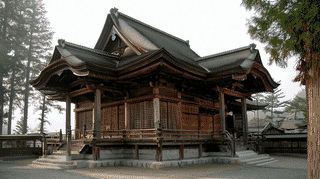
A shrine hall in Tsuyama, Okayama, entered from the gable end. The Agency dates it to 1657; the shrine records building in 1562 and repair in that year.

Former Inukai Family Residence in Okayama City is the tiled farmhouse where Inukai Tsuyoshi was born. Its main house and storehouse are designated; entry is free.
Inoue Family Residence is the oldest townhouse in Kurashiki's Bikan district, its 1721 frame confirmed by ink inscriptions. Three buildings, open since 2023.
Six buildings of the Former Okuni Family Residence in Wake, Okayama, became an Important Cultural Property in 2004. Its 1760 Main House carries a rare linked roof.
Discover the Otakisan Three-Storied Pagoda, an Important Cultural Property dating from 1441, nestled within the ancient Fukushoji Temple complex in Bizen, Okayama. Explore its Muromachi-period architecture, lush hydrangea gardens, and serene mountain trails.
The Ohashi Family Residence in Kurashiki, Okayama, built between 1796 and 1799, became an Important Cultural Property in 1978. Its four buildings and how to visit.
Completed in 1900 in Tsuyama, this timber schoolhouse with a clock tower still holds classes. A rare surviving Meiji middle school, designated in 1995.
Built in the 1620s, Okayama Castle Tsukimi Yagura is the only original building on the main bailey: stone-drop hatches face out, tatami and a veranda face in.
Okayama Castle Nishite Yagura is the castle's other surviving turret: a small-windowed corner tower built for war around 1600, now inside a closed school's grounds.
Former Katayama Family Residence at Fukiya in Okayama: a bengara pigment merchant's compound of five buildings designated in 2006, with hours and access.
Rebuilt in 1612, the Okamaden at Kibitsu Shrine hosts the narukama rite, a fortune read from the sound of a heated cauldron. It was designated in 1980.
Rebuilt in 1543, the North Zuijinmon at Kibitsu Shrine mirrors its tiled southern twin but wears a cypress-bark roof. It became an Important Cultural Property in 1913.
Built in 1357, the South Zuijinmon is the oldest building at Kibitsu Shrine, a tile-roofed eight-legged gate listed as an Important Cultural Property in 1911.
Discover the Former Yakage Wakihonjin Takakusa Family Residence in Okayama, an Important Cultural Property of nine Edo-era buildings featuring elegant white walls, namako-kabe tilework, and refined sukiya-style reception rooms in Japan's only post town with surviving honjin and wakihonjin.
Completed in 1908 and designed by Egawa Saburohachi, the chief architect of Okayama Prefecture, this charming wooden schoolhouse was the first kindergarten building in Japan ever designated an Important Cultural Property. Its innovative "plum-blossom plan" features an octagonal central playroom flanked by four classrooms — a milestone of modern early-childhood education architecture.
The Main Halls of Kumano Shrine in Hayashi, Kurashiki City, Okayama, comprise six independent buildings arranged in a single row, deliberately patterned on the layout of Kumano Hongū-taisha in Kii. The central Second Hall, rebuilt in 1492, is a National Important Cultural Property and a rare survivor of mid-Muromachi painted shrine architecture, with vermillion-lacquered timbers and white gofun walls in a refined sumi-ki-iri kasuga-zukuri style. The other five halls were rebuilt in 1647 under the patronage of the Okayama daimyō Ikeda Mitsumasa. The shrine was founded in 701 and has long been one of western Japan's leading centers of Kumano worship and Shugendō.
A 764.9-metre cut-stone enclosure raised around 1701 at Shizutani School in Bizen City, chiselled to a rounded ridge and still free of weeds after three centuries.
Eleven structures at Shizutani in Bizen City, completed in 1684. The gilt bronze Confucius in the Taiseiden is shown only a few days a year, at the sekisai rite.
Eight structures of 1686 at Shizutani in Bizen City, honouring school founder Ikeda Mitsumasa. Set a terrace below the Confucian shrine as an act of deference.
Discover Shufukuji Hoden, a rare granite treasure hall built in 1338 in Okayama's historic Ashimori district. This Important Cultural Property blends Kasuga-style shrine architecture with medieval stone craftsmanship.
More from Okayama
Okayama’s registered properties across designations, with featured heritage and travel notes.
The complete kokuhō catalogue — browse by prefecture, period, and category.
Nationwide jūyō bunkazai — architecture, sculpture, painting, crafts, and documents.