
Registered Tangible Cultural Properties of Okinawa
沖 縄 県 の 登 録 有 形 文 化 財Okinawa · Registered Tangible Cultural Properties
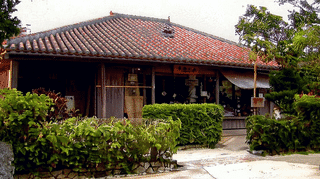
A single-storey timber house at Okinawa World in Nanjo, 127 square metres. Four rooms range along the front and three more lie behind them to the west.

Stretching 354 meters into the sea from the northern coast of Kuroshima in Taketomi, Okinawa, Iko Pier is a historic stone-and-concrete pier registered as a National Tangible Cultural Property in 2005. At high tide, visitors experience the magical sensation of walking on water, making it one of the most stunning scenic spots in the Yaeyama Islands.
Designed in 1961 by architect Nakaza Hisao, the Ufudō Gate at the Okinawa Hotel is a vermilion Ryukyuan red-tiled gate reminiscent of the famous Shureimon. Registered as a National Tangible Cultural Property in 2024, it embodies the architectural heritage of the Ryukyu Kingdom at Okinawa's oldest hotel.
Built in 1961 to a design by architect Nakaza Hisao, the Okinawa Hotel Kawara-Ishigaki is a 92-meter stone wall of Ryukyu limestone crowned with traditional red roof tiles. Encircling Okinawa's oldest hotel in the Odō district of Naha, it forms a distinctly Okinawan streetscape together with the Ufudō Gate. It was registered as a National Tangible Cultural Property in 2024.
The Ryokan-tō at the Okinawa Hotel, founded in 1941 as Okinawa's first tourist hotel, is a three-story reinforced-concrete building completed in 1961 and designed by pioneering architect Nakaza Hisao, the inventor of the iconic hana block. Registered as a National Tangible Cultural Property in 2024, the building preserves early examples of hana blocks, projecting eaves, and sculptured balconies that define Okinawan modern architecture — and uniquely, guests can stay overnight to experience this living cultural heritage firsthand.
Built around 1949, the Okinawa Hotel Brick Building is a rare surviving structure constructed from bricks gathered across war-ravaged Okinawa. Designed by Nakaza Hisao — inventor of the iconic hana block — and registered as a Tangible Cultural Property in 2024, it marks the birthplace of Okinawa's postwar hotel industry, founded by Miyazato Teizō, the 'Father of Okinawa Tourism.'
Moved from Izena Island, this late-Meiji house keeps the rare separated-building (bunmunē) form, its kitchen a wing of its own. Now an indigo studio.
One of Okinawa World's largest relocated houses, this late-Meiji home survived the 1945 battle, shell scars on its pillars. Now a bingata workshop.
Built at Shuri from timber of a demolished Naha mansion, this late-Meiji house has an unusual plan with no back rooms. Now a papermaking studio.
A fūru is an old Okinawan privy-and-pigsty. Built of cut Ryukyu limestone, this rare survivor records a rural custom that local hygiene law ended around 1917.
A coral-limestone wall built in 1909 rings the Kamiyama Residence on Kuroshima, running 87.4 meters of dry-laid stone shaped with care at its gate and corners.
A dug well from 1909 at the southwest corner of the Kamiyama Residence on Kuroshima runs about 4.2 meters deep, with a curb cut from local coral limestone.
Built in 1912 on Kuroshima, the Kamiyama Residence main house is a low, red-tiled timber farmhouse with an eight-mat principal room, a Tangible Cultural Property.
On Kuroshima, this 1938 concrete tank at the Kamiyama Residence held rain caught from the main house roof by bamboo gutters, an answer to scarce island water.
Built in 1902 and moved to a Nago high school campus in 1965, this 9.4 sq m porch with a curved karahafu gable and Ryukyuan red tiles is a rare Meiji survivor.
A 1930 Okinawan house of 125 sq m under red Ryukyuan tiles, moved into Ryukyu Mura in 2011. Its three-room plan carries a modern porch canopy and glazed doors.
On a coral atoll 360 km east of Okinawa, this coursed-limestone office once ran the Tōyō Sugar Company's phosphate mine. Registered in 2005, it is now a museum.
In the port area of Kitadaitō Island stand the remains of a communal bath used by phosphate miners and residents. Two concrete tubs survive. Registered in 2007.
On riverless Kitadaitō Island, a sloping mortar floor of 500 square metres caught rainwater into two sunken tanks to supply the Shimosaka bath. Registered in 2007.
A round stone cistern supplying the Tōyō Sugar employee bath on Kitadaitō Island, about 2.5 m deep and 8.9 m across inside, with limestone walls. Registered in 2007.
More from Okinawa
Okinawa’s registered properties across designations, with featured heritage and travel notes.
The complete kokuhō catalogue — browse by prefecture, period, and category.
Nationwide jūyō bunkazai — architecture, sculpture, painting, crafts, and documents.