
Registered Tangible Cultural Properties of Saga
佐 賀 県 の 登 録 有 形 文 化 財Saga · Registered Tangible Cultural Properties
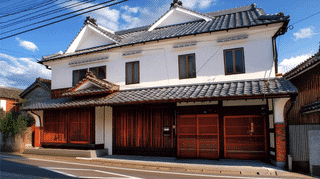
Discover Yoshida Family Residence (Yoshida-ke Jutaku Shuoku), a Registered Tangible Cultural Property in Kashima City, Saga Prefecture. This beautifully preserved Meiji-era machiya features distinctive igura-zukuri architecture with white plastered walls, brick accents, and rare ebony interiors. Located along the historic Tara Kaido road, it offers an authentic glimpse into Japan's merchant heritage near the famous sake breweries of Hizen-Hamashuku.

A 7.3-metre brick chimney at Amabuki Shuzo in Saga, laid in English bond on a square base. It once drew smoke from the kitchen that fed the seasonal brewery crew.
An eleven-metre brick chimney of the Taisho era at Amabuki Shuzo, Saga. Its hexagonal base and twin decorative bands mark the brewery from across the paddy fields.
A late Meiji fermentation warehouse at Amabuki Shuzo in Saga, 39 by 17 metres. Thick earthen walls hold the cold; round log posts and inclined beams carry the roof.
The mid-Meiji main house at Amabuki Shuzo in Saga, where an earthen passage splits office from home. An older storehouse was absorbed into its east half.
A Taisho-era reinforced concrete storehouse cut into a hillside at Amabuki Shuzo, Saga. Still working as a cold store, it borrows its chill from the earth.
The Sanmon gate of Iōji Temple in Ōchi Town, Karatsu City, Saga Prefecture, is a Registered Tangible Cultural Property of Japan. Founded in 1383 by the Hata clan of the Matsura warrior confederacy, this Sōtō Zen temple was once one of the three principal Zen monasteries in Kyushu. Highlights include a 450-year-old cedar tree and one of only six surviving Hizen bells in Japan.
Iō-ji is a Sōtō Zen temple founded in 1383 in Ōchi, Karatsu City, Saga Prefecture, whose main hall is a nationally Registered Tangible Cultural Property. The temple treasures include one of only six surviving Hizen bells in Japan, a 450-year-old cedar tree, and a hidden Yakushi Nyorai statue unveiled once every 25 years.
The Ushizu Akarengakan in Ogi City, Saga Prefecture, is a two-story red brick warehouse built in the mid-to-late Meiji period as a storehouse for Tanakamaru Shōten, the predecessor of the Tamaya Department Store. Featuring distinctive dentil molding, mixed stone-and-brick ventilation openings, and a rare curved mukuri roof, this National Registered Tangible Cultural Property now serves as a gallery and event venue preserving the commercial heritage of historic Ushizu.
The former Tanakamaru family residence in Ushizu, Ogi City, Saga Prefecture, is a magnificent Taishō-era wooden mansion built as the home of Tanakamaru Zenzō, founder of the Tamaya department store chain. Registered as a National Tangible Cultural Property, this grand yet refined sukiya-style residence stands as a testament to the prosperous mercantile history of Ushizu.
Discover Otanigawa Tunnel, a 92-meter brick river tunnel completed in 1911 in Karatsu, Saga Prefecture. This Registered Tangible Cultural Property features elegant English bond brickwork and a three-centered arch, built entirely by local villagers to protect farmland from flooding.
The Okada Saburōsuke Atelier, relocated and restored within Saga Castle Park, is the oldest surviving atelier of a modern Western-style painter in Japan. Originally built around 1908 in Ebisu, Tokyo, it served as the creative headquarters of Okada Saburōsuke, a recipient of the first Order of Culture in 1937. The complex includes the Women's Western Painting Research Institute, which trained pioneering female artists including Iwasaki Chihiro. Registered as a national Tangible Cultural Property in 2022, it is open to visitors free of charge.
Discover Kuretake Sake Brewery Ichiban-gura, a registered tangible cultural property from the Meiji era in Kashima City, Saga Prefecture. Once the largest sake brewery in Kyushu, this magnificent earthen storehouse stands along the historic Hizen Hamashuku Sake Brewery Street.
A brick shed of 5.3 square metres at Koyanagi Sake Brewery in Ogi, Saga. Built in 1928 with slag-brick walls, a segmental arch and a flat roof; registered in 2002.
A roofed workspace of 1928 spanning the gap between the koji room and the west kura at Koyanagi Sake Brewery in Ogi, Saga. Named for its job, registered in 2002.
Discover Saito Shoten Store and Main Residence, a Registered Tangible Cultural Property in Ogi, Saga Prefecture. This historic sugar wholesaler's building tells the story of Japan's beloved yokan confectionery tradition along the Sugar Road.
Discover Ogi Station on the JR Karatsu Line, a beautifully preserved Meiji-era wooden station building registered as a national tangible cultural property. Explore its coal-transport heritage, calligraphy connections, and the charming castle town of Ogi in Saga Prefecture.
An early Showa retirement house in Honjo-machi, Saga City, with an eight-mat formal room, glazed verandas and fine kumiko latticework. Registered nationally in 2022.
A late Edo storehouse moved out of Saga Castle to Honjo-machi, Saga City. Its board-clad base, lime-plastered walls and curved eave soffit survive; registered 2022.
Discover Joranjuku Guest Hall (Gansho-kaku) in Takeo, Saga Prefecture — a Registered Tangible Cultural Property designed by Endo Arata, disciple of Frank Lloyd Wright. Explore its wartime history, elegant architecture, and legacy of cross-cultural education at the foot of Mt. Mifune.
More from Saga
Saga’s registered properties across designations, with featured heritage and travel notes.
The complete kokuhō catalogue — browse by prefecture, period, and category.
Nationwide jūyō bunkazai — architecture, sculpture, painting, crafts, and documents.