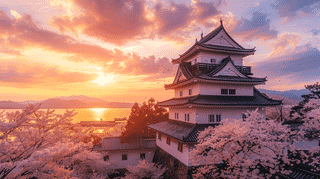
What the Hikone Castle Stables Are
The Hikone Castle Stables are a mid-Edo-period stable building inside Hikone Castle in Konkicho, Hikone City, Shiga Prefecture, designated an Important Cultural Property in 1963 (Showa 38). The building (彦根城馬屋, Hikone-jo Umaya) sits just inside the Sawaguchi entrance, stretching along the inner moat.
The plan bends at a right angle. The east-west range measures 25.2 metres along the ridge and 5.9 metres across, roofed in the Irimoya-zukuri hipped-and-gabled form, with a small well shelter attached. The north-south range measures 31.1 metres by 5.9 metres and meets the first range at its northern end. Both are covered in Kokerabuki, thin split shingles rather than tile.
Construction is placed in the Genroku era, roughly 1688 to 1703. The turrets around the keep went up during the first burst of building in the early Edo period; the Hikone Castle Stables came later, when the domain had settled into peacetime administration and needed working buildings rather than defensive ones.
Why the Hikone Castle Stables Are an Important Cultural Property
Four turrets at the castle were designated together in 1951. The stable had to wait until 1963, and it was not scale or ornament that earned the listing but sheer scarcity.
Hikone City describes the building as a stable of a size unmatched among surviving early modern castles in Japan. The Agency for Cultural Affairs database puts the same point more bluntly: no comparable structure survives anywhere else. Stables were ordinary buildings, built everywhere and kept nowhere. That is exactly why the Hikone Castle Stables matter.
The sources disagree on capacity. Hikone City counts 21 standing bays and tethering bays inside the building; the Agency for Cultural Affairs commentary describes fittings for 19 horses. The divisions a visitor can count today follow the city's reckoning.
What to Look For
Start with the roof. Of the historic buildings that survive within the castle, the Hikone Castle Stables alone are shingled instead of tiled. After rain the wood darkens and every overlapping layer separates into its own line of shadow.
Inside, the bays run on and on down one side of a passage. Standing bays alternate with tethering bays, and the repetition is what makes the length of the building register physically. Only the eastern end breaks the pattern: a small tatami room where the grooms on duty kept watch.
Stand at the inner corner where the two ranges meet and you can see the eaves step slightly out of alignment as one roof passes behind the other. The well shelter attached to the east-west range is a plain reminder of an obvious need. Horses drink, so water had to be on hand.
A second full conservation repair was completed in fiscal 2015. Surfaces look new, which is what a properly repaired wooden building is supposed to look like.
Visiting the Hikone Castle Stables
The Hikone Castle Stables are in the free zone, and the interior can be entered without a ticket. Unlike the turrets on the hill there are no slopes or steps involved: the building stands on level ground just inside the Sawaguchi entrance.
Inside, standing bays and tethering bays run along one side of a passage. The view carries all the way to the small tatami room at the eastern end, so either end of the passage is the place to take in the length of the building. From outside, the shingled roof reads best from the northern face.
No notice restricts photography. Pets cannot be taken into any building, so anyone with a dog will need to take turns at the door of the Hikone Castle Stables.
Opening hours, admission to the paid zone and directions to the castle are collected on the Hikone Castle page.
- 📍 Plan Your Visit to Shiga
- Find tours, activities & transport passes near Hikone Castle Stables
- [ Hikone Castle & Lake Biwa Cruise Experiences ]
Q&A
- Can I go inside the Hikone Castle Stables?
- Yes. The Hikone Castle Stables are in the free zone and the interior can be entered without a ticket. Unlike the hilltop turrets there are no slopes or steps to climb.
- How many horses could the Hikone Castle Stables hold?
- Hikone City counts 21 standing and tethering bays. The Agency for Cultural Affairs database describes fittings for 19 horses. The two sources count the divisions differently.
- Is the roof of the Hikone Castle Stables different from the other buildings?
- Yes. Of the historic buildings surviving inside the castle, only the Hikone Castle Stables are shingled rather than tiled.
- When were the Hikone Castle Stables built?
- In the Genroku era, roughly 1688 to 1703. They were designated an Important Cultural Property in 1963, more than a decade after the turrets.
- Can I take photographs at the Hikone Castle Stables?
- Yes, nothing restricts photography. Pets are not allowed inside the building.
Basic Information
| Name | Hikone Castle Stables |
|---|---|
| Location | Konkicho, Hikone City, Shiga Prefecture |
| Designation | Important Cultural Property |
| Year Designated | 1963 (Showa 38) |
| Quantity | 1 building |
| Dimensions | East-west range 25.2 metres by 5.9 metres / north-south range 31.1 metres by 5.9 metres |
| Owner | Hikone City |
| Public Access | Free zone, interior open |
References
- National Designated Cultural Property Database, Hikone Castle Stables (Agency for Cultural Affairs)
- https://kunishitei.bunka.go.jp/heritage/detail/102/1399
- Cultural Properties within Hikone Castle (Hikone City)
- https://www.city.hikone.lg.jp/kakuka/kanko_bunka/8/2_1/3/4581.html
- Visitor Information for Hikone Castle (Hikone City)
- https://www.city.hikone.lg.jp/kakuka/kanko_bunka/8/2_1/3/4586.html
- List of Designated Cultural Properties in Hikone (Hikone City)
- https://www.city.hikone.lg.jp/kakuka/kanko_bunka/8/2_2/4655.html
- Hikone Castle Stables (Cultural Heritage Online)
- https://bunka.nii.ac.jp/heritages/detail/145098
- Hikone Castle Official Website
- https://hikonecastle.com/
Last verified: 2026.09.15