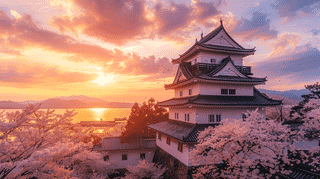
What the Hikone Castle Tenbin Yagura Is
The Hikone Castle Tenbin Yagura is a Momoyama-period gate turret at Hikone Castle in Konkicho, Hikone City, Shiga Prefecture, designated an Important Cultural Property in 1951 (Showa 26). Written 彦根城天秤櫓, it faces a dry cutting carved through the ridge and is linked to the Kane-no-maru bailey by a covered bridge.
At the centre is a single-tiered Yaguramon. A two-storey corner turret stands at either end of it, and a further turret runs back from each corner. Every roof is Hongawarabuki tile. Construction is placed in the Keicho era, roughly 1596 to 1614.
The name describes the shape. Seen head-on, the central gate acts as a fulcrum and the matched corner turrets hang from it like the pans of a balance. Tenbin is the Japanese word for such a scale, and the Hikone Castle Tenbin Yagura is named for nothing more complicated than its symmetry.
Why It Is an Important Cultural Property
The listing rests on two things: how completely the building survives, and how legible its job still is.
The cutting below is the castle's principal barrier on the approach side. Paths climbing from the Ote-mon and Omote-mon entrances both stop here. Drop the bridge and the inner bailey is severed from the rest of the hill and can be held on its own. The Hikone Castle Tenbin Yagura preserves that arrangement of bridge and gate turret essentially as it was built.
Matched corner turrets at both ends of a gate are uncommon in Japanese castle architecture. In the Hikone Castle Tenbin Yagura the tactical logic and the display expected at a lord's front gate arrive at the same answer.
What to Look For
Look at the Ishigaki before you look at the building. Seen from the cutting, the stonework to the right and the stonework to the left are not the same wall. The right-hand side is original Uchikomi-hagi work from the castle's construction, the joints dressed by hammer until the blocks sit close. The left-hand side was rebuilt in the late Edo period with stones laid so the joints run in diagonal lines.
The seam falls near the middle of the building, and once you have seen it you cannot unsee it. One turret, two centuries of masonry, a visible join between them. Most people who stop in front of the Hikone Castle Tenbin Yagura are looking for exactly that line.
Crossing the bridge, glance down. The cutting was hacked out of the hill by hand, and its depth is the defence.
On the apron in front of the Hikone Castle Tenbin Yagura grows Rubus hiraseanus, a bramble known nowhere but this castle, transplanted here for visitors to see. It is easy to walk straight past while staring at stone.
Visiting the Hikone Castle Tenbin Yagura
The Hikone Castle Tenbin Yagura is in the paid zone and its interior is open. The route crosses the covered bridge from the Kane-no-maru bailey and passes straight through the gate.
To see the masonry seam, take the path down into the cutting instead of crossing. The bridge gives no view of what lies directly beneath it, and the difference between the two sides only resolves from below.
For the building as a whole, stand on the Kane-no-maru side before stepping onto the bridge; the symmetry fits a single frame. Nothing restricts photography.
Opening hours, admission and directions to the castle are on the Hikone Castle page.
- 📍 Plan Your Visit to Shiga
- Find tours, activities & transport passes near Hikone Castle Tenbin Yagura
- [ Hikone Castle & Lake Biwa Cruise Experiences ]
Q&A
- Where does the name Hikone Castle Tenbin Yagura come from?
- From its shape seen head-on. A two-storey corner turret stands at each end of the central gate, so the building looks like a balance scale, which is what tenbin means.
- Why does the stonework under the Hikone Castle Tenbin Yagura differ left and right?
- The two sides were built at different times. Viewed from the cutting, the right-hand side is original uchikomi-hagi masonry, while the left was relaid during a late Edo-period repair. The join is visible near the middle of the building.
- Is the interior of the Hikone Castle Tenbin Yagura open to visitors?
- Yes. It lies in the paid zone, and the route crosses the covered bridge from the Kane-no-maru bailey straight through the gate.
- When was the Hikone Castle Tenbin Yagura built?
- In the Keicho era, roughly 1596 to 1614. The centre is a single-tiered gate turret, the ends are two-storey corner turrets, and all roofs are tiled.
- Where is the best place to photograph the Hikone Castle Tenbin Yagura?
- From the Kane-no-maru side, just before you step onto the bridge, where the symmetry reads clearly. For the masonry seam, take the path down into the cutting instead.
Basic Information
| Name | Hikone Castle Tenbin Yagura |
|---|---|
| Location | Konkicho, Hikone City, Shiga Prefecture |
| Designation | Important Cultural Property |
| Year Designated | 1951 (Showa 26) |
| Quantity | 1 building |
| Dimensions | Not recorded in the Agency for Cultural Affairs database |
| Owner | Hikone City |
| Public Access | Paid zone, interior open |
References
- National Designated Cultural Property Database, Hikone Castle Tenbin Yagura (Agency for Cultural Affairs)
- https://kunishitei.bunka.go.jp/heritage/detail/102/1396
- Cultural Properties within Hikone Castle (Hikone City)
- https://www.city.hikone.lg.jp/kakuka/kanko_bunka/8/2_1/3/4581.html
- Visitor Information for Hikone Castle (Hikone City)
- https://www.city.hikone.lg.jp/kakuka/kanko_bunka/8/2_1/3/4586.html
- List of Designated Cultural Properties in Hikone (Hikone City)
- https://www.city.hikone.lg.jp/kakuka/kanko_bunka/8/2_2/4655.html
- Hikone Castle Official Website
- https://hikonecastle.com/
Last verified: 2026.09.15