
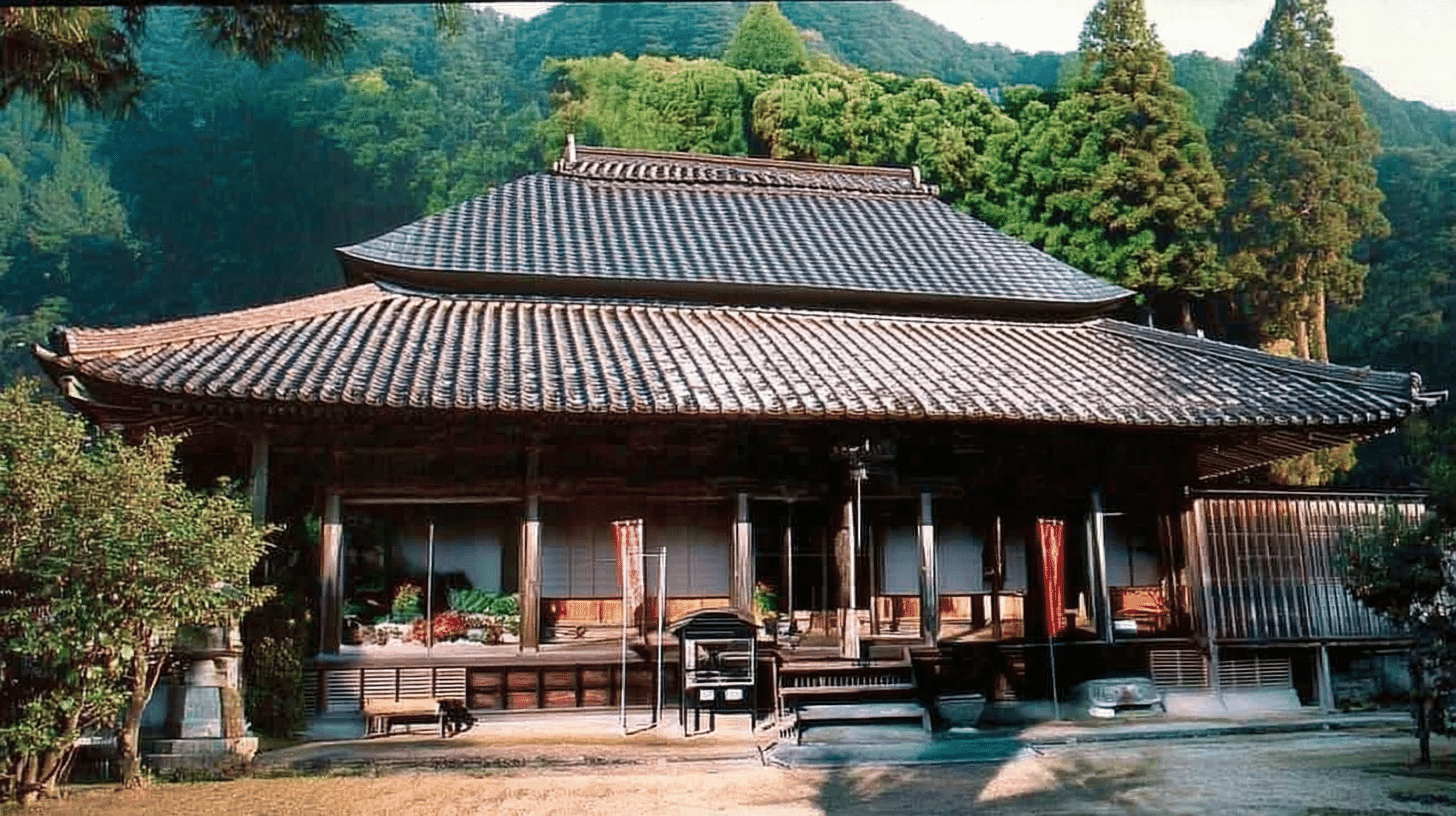
One Main Hall, a Registered Tangible Cultural Property since 2005
Manpukuji Main Hall (萬福寺本堂, Manpukuji Hondo) stands at 20 Teramae, Nobuno, Naka Town, Naka District, Tokushima Prefecture, an Edo-period building entered on the register of tangible cultural properties on 9 February 2005. It is a registered property rather than a designated one.
The quantity is one building. The owner is the temple.
The structure is timber, single-storeyed, thatched with sheet iron laid over it for the time being and tile in part, with a floor area of 181 square metres. The date field reads Edo, and the year field 1830 to 1867.
Two Roofing Materials Recorded for One Roof
The structural field sets down both the proper material and the present one.
It reads thatched, with sheet iron for the time being, and tile in part. What stands in the brackets is what lies there now.
A temporary covering shelters a roof until it can be laid properly. Thatch wears, and renewing it takes both labour and material.
The commentary likewise gives a hipped roof, formerly thatched, with a tiled lean-to running round all 4 sides. The word formerly is attached.
The former Takahashi main house is thatched, as is the Haba residence, and the Nikaido residence carries thatch with bamboo eaves. Those give the present material.
Here the roof is thatched and yet carries iron at the time of the record, with tile on part of it: three materials bear on one building.
A Main Hall in the Shape of a House
A temple building whose outward form is close to a dwelling.
The Agency closes that its outward form, of the kind known as four-sided eaves in the manner of a house, shows the character of the district.
Four-sided eaves means a canopy carried round all four faces. This hall is hipped, with a tiled lean-to running round all 4 sides, which is that form.
The Shigeta main building is called a fine example of a farmhouse with eaves running all round. That is a farmhouse.
Here a temple hall takes the same form. The shape of building in a district runs across differences of use.
As a way of stating value this is the thirteenth met: the character of a place showing in the outward form.
Laid Out on the Plan of an Abbot's Quarters
The way the interior divides follows the form of a priest's residence.
The Agency records a hojo type plan of 6 rooms, with broad verandas on the south and west.
A hojo is the building where the head priest of a temple lives, laid out in six rooms set two deep and three across.
Broad verandas run along 2 of the sides, the south and the west.
The columns are square and the outer bracketing is of boat-shaped arms, a plain form of bracket as such things go.
The Jizo hall, the goma hall and the fuda hall at Kannonshoji each enclose a single room. This hall divides into 6, with an entrance set between it and the priests' quarters to the east.
Visiting
The hall stands at 20 Teramae, Nobuno, Naka Town, Naka District, Tokushima Prefecture.
Its position is recorded: in a precinct running east and west, facing south, with an entrance between it and the priests' quarters to the east.
At 181 square metres it is the largest of the 4 buildings in the precinct. The storehouse covers 23 square metres, the belfry has an area of 8.7 square metres and the guardian shrine hall a floor area of 1.0 square metres.
That makes this hall 181 times the shrine hall. Facing south, it is seen head-on as one enters the precinct.
These are temple buildings, and whether and when they may be visited follows the temple's own arrangements. Check before travelling.
Q&A
- When was the hall registered?
- On 9 February 2005, as a registered tangible cultural property. It is registered rather than designated, and the quantity is one building.
- How is it roofed?
- The structural field gives thatch, with sheet iron laid over it for the time being, and tile in part. Thatch is the proper material; iron sits there now.
- What is valued in it?
- That its outward form, of the kind known as four-sided eaves in the manner of a house, shows the character of the district. A temple hall takes the shape of a dwelling.
- What is the interior like?
- A hojo type plan of six rooms, with broad verandas on the south and west. The columns are square and the outer bracketing is of boat-shaped arms.
- When was it built?
- The year field runs from 1830 to 1867, a span of 37 years. Unlike the other three buildings in the precinct, no grounds for narrowing it are given.
Basic Information
| Name | Manpukuji Main Hall (萬福寺本堂, Manpukuji Hondo); separate from other properties of the same name elsewhere in Japan |
|---|---|
| Location | 20 Teramae, Nobuno, Naka Town, Naka District, Tokushima Prefecture |
| Designation | Registered tangible cultural property (structure, religious architecture); registered rather than designated; 4 buildings in the precinct were registered on the same day |
| Year Designated | 2005 (9 February), registered |
| Quantity | 1 building |
| Dimensions | Timber, single-storeyed, thatched with sheet iron laid over it for the time being and tile in part, with a floor area of 181 square metres. It stands facing south in a precinct running east and west, with an entrance between it and the priests' quarters to the east. The plan is of hojo type with 6 rooms and broad verandas on the south and west; the columns are square and the outer bracketing of boat-shaped arms. The roof is hipped, formerly thatched, with a tiled lean-to round all 4 sides. The date field reads Edo and the year field 1830 to 1867 |
| Owner | Manpukuji |
| Public Access | A temple building; visiting follows the temple's own arrangements |
References
- Cultural Heritage Online: the Manpukuji main hall in Naka, Tokushima
- https://bunka.nii.ac.jp/heritages/detail/180856
- Agency for Cultural Affairs database: the Manpukuji main hall
- https://kunishitei.bunka.go.jp/bsys/maindetails/101/00004636
- Cultural Heritage Online: the Manpukuji guardian shrine hall
- https://bunka.nii.ac.jp/heritages/detail/195639
- Tokushima Prefecture: cultural properties
- https://www.pref.tokushima.lg.jp/
Last verified: 2026.09.13
