
Edo
Tokushima · 江戸Browse Tokushima’s cultural heritage from the Edo period (1603 – 1868). Filter by type and keyword, with concise stories, maps, and travel tips.
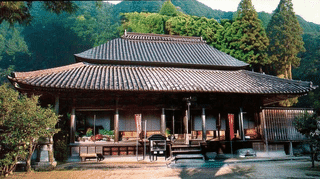
Discover Manpuku-ji Main Hall, a Registered Tangible Cultural Property in Naka Town, Tokushima. This 170-year-old Edo period Buddhist temple showcases unique "shiho-buta minka" regional architecture with traditional thatched roofing—an authentic off-the-beaten-path destination in Shikoku.

A 1710 farmhouse above the upper Akui River in Kamiyama Town, dated by its ridgepole tablet and designated in 1976 as the oldest six-room house plan in the district.
Built in 1630 opposite the thirteenth Shikoku pilgrimage temple, this three-bay shrine hall layers a dormer gable over a cusped one and keeps its polychrome carving.
Standing halfway up Mt. Kirihata in Awa City, Tokushima, the Kirihataji Daitō is a National Important Cultural Property rescued from the early Meiji abolition of Buddhist temples. Originally commissioned in 1607 by Toyotomi Hideyori to pray for the repose of his father Hideyoshi's soul, it was dismantled from Osaka's Sumiyoshi Shinra-ji and painstakingly rebuilt at Kirihataji, the 10th temple on the Shikoku Pilgrimage, over roughly a decade. Its unique five-bay-square-over-three-bay-square form is the only surviving example of its type in Japan.
Jōrokuji Kannon-dō is an elegant two-tiered Buddhist hall in Tokushima City, rebuilt in 1648 and designated a National Important Cultural Property of Japan. Part of the Sōtō Zen temple Jōrokuji—affectionately called the "Hōryū-ji of Awa" for its concentration of historic buildings—the hall enshrines a nearly five-meter-tall Heian-period statue of Avalokiteshvara that gave the temple its name. This guide covers the hall's architecture, history, nearby attractions, and essential travel information for international visitors.
Jōrokuji's main hall was once the abbot's quarters, rebuilt in 1629 for a lord's daughter. Its chamfered pillars mark early-Edo work and a blood-ceiling tradition.
Tokushima's oldest farmhouse, built in the early Edo period above the Anabuki River in Mima. The family here still weaves hemp cloth for imperial enthronements.
Built in 1756, the vermilion Anrakuji Temple Main Gate in Mima, Tokushima pairs orthodox Zen bracketing above with an unconventional lower storey. Registered 2009.
At the sixth Shikoku pilgrimage temple in Kamiita, Tokushima, the late Edo Anrakuji Temple Hojo has a thatched roof edged in tile and a raised lord's room.
Discover Daisendō, a registered Tangible Cultural Property in Tsurugi Town, Tokushima. This Edo-period Buddhist hall serves as the 13th stop on the Haba Shikoku pilgrimage—a local 88-temple route created so that ordinary villagers could experience the spiritual journey of Shikoku.
Tucked into a hillside in Tsurugi-chō, Tokushima Prefecture, Kaize-dō is the 34th station of the Haba Shikoku 88 Sacred Places, a local Edo-period miniature version of Shikoku's great pilgrimage. Originally founded in 1616 and rebuilt in 1816, this three-bay pyramid-roofed hall with open south and east sides was registered as a national tangible cultural property in 2017, and it preserves a vivid trace of rural folk Buddhism in the Shikoku mountains.
The Former Oiso Family Residence in Matsushige, Tokushima, is a National Registered Tangible Cultural Property built during the late Edo period as the home of the Oiso family, who prospered through indigo dye manufacturing. Featuring a distinctive gable roof with plaster walls and a robust timber framework, it preserves the legacy of the Awa indigo industry. Now maintained within the grounds of Kashino Club.
Relocated from an indigo merchant's house in 1954, the Tatsumi Zashiki at Tokushima's Awa Jurobei Yashiki is a 21-mat room of fine timbers, registered in 2024.
Built in 1855 and moved here in 1954, the Nagayamon at Tokushima's Awa Jurobei Yashiki carries a formal hongawara tile roof, and was registered in March 2024.
Built in 1810 at Kira in Tsurugi Town, Tokushima, this open-sided thatched hall is station thirty on the Habashikoku circuit, a miniature local Shikoku pilgrimage.
This late Edo thatched farmhouse at Tsurui in Higashi-Iya, Tokushima, was registered in 2019 as a model of the Iya house form. It is a private home and is not open.
The 1843 gate of Saikyoji in Mima, Tokushima, is a three-bay yakuimon whose outer eaves are boarded and carved with clouds, the detail that put it in the register.
Saikyoji's 1858 main hall in Mima, Tokushima, is a registered property. Its 14 by 16 metre plan follows Jodo Shinshu practice, and dragon and tiger guard the porch.
Built in 1810 at Jizoji, fifth temple of the Shikoku pilgrimage in Tokushima, this plastered storehouse holds an octagonal revolving sutra case. Registered in 2011.
This hall of Kobo Daishi at Jizoji in Tokushima dates from 1711 to 1716 and was remodelled late in the Edo period. Carved transoms, celestial women on the ceiling.