
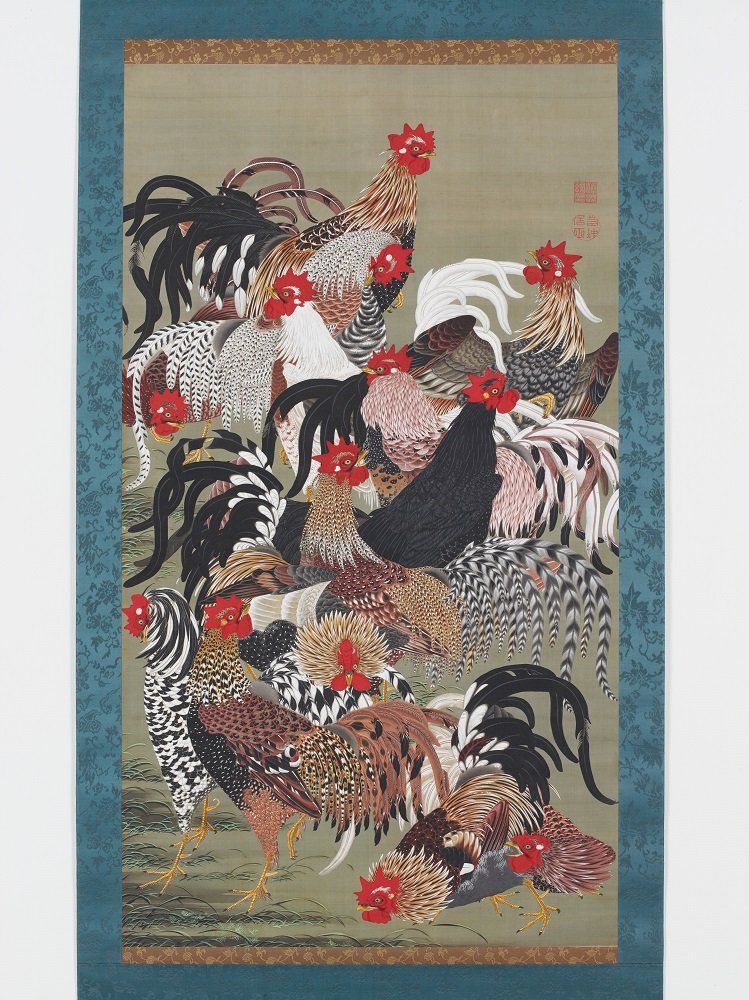
Dōshoku Sai-e: Itō Jakuchū's Colorful Realm of Living Beings
In the autumn of 1765, a Kyoto painter of about fifty named Itō Jakuchū began handing over a group of large silk paintings to Shōkoku-ji, a Rinzai Zen temple north of the old imperial palace. He asked for no payment. The paintings were a votive gift, dedicated for the perpetual memorial of his late parents, a younger brother, and eventually himself. That group grew into thirty hanging scrolls of birds, flowers, fish, and insects, known today as the Dōshoku Sai-e, a title usually rendered in English as the Colorful Realm of Living Beings.
Each scroll measures roughly 142 centimeters tall and 80 centimeters wide, painted in mineral pigments on silk. Seen in a row, the thirty form a single sweeping survey of the natural world as one painter saw it: roosters quarreling in a yard, a phoenix balanced on one leg above an old pine, carp circling under lotus leaves, a snail crawling past a beetle at the edge of a pond.
The set is now owned by the Japanese state and kept at the Sannomaru Shōzōkan, the museum of the imperial collections inside the Imperial Palace East Gardens in Tokyo. It was designated a National Treasure on 30 September 2021.
The painter and the gift
Jakuchū (1716–1800) was the eldest son of a wholesale greengrocer in Kyoto's Nishiki Market. He inherited the family business but cared little for trade. In 1755, at about forty, he passed the shop to a younger brother and gave himself over entirely to painting.
He had studied the Kano school and Chinese Song and Yuan works, then set that training aside to draw from life. By his own account he kept dozens of chickens in his garden and watched them for years before he felt able to paint one. That habit of patient looking runs through every scroll.
His connection to Shōkoku-ji came through Daiten Kenjō, a learned monk who later became the temple's abbot. The friendship shaped the most ambitious project of Jakuchū's life. Alongside the thirty bird-and-flower scrolls he painted a Buddhist triad of Shakyamuni, Manjushri, and Samantabhadra, copied after older models. The three sacred images stood at the center and the thirty nature scrolls flanked them, thirty-three paintings meant to be hung together.
For decades the full set appeared once a year, at the Kannon memorial rite held at the temple on 17 June. Visitors crowded the approach, and stalls lined the path.
The arrangement ended in the upheaval of the early Meiji period. Anti-Buddhist policy left many temples destitute, and in 1889 Shōkoku-ji presented the thirty scrolls to Emperor Meiji, keeping only the central triad. In return the temple received ten thousand yen, a sum that let it hold onto its grounds. The paintings became imperial property and were used to decorate the palace when distinguished guests arrived. In 1989 the imperial family transferred them to the state, and four years later the Sannomaru Shōzōkan opened to house the collection.
Why it ranks among Japan's National Treasures
The thirty scrolls are widely read as the high point of Japanese bird-and-flower painting, a tradition with roots in Chinese court art. What sets Jakuchū apart is the collision of two things that usually pull against each other: an almost scientific attention to living detail, and a bold sense of design that bends nature toward pattern and rhythm.
Close looking rewards the visitor with technical surprises. Jakuchū often painted color onto the back of the silk as well as the front, a method called ura-zaishiki, so that white feathers and pale petals glow with a depth no surface layer could give. In the late scroll of a white phoenix on an old pine, the bird's plumage takes on a lacelike shimmer through this back-coloring.
His pigments place the work at the leading edge of its century. Analysis of the scroll of fish revealed Prussian blue in the body of a small grouper at the lower left. The blue was a synthetic pigment newly arrived from Europe, and its presence here, in a work painted between about 1758 and 1766, is among the earliest confirmed uses in Japan.
The designation in 2021 placed the Dōshoku Sai-e beside National Treasures by Jakuchū's great contemporaries in Kyoto, the painters Yosa Buson, Ike no Taiga, and Maruyama Ōkyo. Within Jakuchū's own output, this set sits at the very center.
What to look for
The scroll titled Gunkei-zu, or Roosters, is the one many visitors come for. Jakuchū packs the silk with about thirteen birds in every imaginable posture, their combs overlapping until it is hard to tell where one body ends and the next begins. The birds are seen almost at eye level while the grass below is viewed from above, a deliberate clash of angles that makes the picture feel alive rather than arranged.
The white phoenix scroll, Rōshō Hakuhō-zu, belongs to the final phase of the project and shows the back-coloring technique at its boldest. The bird stands on one leg, head turned toward a rising sun.
In the fish scrolls, look low and to the side for the small blue grouper carrying that historic Prussian blue. In the pond scroll of insects, count the species: dragonflies, a praying mantis, a snail, frogs, all rendered with the patience of a naturalist. The scrolls of mandarin ducks and golden pheasants set against snow show Jakuchū handling white on white, a quiet test of skill after the riot of the rooster yard.
Because the silk is fragile, the scrolls are rotated rather than shown all at once, so the specific paintings on view change with each display.
Seeing the work, in Tokyo and Kyoto
The Sannomaru Shōzōkan sits just inside the Ōte-mon gate of the Imperial Palace East Gardens, a short walk from Tokyo Station. The surrounding gardens are open to the public without charge and reward an unhurried stroll past the stone walls of the old Edo Castle keep.
At the time of writing the museum is closed for the completion of a new building, with a grand opening scheduled for autumn 2026. For that reopening the museum has announced a run of special exhibitions, and the second of them is planned to gather all thirty scrolls in one room, the first such showing in Japan since 2016 and the first anywhere since the set traveled to Paris in 2018. Anyone hoping to see a particular scroll, or the complete thirty, should check the museum's official schedule before visiting, since the lineup rotates and reservation rules vary by exhibition.
Kyoto offers a second route to the work. At Shōkoku-ji, where the paintings began their life, the Jōtenkaku Museum displays high-quality collotype reproductions, and since 2014 these copies have once again been hung at the temple for the June memorial rite, recreating the original setting around the Buddhist triad that still belongs to the temple.
Q&A
- Can I see the original Dōshoku Sai-e right now?
- Not at present. The Sannomaru Shōzōkan, which holds the scrolls, is closed for construction ahead of a grand opening planned for autumn 2026. Check the museum's official website for the reopening date and exhibition schedule.
- Are all thirty scrolls shown together?
- Rarely. Because the silk is light-sensitive, the scrolls are usually rotated a few at a time. A full thirty-scroll display is planned among the exhibitions marking the museum's 2026 reopening.
- Why are the paintings in Tokyo and not at the temple in Kyoto?
- Shōkoku-ji presented the thirty scrolls to Emperor Meiji in 1889 during a period of severe hardship for Buddhist temples. They passed to the state in 1989 and are now kept at the Sannomaru Shōzōkan. The temple retained the central Buddhist triad.
- What does the title Dōshoku Sai-e mean?
- The name comes from the wording of Jakuchū's own donation letter and describes paintings of animals and plants rendered in vivid color. Museums often translate it as the Colorful Realm of Living Beings.
- Can I view the scrolls without traveling to Japan?
- The Sannomaru Shōzōkan publishes high-resolution images of the collection online, which allow close study of the brushwork. Collotype reproductions can also be seen at Shōkoku-ji's Jōtenkaku Museum in Kyoto.
Basic Information
| Name | Dōshoku Sai-e (Colorful Realm of Living Beings), by Itō Jakuchū |
|---|---|
| Category | Painting, color on silk |
| Count | Thirty hanging scrolls, each about 142 cm by 80 cm |
| Artist | Itō Jakuchū (1716–1800) |
| Period | Edo period, painted about 1758 to 1766 |
| Designation | National Treasure, designated 30 September 2021 |
| Owner | The Japanese state, held by the Agency for Cultural Affairs |
| Repository | Sannomaru Shōzōkan, Imperial Palace East Gardens, Chiyoda, Tokyo |
| Provenance | Shōkoku-ji, then imperial property from 1889, transferred to the state in 1989 |
| Access | Currently closed for construction; grand opening planned for autumn 2026 |
References
- Agency for Cultural Affairs, National Cultural Properties Database
- https://kunishitei.bunka.go.jp/bsys/maindetails/201/00011972
- Sannomaru Shōzōkan, Museum of the Imperial Collections, collection record
- https://shozokan.nich.go.jp/collection/object/SZK002949
- Shōkoku-ji Jōtenkaku Museum, Jakuchū and early modern painting
- https://www.shokoku-ji.jp/museum/exhibition/jakuchu/
Last verified: 2026.06.12