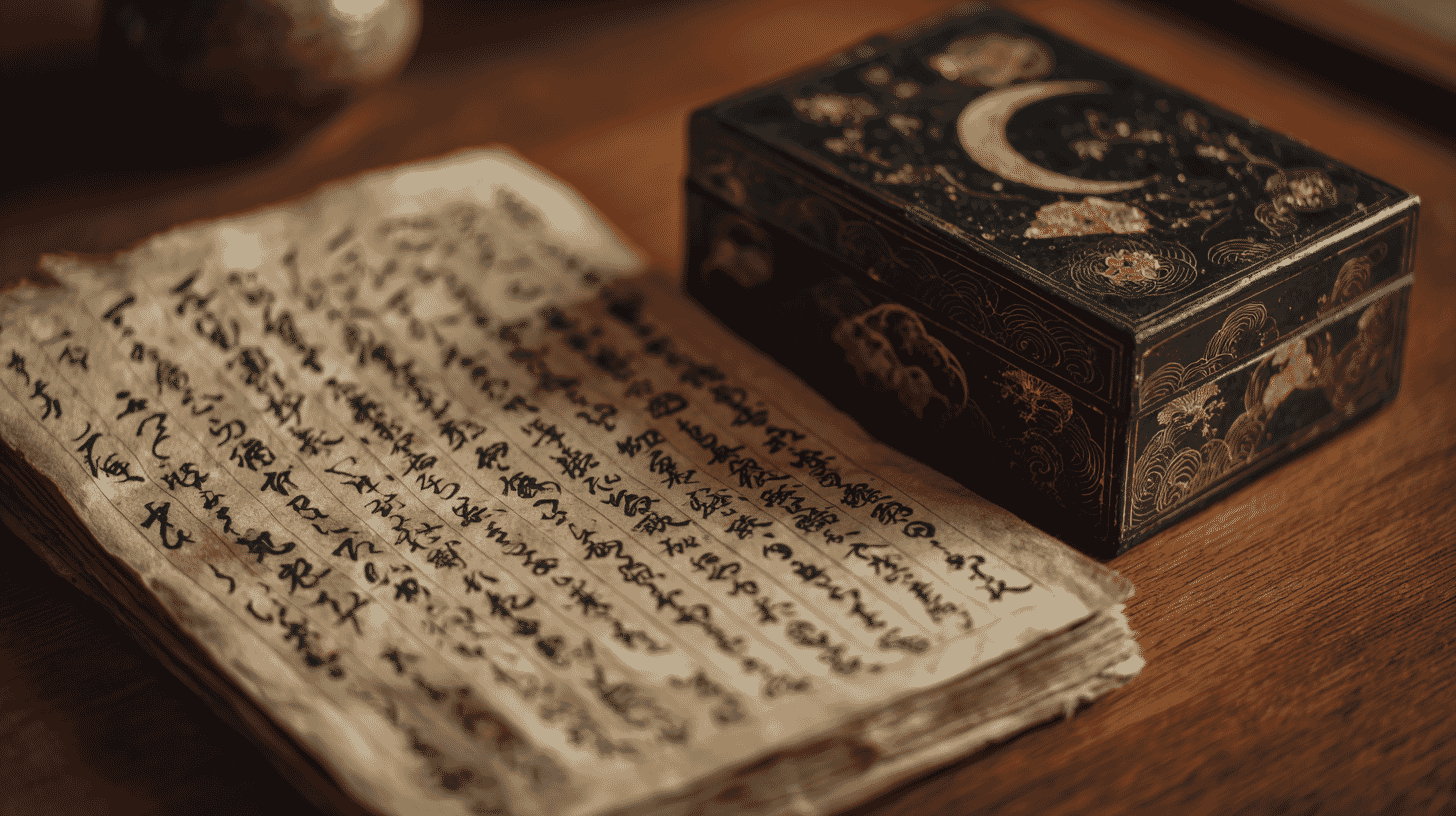
Sarashina Nikki: A Thousand-Year-Old Woman's Memoir Preserved as a National Treasure
Nearly a thousand years ago, a young girl in the remote eastern provinces of Japan dreamed of reading The Tale of Genji. She grew up, traveled to the capital, fell in love with literature, navigated the complexities of court life, married, and watched her husband die—then, in her fifties, she wove all of it into a deeply personal memoir. This was the Sarashina Nikki (Sarashina Diary), one of the masterpieces of Heian-period literature. But the original manuscript was lost. Were it not for one extraordinary man who copied it by hand two centuries later, this intimate record of a woman's inner life might have vanished forever.
That man was Fujiwara no Teika (1162–1241), one of Japan's greatest poets and the most important literary scholar of the Kamakura period. His handwritten copy of the Sarashina Nikki—a small, elegant booklet measuring just 16.4 by 14.5 centimeters—is the oldest surviving manuscript of this work and, remarkably, the sole ancestor of every copy that has ever existed. It was designated a National Treasure of Japan on June 27, 2023, and is preserved alongside a magnificent lacquer book box decorated with waves and moonlight at the Museum of the Imperial Collections (Sannomaru Shozokan) within the Imperial Palace grounds in Tokyo.
The Sarashina Nikki: A Heian Woman's Life in Her Own Words
The Sarashina Nikki was written around 1059 CE by a woman known to history only as "Sugawara no Takasue no Musume"—the Daughter of Sugawara no Takasue. Her personal name, like those of so many women in ancient Japan, was never recorded. She is sometimes called Lady Sarashina, though the name Sarashina itself refers to a district associated with a poem at the diary's end, not a place she actually called home.
The diary spans roughly forty years of her life, from age twelve or thirteen to her early fifties. It begins with one of the most vivid and beloved passages in all of Japanese literature: her account of the long journey from Kazusa Province (present-day Chiba Prefecture) to the capital in Kyoto, when her father's provincial appointment ended in 1020. The three-month trek gave her a child's-eye view of Japan's landscape—including a striking glimpse of the then-active Mount Fuji.
Throughout her life, Lady Sarashina was consumed by her love of fiction, especially The Tale of Genji, which had been completed around the time she was born. She prayed fervently to read it in full, and when she finally obtained the entire work, she was so absorbed that she did not even attend to her devotions. The diary traces her gradual realization that the romantic fantasies of fiction did not match the hardships of real life—a trajectory from youthful idealism through marriage, loss, and eventually a deepening commitment to Buddhist faith. It is at once a travel narrative, a literary confession, a spiritual autobiography, and a hauntingly personal record of dreams, eleven of which are described in vivid detail.
The Sarashina Nikki stands as one of the six great literary memoirs of the mid-Heian period, alongside the Pillow Book of Sei Shōnagon, the Diary of Lady Murasaki, and the Kagerō Nikki. Ivan Morris's English translation appeared in 1971 under the evocative title As I Crossed a Bridge of Dreams, while a more recent scholarly translation by Sonja Arntzen and Itō Moriyuki was published by Columbia University Press in 2014.
Fujiwara no Teika: The Man Who Saved Japanese Literature
Fujiwara no Teika is remembered today as one of Japan's greatest poets and as the compiler of the beloved Ogura Hyakunin Isshu (One Hundred Poems by One Hundred Poets), which is still used in the traditional New Year's card game, karuta. But among scholars, his most extraordinary legacy may be his tireless work as a literary copyist. In an age before printing, the survival of great works depended entirely on scribes who faithfully transcribed manuscripts by hand. Teika was perhaps the most dedicated and meticulous of them all.
Over the course of his long life, Teika copied a remarkable number of Heian literary classics, including The Tale of Genji, the Tosa Diary, and the Kokin Wakashū. Many of these copies became the oldest surviving manuscripts—or even the sole ancestors—of works that are now cornerstones of the Japanese literary canon. The Sarashina Nikki is one such case.
Teika's copy of the Sarashina Nikki was made after 1230, when he was already in his late sixties. According to a reference in his own diary, the Meigetsuki (Record of the Clear Moon), he was aware of the work by 1230 at the latest. The story of how this particular copy came to be is itself remarkable: Teika had lent a manuscript of the diary to someone who wished to copy it, but that person lost the original and returned only the new copy. Teika then used that imperfect transcription as his source, carefully copying it out again while adding red-ink annotations to mark doubtful or unclear passages. In a colophon at the end, he noted the problems he had encountered and the critical commentary he had supplied.
Teika was also known for his distinctive calligraphy. His bold, idiosyncratic brushwork became known as "Teika-yō" (Teika style) and was widely admired and imitated for centuries. Even Teika himself was modest about it—in his diary, he once described his own characters as looking "like the devil." Yet the Adobe font "Kazuraki SPN," released in 2009, was inspired by his calligraphic style, a testament to its enduring appeal.
Why This Manuscript Became a National Treasure
The Sarashina Nikki manuscript by Fujiwara no Teika holds a uniquely important position in Japanese literary history for three interconnected reasons.
First, it is the oldest surviving copy of the Sarashina Nikki. The original, written by Lady Sarashina herself in the eleventh century, has been lost, as is the case with nearly all Heian-period manuscripts. Teika's thirteenth-century transcription is the earliest witness to the text.
Second, and even more remarkably, it is the sole ancestor—the "sobon" (祖本)—of every other copy of the Sarashina Nikki that has ever existed. Modern scholars made this astonishing discovery by identifying a specific physical error in Teika's booklet: at some point, the pages were bound in the wrong order, creating a "sakkan" (錯簡, disorder of pages) that rendered certain passages incomprehensible. This same disorder appears in every subsequent manuscript and printed edition of the diary without exception. This means that every version of the Sarashina Nikki in existence—whether handwritten copy, woodblock-printed edition, or modern typeset text—descends directly from this single, small booklet.
Third, the manuscript is a critical scholarly edition (kanbutsu) as well as a faithful transcription. Teika did not merely copy the text; he identified problems, marked uncertain readings in red ink, and added explanatory notes. His editorial work has been indispensable for scholars attempting to reconstruct the original text.
For these reasons, the manuscript was officially designated a National Treasure on June 27, 2023. It had long been recognized as being of the highest cultural significance, but because it was held by the Imperial Household Agency—whose collections were not subject to the Cultural Properties Protection Law—it could not be formally designated. In October 2023, the museum's administration was transferred from the Imperial Household Agency to the National Institutes for Cultural Heritage, bringing the collection under the legal framework for cultural property designation and making this long-overdue recognition possible.
The Maki-e Book Box: Waves and Moonlight in Gold Lacquer
Alongside the manuscript itself, a beautifully crafted lacquer book box is designated as an "appendage" (附, tsuki) to the National Treasure. Known as the "Nami ni Tsuki Maki-e Sōshi-bako" (Wave and Moon Maki-e Book Box), this small box was made to house the precious booklet. Its surface is decorated with an elegant design of ocean waves and a luminous moon, executed in the maki-e technique—a traditional Japanese lacquerwork art in which gold or silver powder is sprinkled onto wet lacquer to create shimmering, raised designs.
The motif of moonlight over waves carries deep poetic resonance in Japanese culture, evoking the aesthetic ideal of "mono no aware" (the pathos of things)—a sensitivity to the beauty and transience of the natural world that pervades the Sarashina Nikki itself. The box is a work of art in its own right and a testament to the reverence with which this manuscript has been treated across the centuries.
Where to See It: The Museum of the Imperial Collections
The Sarashina Nikki manuscript and its maki-e book box are held by the Museum of the Imperial Collections, Sannomaru Shozokan (皇居三の丸尚蔵館), located within the Imperial Palace East Gardens in the heart of Tokyo. This museum preserves approximately 9,800 works of art and historical artifacts that were donated to the nation by the Imperial Family beginning in 1989.
The museum first opened in 1993, and a major reconstruction and expansion project has been underway since 2019. The Phase I building opened in November 2023 with expanded exhibition space and modern facilities. As of May 2025, the museum has entered a temporary closure for the connection of the Phase I and Phase II buildings. The full reopening is scheduled for autumn 2026, at which point the museum will feature dramatically expanded exhibition galleries (1,300 square meters, roughly eight times the original), enlarged storage facilities (4,000 square meters), and a café—the first within the Imperial Palace grounds.
Because the Sarashina Nikki is an extremely delicate manuscript, it is not on permanent display. It is shown periodically in special exhibitions, with different pages displayed on each occasion. The manuscript was most recently exhibited during the opening commemorative exhibition "Elegance of the Imperial Court" (Kōshitsu no Miyabi), Phase 3 (March 12 to May 12, 2024), which included a page change partway through the run. Visitors are encouraged to check the museum's official website and exhibition schedule for future viewing opportunities.
Exploring the Surroundings: The Imperial Palace East Gardens and Central Tokyo
A visit to the Museum of the Imperial Collections is also an opportunity to explore the Imperial Palace East Gardens (Kōkyo Higashi Gyoen), one of Tokyo's most serene and historically rich green spaces. The gardens are built on the site of the former Edo Castle, the seat of the Tokugawa shoguns, and preserve remnants of the castle's massive stone walls, moats, and guard towers. Highlights include the Tenshudai (the stone base of the original castle keep), the Ninomaru Garden designed by Kobori Enshū, and the Hyakunin Bansho (Hundred-Man Guard House). Entry to the gardens is free.
The museum is conveniently located near Tokyo Station and the Otemachi and Takebashi subway stations, placing visitors within easy reach of other major cultural destinations. The Tokyo National Museum in Ueno, which holds numerous National Treasures including other manuscripts by Fujiwara no Teika, is about 15 minutes away by train. The nearby Marunouchi and Nihonbashi districts offer world-class shopping and dining. For those with a deeper interest in Japanese calligraphy and literary manuscripts, the Gotoh Museum in Setagaya (accessible by train from central Tokyo) also holds significant collections.
- 📍 Plan Your Visit to Tokyo
- Find tours, activities & transport passes near Sarashina Diary (written by Fujiwara Teika) / with a Booklet
- [ Tokyo Skytree Asakusa & teamLab Experiences ]
Q&A
- What exactly is the Sarashina Nikki?
- The Sarashina Nikki (Sarashina Diary) is a literary memoir written around 1059 CE by a Heian-period noblewoman known as Sugawara no Takasue's Daughter (Lady Sarashina). It covers approximately forty years of her life, from a childhood journey across Japan to her reflections on aging, loss, and Buddhist faith. It is celebrated as one of the great works of Heian women's literature.
- Why is Fujiwara no Teika's copy so important?
- Teika's copy, made after 1230, is the oldest surviving manuscript of the Sarashina Nikki and, crucially, the sole ancestor of every other version in existence. A page-binding error in this booklet was reproduced in every subsequent copy, proving that all later manuscripts descend from this single source. Teika also added scholarly annotations that aid in understanding the text.
- Can I see the Sarashina Nikki manuscript at the museum now?
- The Museum of the Imperial Collections (Sannomaru Shozokan) is currently closed for construction and is scheduled to fully reopen in autumn 2026. Even when open, the manuscript is not permanently displayed due to its fragility; it appears in special exhibitions on a rotating basis. Please check the museum's official website for the latest exhibition schedule.
- Is there an English translation of the Sarashina Nikki?
- Yes, there are two major English translations. Ivan Morris published "As I Crossed a Bridge of Dreams" (Penguin Classics, 1971), and Sonja Arntzen and Itō Moriyuki produced a more recent scholarly edition, "The Sarashina Diary: A Woman's Life in Eleventh-Century Japan" (Columbia University Press, 2014). Both offer rich introductions and commentary.
- How do I get to the Museum of the Imperial Collections?
- The museum is located in the Imperial Palace East Gardens. The most convenient access is via the Ōte-mon Gate, approximately 5 minutes on foot from Otemachi Station (Tokyo Metro, exit C13a) or about 15 minutes from Tokyo Station (JR, Marunouchi North Exit). A security bag check is required upon entry to the East Gardens.
Basic Information
| Designated Name | Sarashina Nikki (Copied by Fujiwara no Teika) / with Maki-e Book Box with Wave and Moon Design |
|---|---|
| Japanese Name | 更級日記〈藤原定家筆〉/附 波に月蒔絵冊子箱 |
| Category | National Treasure (Calligraphy and Literary Works) |
| Period | Kamakura period (after 1230) |
| Author of Original Text | Sugawara no Takasue no Musume (Lady Sarashina), ca. 1008 – after 1059 |
| Copyist | Fujiwara no Teika (Sadaie), 1162–1241 |
| Dimensions | 16.4 cm × 14.5 cm (1 booklet) |
| National Treasure Designation Date | June 27, 2023 |
| Owner | The Nation (under the custody of the Agency for Cultural Affairs) |
| Location | Museum of the Imperial Collections, Sannomaru Shozokan, 1-8 Chiyoda, Chiyoda-ku, Tokyo (within the Imperial Palace East Gardens) |
| Museum Hours | 9:30 AM – 5:00 PM (last entry 4:30 PM); closed Mondays (currently closed for construction until autumn 2026) |
| Admission | General: ¥1,000 / University students: ¥500 / Under 18 and over 70: Free |
| Access | 5 min walk from Otemachi Station (Tokyo Metro); 15 min walk from Tokyo Station (JR) |
| Official Website | https://shozokan.nich.go.jp/ |
References
- Cultural Heritage Online – Sarashina Nikki (Fujiwara no Teika)
- https://bunka.nii.ac.jp/db/heritages/detail/550831
- WANDER Kokuho – National Treasure: Sarashina Nikki (Fujiwara no Teika) [Museum of the Imperial Collections / Tokyo]
- https://wanderkokuho.com/201-12013/
- Sarashina Nikki – Wikipedia (English)
- https://en.wikipedia.org/wiki/Sarashina_Nikki
- Fujiwara no Teika – Wikipedia (English)
- https://en.wikipedia.org/wiki/Fujiwara_no_Teika
- Museum of the Imperial Collections, Sannomaru Shozokan – Official Website
- https://shozokan.nich.go.jp/
- Museum of the Imperial Collections – Opening Commemorative Exhibition "Elegance of the Imperial Court"
- http://pr-shozokan.nich.go.jp/miyabi/
- Agency for Cultural Affairs – National Designated Cultural Properties Database
- https://kunishitei.bunka.go.jp/bsys/maindetails/201/00012013
- The Sarashina Diary: A Woman's Life in Eleventh-Century Japan – Columbia University Press
- https://cup.columbia.edu/book/the-sarashina-diary/9780231167185/
- Visit Chiyoda – Museum of the Imperial Collections
- https://visit-chiyoda.tokyo/app/spot/detail/987
Last verified: 2026.02.17
Nearby heritages
- Colored Paperback Illustrations of the Mongolian Invasion
- Chiyoda, Chiyoda Ward, Tokyo
- Colorful Silk Painting of Animals and Plants (by Ito
- Chiyoda, Chiyoda Ward, Tokyo
- Chinese Lion Painting on Gold Paper (by Kano Eitoku / Six
- Chiyoda, Chiyoda Ward, Tokyo
- Colored Silk Painting of Kasuga Gongen Genki E (painted by
- Chiyoda, Chiyoda Ward, Tokyo
- Mourning Book〈Original Site Wang Xizhi〉
- Chiyoda, Chiyoda Ward, Tokyo
- Collection of Japanese and Chinese Poems (cloud Paper)
- Chiyoda, Chiyoda Ward, Tokyo
- The Second and Fourth Volumes of the Manyoshu (Kanazawa
- Chiyoda, Chiyoda Ward, Tokyo
- Folding Screen 〈Ono Michifu Brush/〉
- 1-1 Chiyoda, Chiyoda-ku, Tokyo
- Copper-Painted Lanling King Figurine (by Unno Katsumin)
- Located in the East Gardens of the Imperial Palace, 1-8 Chiyoda, Chiyoda-ku, Tokyo
- Chrysanthemum Makie and Mother-of-Pearl Inlay Bookshelf
- Chiyoda, Chiyoda Ward