
Two Scrolls, National Treasure since 2024
Collection of Japanese and Chinese Poems (Cloud Paper) (和漢朗詠集, Wakan Roeishu) is a Heian-period work of calligraphy at Chiyoda, Chiyoda Ward, Tokyo, designated a National Treasure on 27 August 2024. The owner is the state through the Agency for Cultural Affairs.
A designation in 2024 is the most recent encountered here, later than the Sanmyakuinki, the Sarashina Diary and the Soranjo of 2023.
The Museum of the Imperial Collections records the title as the cloud-paper Wakan Roeishu, in two scrolls, measuring 27.0 by 1418.3 centimetres for the upper scroll and 27.0 by 1433.2 centimetres for the lower. Each scroll runs to more than fourteen metres.
The Attributed Hand and the Inferred Hand Differ
The field for the writer and the commentary give different names.
The field reads: attributed to Fujiwara no Yukinari, who lived from 972 to 1027. Attributed marks what tradition holds.
The commentary, however, states that the writer is thought to have been Minamoto no Kaneyuki, of the middle eleventh century.
By tradition Yukinari; by inference Kaneyuki. Two names stand side by side within one record.
On the katana with the gold-inlaid attribution to Masamune, an appraiser set the maker's name in gold. On the tachi inscribed Masatsune, several smiths shared the name and the signature alone settled nothing. Here two names arise from two different grounds, tradition and inference. How a maker is fixed differs from property to property.
The Title Comes from the Paper
Cloud paper stands in the title.
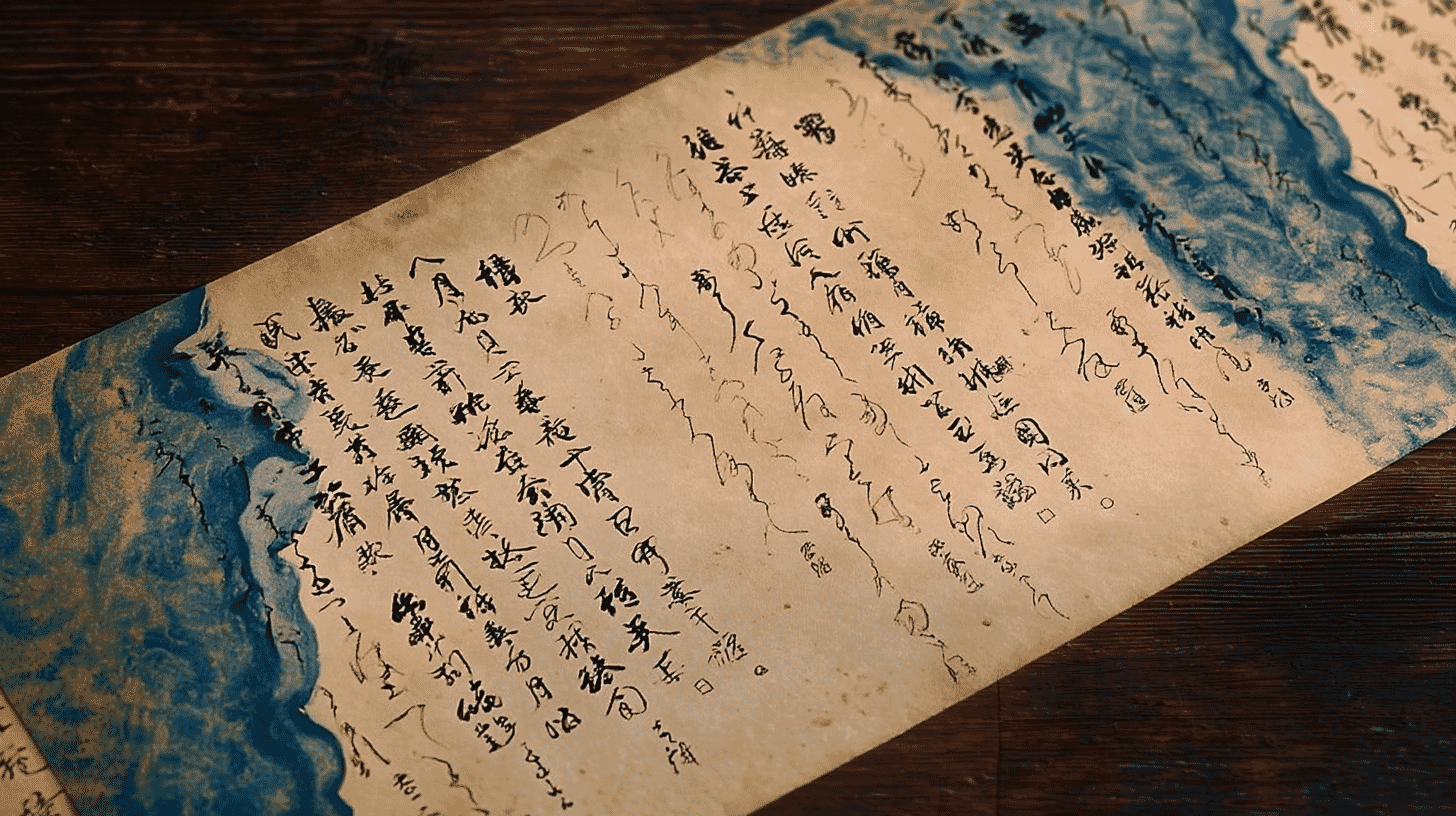
Cloud paper is a kind of decorated sheet. The record explains that the name comes from the use of paper bearing indigo cloud shapes.
How it is used is recorded too: cloud paper predominates, placed at the lower right and upper left of each sheet, and continued so as to create an effect across the whole. The position of the cloud is set sheet by sheet so that the joined length reads as one design.
Several origins for titles have appeared here. A sword's title transcribes its inscription; the Soranjo takes the opening words of its text; color on silk and ink on paper name the material. This one names a particular decorated paper.
A related entry covers a Wakan Roeishu on Chinese paper. Same text, different paper, separate property. The paper is what divides them.
Three Scripts Mixed in One Scroll
The manner of writing is described as well.
The forms of the characters mix three scripts: the formal, the running and the cursive.
The formal script sets each stroke apart, the running script joins them somewhat, and the cursive greatly simplifies them. All three appear within a single work.
On the engraved mirror, front and back carried different subjects. On the Taihi Tenmoku bowl, inside and outside were made by opposite means. Here the script changes within one surface.
The record also calls this the oldest surviving example on cloud paper. That assessment stands in the Museum of the Imperial Collections' record; it has not been confirmed in the Agency's material, and the source is named here accordingly.
Many Fragments, Each Recorded Apart
Detached fragments of the Wakan Roeishu are recorded in great number.
Fragments of the upper and lower scrolls appear under a series of names taken from temples, former owners and other associations, each a separate entry.
The word used for these fragments means a cut piece, and the word before it derives from provenance or a previous holder. Fragments of one text are each given a name and recorded separately.
With the Choju Jinbutsu Giga and the Saigyo scrolls, fragments were likewise recorded apart from the main work. Here the number is of another order.
The state owns the scrolls, held at Chiyoda, Chiyoda Ward, Tokyo. They are not kept on permanent display, and work on paper is vulnerable to light, so periods on view are limited. Exhibition plans can change, so check before travelling.
Q&A
- When was the work designated?
- On 27 August 2024, as a National Treasure. It is at Chiyoda, Chiyoda Ward, Tokyo, and owned by the state. This is the most recent designation among the properties covered here.
- Who wrote it?
- The field for the writer reads attributed to Fujiwara no Yukinari, while the commentary says the writer is thought to have been Minamoto no Kaneyuki. Tradition and inference give two different names within one record.
- What is cloud paper?
- Paper bearing indigo cloud shapes. The record notes that it predominates, placed at the lower right and upper left of each sheet and continued so as to create an effect across the whole length.
- Is it written in one script?
- No. The record states that the character forms mix three scripts: the formal, the running and the cursive. All three appear within a single work.
- Are fragments recorded too?
- Many. Fragments of the upper and lower scrolls are listed under names drawn from temples, former owners and other associations, each as a separate entry.
Basic Information
| Name | Collection of Japanese and Chinese Poems, Cloud Paper (和漢朗詠集, Wakan Roeishu); the Museum of the Imperial Collections calls it the cloud-paper Wakan Roeishu |
|---|---|
| Location | Chiyoda, Chiyoda Ward, Tokyo |
| Designation | National Treasure (calligraphy); a Wakan Roeishu on Chinese paper is a separate property |
| Year Designated | 2024 (27 August), National Treasure |
| Quantity | 2 scrolls |
| Dimensions | By the museum's record, the upper scroll measures 27.0 by 1418.3 centimetres and the lower 27.0 by 1433.2 centimetres. Ink on paper, the sheets being cloud paper bearing indigo cloud shapes, with the formal, running and cursive scripts mixed. The period is Heian, the 11th century |
| Owner | The state, through the Agency for Cultural Affairs |
| Public Access | Not on permanent display; work on paper is vulnerable to light and shown only briefly |
References
- The Museum of the Imperial Collections: the cloud-paper Wakan Roeishu
- https://shozokan.nich.go.jp/collection/object/SZK003047
- The Museum of the Imperial Collections: announcement
- https://shozokan.nich.go.jp/news/20240319_01.html
- The Museum of the Imperial Collections, Sannomaru Shozokan
- https://shozokan.nich.go.jp/
- Agency for Cultural Affairs, National Cultural Properties Database
- https://kunishitei.bunka.go.jp/
Last verified: 2026.09.05