
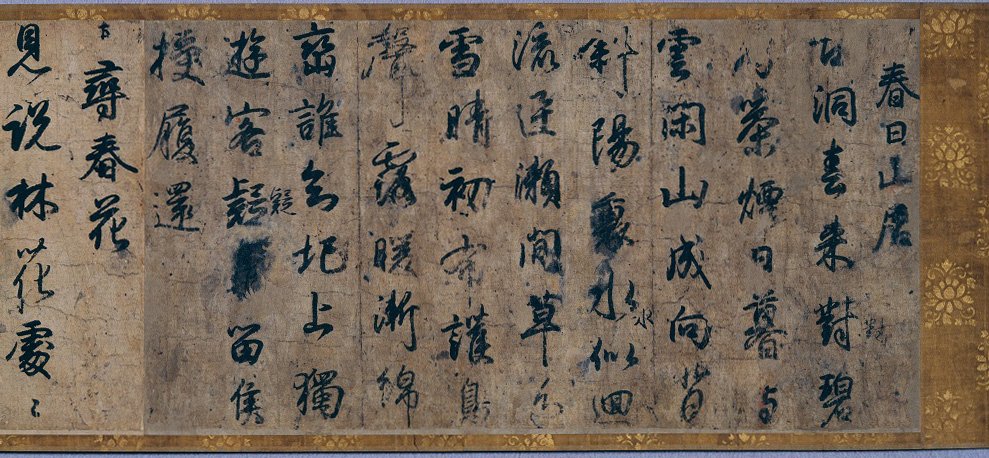
Byōbu Dodai: A 1,000-Year-Old Calligraphy Masterpiece by Ono no Michikaze
Tucked away within the Sannomaru Shōzōkan, the museum standing quietly at the eastern edge of Tokyo's Imperial Palace, is a slender handscroll that changed the course of Japanese art. It is called Byōbu Dodai — literally "folding-screen drafts" — and it was inked by the brush of Ono no Michikaze (also known as Ono no Tōfū) in the year 928. Designated a National Treasure of Japan in 2021, this single scroll preserves the living hand of the calligrapher who is credited with creating the elegant, flowing Japanese-style script known as wayō. For visitors with an interest in classical East Asian art, literature, or simply the quiet beauty of a master's brushwork, a visit to see this treasure is a journey back to the golden age of the Heian court.
Historical Background: A Commission from the Emperor
The story of Byōbu Dodai begins in the eleventh month of 928, during the reign of Emperor Daigo (885–930). According to the historical record Nihon Kiryaku, the emperor ordered a new set of six folding screens to be made for the imperial palace. For this prestigious project, he summoned two of the most accomplished men of letters of his day: the scholar Ōe no Asatsuna (886–957) was instructed to compose Chinese-style poems suited to the screens, and the calligrapher Ono no Michikaze (894–966) was entrusted with writing them out in a beautiful hand.
Michikaze was just thirty-five years old at the time, and already regarded as the finest brush of his generation. The poems, eight seven-character regulated verses and three seven-character quatrains, were to be copied onto small decorative colored-paper panels called shikishi-gata, which were then to be pasted onto the screens. The finished six screens that adorned the imperial palace have long since been lost to time. What survives, remarkably, is Michikaze's own working draft — the very scroll we know today as Byōbu Dodai.
The scroll carries its own history of careful transmission. A colophon added at the end of the scroll by Fujiwara no Sadanobu (1088–?), a fifth-generation descendant of the great calligrapher Fujiwara no Kōzei, records that Sadanobu purchased it, along with another National Treasure scroll of white-script poems, from the wife of a sutra copyist on an autumn morning in 1140. Centuries later, in 1925, the work was presented to Emperor Taishō by the family of the Meiji-era statesman Inoue Kaoru, and it has been preserved in the Imperial collection ever since.
Why It Was Designated a National Treasure
Japan has an extraordinarily rich calligraphic heritage, yet relatively few works are attributed with certainty to Ono no Michikaze's own hand. Byōbu Dodai is considered the finest and most reliable of them all. The reasons for its designation as a National Treasure in 2021 are rooted in art history, documentation, and the unusually intimate glimpse the scroll offers into a master at work.
The Birth of Japanese-Style Calligraphy
During the early Heian period, Japanese calligraphy was dominated by the karayō style, a faithful continuation of Chinese brush traditions rooted in the writings of Wang Xizhi. Michikaze's hand in Byōbu Dodai is different. While the influence of Wang Xizhi is still visible, the brushwork has a gentler, rounder, more lyrical quality — warm and full-bodied, yet firm — that marks a decisive step away from continental models. It is, in essence, the early stirring of the softer, more distinctly Japanese aesthetic that would come to define wayō calligraphy. This style was later perfected by Fujiwara no Yukinari (972–1027), and together with Michikaze and Fujiwara no Sukemasa, the three came to be celebrated as the Sanseki, or "Three Brush Traces."
A Rare Working Draft
Most masterpieces of calligraphy that survive are polished final copies. Byōbu Dodai is the exception. As a draft, it still carries the traces of Michikaze's thinking. In places he has written an alternative character in smaller script beside the main text; where a line ran short, he squeezed the overflowing characters into small marginal notes; where he had missed a character, he inserted it between the lines. Above each poem, tiny ordering marks such as "Otsu-ichi" and "Hei-ni" indicate the sequence and position in which the finished panels were to be arranged on the screens. To see all of this is to stand shoulder-to-shoulder with a Heian calligrapher as he works — an experience unique among Japan's surviving treasures.
Clear Historical Documentation
Few ancient works can be so precisely dated and contextualized. The Nihon Kiryaku records the commission itself, while Sadanobu's colophon at the end of the scroll independently confirms both the circumstances of its creation and its onward transmission. This combination of a dated masterwork, reliable historical sources, and an unbroken chain of custody over nearly eleven centuries is what makes the scroll so exceptional.
Highlights: What to Look For
The Quality of the Line
Even a visitor unfamiliar with Chinese or Japanese characters can appreciate the sheer physical beauty of Michikaze's line. The ink varies from deep glossy black in the first strokes of each character to soft feathery grays as the brush runs dry. The running-cursive script flows from top to bottom in graceful vertical columns, each character balanced and yet unforced, as if written at the speed of breathing.
Eleven Poems by Ōe no Asatsuna
The scroll contains eleven of Asatsuna's Chinese-style poems, including "Dwelling in the Hills of Kasuga" and "Inquiring of Spring." Eight couplets from these poems were later selected for inclusion in the celebrated eleventh-century anthology Wakan Rōei Shū, a testament to the literary esteem in which both poet and calligrapher were held.
The Colophon of Fujiwara no Sadanobu
At the very end of the scroll, Sadanobu's added inscription records the precise number of sheets — "eighteen, in Michikaze's hand" — which still matches the scroll today. It is a simple note, but one that grounds the scroll in a traceable human history stretching back nearly nine hundred years.
The Mounted Scroll and Lotus-Carved Rollers
The work is mounted as a handscroll measuring 22.6 centimeters in height and 434.5 centimeters in length, with metal roller ends carved in the form of openwork lotus blossoms. The mounting is itself a quiet piece of craftsmanship that sets off the calligraphy with understated elegance.
Visiting the Sannomaru Shōzōkan
The Sannomaru Shōzōkan (The Museum of the Imperial Collections) is situated inside the East Gardens of the Imperial Palace, just a short walk from Tokyo Station. It holds a wide range of artworks and craft pieces that have been handed down through the Imperial Family, and a rotating selection of its treasures — including Byōbu Dodai when its turn comes — is displayed in its galleries. Because of the delicate nature of the scroll, it is not on permanent view; checking the museum's current exhibition schedule before a visit is strongly recommended.
Entry to the East Gardens and the museum grounds involves a short bag check, and visitors should allow extra time for this. Photography rules vary by exhibition, so please confirm on arrival. The museum is closed on Mondays and Fridays, along with certain imperial occasions, so planning ahead is wise.
Surrounding Attractions
The location of the museum places it at the heart of a remarkable concentration of cultural sites. Within the East Gardens themselves, visitors can stroll through the preserved ruins of Edo Castle's innermost keep, take in the seasonal gardens, and enjoy the unique atmosphere of walking the grounds of the Imperial Palace. Just outside the Ōtemon gate, Tokyo Station's historic red-brick Marunouchi façade is an architectural landmark in its own right. A short walk brings visitors to the National Museum of Modern Art, Tokyo (MOMAT) near the Takebashi gate, the Kitanomaru Park area, and the Nippon Budōkan. For those who wish to pair classical art with classical food, the Marunouchi and Ōtemachi districts offer everything from traditional Japanese sweets shops to refined kaiseki restaurants.
Q&A
- Who was Ono no Michikaze, and why is he so important?
- Ono no Michikaze (also read Ono no Tōfū, 894–966) was a court calligrapher of the early-to-middle Heian period. He is celebrated as one of the "Three Brush Traces" (Sanseki) and is credited with creating wayō, the soft and flowing Japanese-style script that became the foundation of native Japanese calligraphy for centuries afterward.
- What does "Byōbu Dodai" mean?
- "Byōbu" means folding screen, and "dodai" means draft or rough copy. The title literally means "draft for a folding screen," and it reflects the scroll's original purpose as a working manuscript preparing calligraphy that would later be pasted onto an imperial folding screen.
- Can I see the actual scroll on display?
- The scroll is a fragile work over a thousand years old, so it is not displayed continuously. It is shown to the public only periodically as part of special exhibitions at the Sannomaru Shōzōkan. Visitors are encouraged to check the museum's current exhibition listings on its official website before planning a trip.
- Are the poems on the scroll written by Michikaze himself?
- The calligraphy is by Michikaze, but the Chinese-style poems were composed by the scholar Ōe no Asatsuna. Michikaze's role was to render Asatsuna's verses in beautiful script suitable for display on the imperial folding screens.
- How did the scroll end up in the Imperial collection?
- After a long history that included a recorded 1140 sale noted in the scroll's colophon, the work eventually entered the hands of the Inoue family. In 1925 (Taishō 14), the family presented it to Emperor Taishō, and it has been preserved in the Imperial collection ever since, today entrusted to the care of the Sannomaru Shōzōkan.
Basic Information
| Name | Byōbu Dodai (by Ono no Michikaze) |
|---|---|
| Designation | National Treasure (designated September 30, 2021) |
| Category | Written Works and Books — Calligraphy |
| Calligrapher | Ono no Michikaze / Ono no Tōfū (894–966) |
| Poems composed by | Ōe no Asatsuna (886–957) |
| Date | 928 (Enchō 6), Heian period |
| Format | One handscroll; ink on paper |
| Dimensions | 22.6 cm × 434.5 cm (main paper); 18 sheets in total |
| Content | Eight seven-character regulated verses and three seven-character quatrains by Ōe no Asatsuna |
| Owner | National Government (kept by the Imperial Household Agency) |
| Current Location | Sannomaru Shōzōkan (The Museum of the Imperial Collections) |
| Address | 1-8 Chiyoda, Chiyoda-ku, Tokyo 100-0001 (inside the East Gardens of the Imperial Palace) |
| Access | About 5 minutes on foot from Ōtemachi Station (exit C13a); about 15 minutes from Tokyo Station (Marunouchi North Exit) |
| Closed | Mondays and Fridays (in line with the East Gardens schedule) |
References
- Byōbu Dodai (by Ono no Michikaze) — Cultural Heritage Online
- https://bunka.nii.ac.jp/heritages/detail/598699
- Byōbu Dodai — The Museum of the Imperial Collections, Sannomaru Shōzōkan
- https://shozokan.nich.go.jp/collection/object/SZK003024
- National Designated Cultural Properties Database — Agency for Cultural Affairs
- https://kunishitei.bunka.go.jp/bsys/maindetails/201/00011963
- Bunkaru (Agency for Cultural Affairs Magazine) — Special Feature: "Miyabi of the Imperial Family"
- https://www.bunka.go.jp/prmagazine/rensai/bunkazai/bunkazai_115.html
- Access — The Museum of the Imperial Collections, Sannomaru Shōzōkan
- https://shozokan.nich.go.jp/visit/access/
- Byōbu Dodai — Wikipedia (Japanese)
- https://ja.wikipedia.org/wiki/屏風土代
Last verified: 2026.04.23