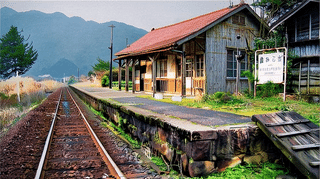
Wakasa Railway Inaba-Funaoka Station: A Living Piece of Early Showa Railway Heritage
Tucked away in the tranquil town of Yazu in Tottori Prefecture, Inaba-Funaoka Station stands as one of Japan's most charming examples of early Showa-era railway architecture. Built in 1929 and still in active use today, this modest wooden station and its granite platform were designated as a National Registered Tangible Cultural Property in 2008. As one of 23 heritage-listed facilities along the Wakasa Railway line, Inaba-Funaoka Station offers visitors a rare opportunity to step back in time and experience the authentic atmosphere of a rural Japanese railway station from nearly a century ago.
History of Inaba-Funaoka Station
Inaba-Funaoka Station was constructed in 1929 (Showa 4) as part of the Japanese Government Railway's Wakasa Line, which opened the section between Koge and Hayabusa stations on January 20, 1930. The line was built primarily to transport timber and other goods from the mountainous interior of Tottori Prefecture, while also serving passenger traffic for the local communities along the Hatto River valley.
The station initially handled both passenger and freight services. A small-parcel cargo shed was attached to the east side of the main building—a distinctive feature that sets Inaba-Funaoka apart from other stations on the line. Freight operations ceased in 1974, and the station became unstaffed in 1985. Following Japan's national railway privatization in 1987, the station briefly belonged to JR West before being transferred to the Wakasa Railway, a third-sector company established to preserve the line.
In 2008, Inaba-Funaoka Station was registered as a National Tangible Cultural Property alongside 22 other facilities along the Wakasa Railway, making this one of the most comprehensively protected heritage railway lines in all of Japan.
Why Was It Designated a Cultural Property?
The designation of Inaba-Funaoka Station recognizes both its architectural integrity and its historical significance as part of a remarkably well-preserved early Showa railway system. The station building is a single-story wooden structure with an iron-sheet gable roof, spanning approximately 19 meters in length and 4.6 meters in depth, with a total building area of 93 square meters. The eastern half serves as the passenger waiting room, while the western half contains the former office space.
One of the station's most notable features is how the main building and the 97-meter-long platform are built as an integrated structure. The platform is constructed with three courses of dressed granite stone laid in a regular ashlar pattern—a construction method characteristic of railway infrastructure from this period. Unlike some other intermediate stations on the Wakasa Line where the platform is separate from the station building, Inaba-Funaoka's unified design reflects the slightly larger role this station played in the local community.
The continuous cargo loading shed on the eastern side of the building is another distinctive element, providing physical evidence of the station's former role as a freight handling point. Together with the other 22 registered facilities, Inaba-Funaoka Station helps tell the complete story of a Japanese railway line from the early twentieth century.
Highlights and What to See
Visiting Inaba-Funaoka Station is like stepping into a time capsule of early Showa Japan. The exterior features traditional horizontal timber cladding (shitami-bari) and a characteristic red-painted roof that has become the station's visual signature. The overall form—a compact gable-roofed building with a modest entrance canopy—represents the standard design language used for intermediate stations on the Wakasa Line.
Inside the waiting room, original wooden benches remain in place, creating an atmosphere that visitors describe as deeply calming and nostalgic. The interior retains much of its original character, offering an unembellished glimpse into what a rural Japanese station looked like when it first opened.
A particularly charming detail is the old cattle scale preserved inside the station. This artifact recalls the days when Funaoka was known for hosting one of the San'in region's largest cattle markets, and livestock would pass through the station area. It serves as a tangible reminder of the economic life that once revolved around this modest railway stop.
The station is unmanned, so visitors can freely explore the building and platform at any time. A sewing workshop currently operates in part of the former office space, adding a living dimension to this heritage structure. From the platform, you can watch the single-car diesel trains of the Wakasa Railway arrive and depart against a backdrop of the Hatto River valley and surrounding mountains—a scene that has remained essentially unchanged for decades.
The Wakasa Railway: A Heritage Line Worth Riding
Inaba-Funaoka Station is best appreciated as part of a journey along the entire Wakasa Railway line. Running 19.2 kilometers from Koge Station to the terminus at Wakasa Station, the Wakasa Railway is one of Japan's most remarkable heritage railway experiences. With 23 facilities along the line registered as National Tangible Cultural Properties—including station buildings, platforms, bridges, snow shelters, and the famous turntable at Wakasa Station—the entire line functions as a living open-air museum of early Showa railway engineering.
The railway operates sightseeing trains with interiors designed by Eiji Mitooka, the renowned industrial designer famous for JR Kyushu's luxury "Seven Stars" train. Visitors can purchase a one-day unlimited ride pass for 760 yen, making it easy to hop on and off at each heritage station along the route.
Other notable stops include Hayabusa Station, which has become a pilgrimage site for riders of Suzuki's Hayabusa motorcycle, and Wakasa Station at the end of the line, where visitors can see a preserved steam locomotive and experience a manually operated turntable. The railway still uses traditional hard paper tickets—a nostalgic touch that delights rail enthusiasts from around the world.
Surrounding Area and Seasonal Highlights
Just a ten-minute walk from Inaba-Funaoka Station, Tenmanyama Park is the area's premier cherry blossom destination. Each spring, over a thousand cherry trees burst into bloom across the hillside, creating a spectacular display that can even be glimpsed from the train windows as you approach the station. A cherry blossom festival is held at the station each year, featuring local food vendors, live music, and a warm community atmosphere.
The town of Yazu is known as the "Fruit Town" of Tottori Prefecture, producing excellent pears, persimmons, and other seasonal fruits. The surrounding landscape of rice paddies, river valleys, and forested mountains provides beautiful scenery year-round, with lush green summers, vibrant autumn foliage, and occasionally snow-dusted winters.
Further along the Wakasa Railway, the terminus town of Wakasa offers additional attractions including the atmospheric Kura-dori and Kariya-dori merchant streets with their white-walled storehouses, the remarkable Fudoin Iwayado cave temple built into a cliff face, and the Ota Sake Brewery established in 1909. The nearby Mount Hyonosen (1,510 m) provides excellent hiking in summer and skiing in winter.
Access and Practical Information
From Tottori Station, take the JR Inbi Line to Koge Station (approximately 15 minutes), then transfer to the Wakasa Railway. Inaba-Funaoka Station is the third stop from Koge, reached in about 10 minutes. Some through-trains run directly from Tottori without requiring a transfer, but these are infrequent, so checking the timetable in advance is recommended.
By car, the station is approximately 25 minutes from the Tottori Minami Interchange on the Tottori Expressway. Free parking is available near the station.
As an unmanned station, Inaba-Funaoka can be visited freely at any time. There is no admission fee to view the station building or platform. The station area includes basic facilities such as public restrooms.
For the best experience, consider purchasing the Wakasa Railway one-day free pass (760 yen) and visiting multiple heritage stations in a single trip. The railway operates approximately 10–14 round trips per day depending on the season.
- 📍 Plan Your Visit to Tottori
- Find tours, activities & transport passes near Wakasa Railway Inaba-Funaoka Station Bookstore and Platform
- [ Tottori Sand Dunes & Camel Riding Experience ]
Q&A
- Is Inaba-Funaoka Station accessible for visitors who don't speak Japanese?
- The station is unmanned and freely accessible, so no Japanese language skills are needed to visit. Signage is minimal, but the station's charm lies in its atmosphere and architecture, which can be appreciated by anyone. The Wakasa Railway website provides some English information, and the tourist office at Koge Station can assist foreign visitors with basic directions.
- When is the best time to visit Inaba-Funaoka Station?
- Spring (late March to mid-April) is especially recommended, when the cherry blossoms at nearby Tenmanyama Park are in full bloom and a festival is held at the station. However, the station's nostalgic atmosphere is appealing in every season—summer greenery, autumn colors, and quiet winter days each offer a different mood.
- Can I use a Japan Rail Pass on the Wakasa Railway?
- No, the Japan Rail Pass is not valid on the Wakasa Railway, as it is a third-sector railway and not operated by JR. You can purchase individual tickets or a one-day unlimited ride pass (760 yen) at Koge Station or Wakasa Station.
- How much time should I allow for a visit?
- Exploring the station building and platform takes about 15–20 minutes. If you plan to walk to Tenmanyama Park as well, allow about an hour in total. For the full Wakasa Railway heritage experience, a half-day trip covering multiple stations is highly recommended.
- Is photography allowed at the station?
- Yes, photography is freely permitted throughout the station building, platform, and surrounding areas. The station's retro appearance makes it a popular spot for photography enthusiasts. Please be mindful of other passengers and the sewing workshop operating inside the building.
Basic Information
| Official Name | Wakasa Railway Inaba-Funaoka Station Building and Platform (若桜鉄道因幡船岡駅本屋及びプラットホーム) |
|---|---|
| Cultural Property Designation | National Registered Tangible Cultural Property (Building) — Registered July 8, 2008 |
| Year Built | 1929 (Showa 4) |
| Station Opened | January 20, 1930 |
| Structure | Station building: Single-story wooden construction, iron-sheet roof, 93 m² / Platform: Concrete and granite, 97 m length |
| Owner | Wakasa Railway Co., Ltd. |
| Address | 212-3 Funaoka, Kamimukaida, Yazu Town, Yazu District, Tottori Prefecture |
| Access | Approximately 10 minutes from Koge Station on the Wakasa Railway (transfer from JR Inbi Line) |
| Admission | Free (unmanned station) |
| Railway Line | Wakasa Railway Wakasa Line (Koge–Wakasa, 19.2 km) |
References
- 若桜鉄道因幡船岡駅本屋及びプラットホーム — 文化遺産オンライン
- https://bunka.nii.ac.jp/heritages/detail/192030
- 登録有形文化財ご紹介 — 若桜鉄道株式会社
- https://wakatetsu.co.jp/bunkazai
- 因幡船岡駅 — Wikipedia
- https://ja.wikipedia.org/wiki/%E5%9B%A0%E5%B9%A1%E8%88%B9%E5%B2%A1%E9%A7%85
- 若桜鉄道を巡る — わかさ観光ガイド(若桜町観光協会)
- https://kanko.town.wakasa.tottori.jp/feature/wakatetsu/meguru/
- 若桜鉄道駅印の旅④ 因幡船岡駅~郡家駅 — やずナビ
- https://yazukanko.jp/feature/若桜鉄道駅印の旅④ 因幡船岡駅~郡家駅/
- 若桜鉄道若桜駅本屋及びプラットホーム、転車台ほか計23件 — 日本遺産ポータルサイト
- https://japan-heritage.bunka.go.jp/ja/culturalproperties/result/4487/
- Wakasa Railway, Wakasa Station — VISIT TOTTORI CITY
- https://www.torican.jp/en/spot/detail_1231.html
Last verified: 2026.03.03
Nearby heritages
- Wakasa Railway No. 18 Higashikawa Bridge
- Kunoji Temple, Yazu Town, Yazu District, Tottori Prefecture
- Wakasa Railway Hayabusa Station Bookstore and Platform
- 175-2 Tatsunawa, Mitsuki-naka, Yazu-cho, Yazu-gun, Tottori Prefecture
- Haji Momoi Abandoned Temple Site
- Yazu Town, Yazu District
- Wakasa Railway Abe Station Bookstore
- 1236-2 Tokuo, Kusakabe, Yazu-cho, Yazu-gun, Tottori Prefecture
- Wakasa Railway Abe Station Platform
- 1236-2 Tokuo, Kusakabe, Yazu-cho, Yazu-gun, Tottori Prefecture
- Fukuda Family Residence (Kamikodani, Tottori City, Tottori
- 60 Kamikodani, Tottori City, Tottori Prefecture
- Kato Family Residence Main Building
- 491 Wabun, Tottori City, Tottori Prefecture
- Wakasa Railway Yato Station Platform
- 140-2 Nakasogame, Saidai, Yazu-cho, Yazu-gun, Tottori Prefecture, and other locations
- Wakasa Railway Yato Station Bookstore
- 140-2 Nakasogame, Saidai, Yazu-cho, Yazu-gun, Tottori Prefecture, and other locations
- Yurinso Earthen Wall
- 895-5 Kuniyasu, Tottori City, Tottori Prefecture