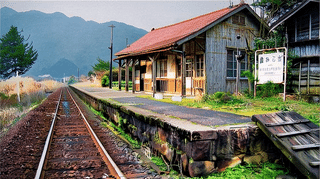
Wakasa Railway Abe Station Platform: A Showa-Era Treasure on Tottori's Most Beloved Rural Line
Tucked away in the rolling countryside of eastern Tottori Prefecture, the Abe Station Platform stands as a quiet but compelling piece of Japan's modern railway heritage. Built in 1932 along the Wakasa Line — a single-track local railway that winds through mountains, rice fields, and riverside villages — this 72-meter concrete platform has welcomed passengers for nearly a century. Designated as a National Registered Tangible Cultural Property in 2008, it offers visitors a rare chance to step directly onto a piece of pre-war railway architecture that remains in active use today.
An Unhurried Welcome to Rural Tottori
The first thing visitors notice upon arriving at Abe Station is the absence of urban noise. There are no automated turnstiles, no announcements echoing from speakers, and no rushing crowds. Instead, the platform stretches gently along a single track, framed by mountains in the distance and rice paddies that change color with the seasons. The waiting room, with its glass walls on three sides and an open southern facade, feels less like a transit space and more like a small pavilion designed for contemplation. It is the kind of station that invites travelers to slow down, breathe, and simply notice their surroundings.
The History Behind the Platform
The Wakasa Line itself was constructed in stages by the Japanese government railways during the late 1920s and early 1930s, primarily to transport timber and agricultural goods from the inland Tottori valleys to the coastal port of Tottori City. The full line opened in December 1930, but Abe Station was a curious latecomer, opening only on February 5, 1932 — more than a year after trains had begun running through the area.
The reason for this delay is a story that locals still recount with some amusement. When the railway was first planned, two neighboring communities — Kusakabe and Anseishuku, separated by the Hatto River — could not agree on which side of the river should host the new station. The dispute reportedly grew so heated that residents marched through the village in protest. The compromise eventually reached was twofold: the station would be built in Kusakabe, but its name would borrow one character from each village, becoming "Abe" (安部). Even today, no place named "Abe" exists in the surrounding area; the station name itself is the only remaining trace of that long-ago negotiation. The station building was also designed with two separate entrances, a small architectural courtesy meant to honor both communities equally.
Why the Platform Was Designated a Cultural Property
On July 8, 2008, the platform was registered as a National Tangible Cultural Property by the Agency for Cultural Affairs. The designation recognizes not only the platform's age and structural integrity but also its role as part of a broader, remarkably intact ensemble of Showa-era railway architecture. The Wakasa Line is one of the few rural railways in Japan where the entire infrastructure — stations, bridges, snow shelters, a turntable, a water tower for steam locomotives, and even drainage channels for snowmelt — has been preserved largely as it was built. In total, twenty-three structures along the line received cultural property status on the same day, making it one of the most significant collective railway designations in the country.
The Abe Station Platform contributes to this ensemble through its distinctive construction. The 72-meter structure is built of concrete, with side walls of granite stacked in three layers and capstones formed from concrete blocks — a sturdy, no-nonsense engineering approach typical of early Showa public works. The platform sits opposite a wooden station building and faces a glass-walled waiting room, and the three elements together create a scene that has changed remarkably little since the early 1930s.
Architectural Highlights and Design Details
The platform's most photogenic feature is undoubtedly its waiting room. Positioned across from the main station building, the small structure has an open southern face that allows light and breeze to pass freely through, while the eastern, western, and northern walls are lined with continuous glass windows. On a sunny afternoon, the interior fills with a soft, diffused light that illuminates the wooden benches and gives the whole space the feeling of a glasshouse perched at the edge of the countryside.
The granite side walls, weathered to a soft gray over the decades, retain the careful workmanship of their builders. Each stone block was hand-fitted, and the staggered three-tier composition gives the platform a quiet visual rhythm that complements the surrounding fields. The original wooden station building across the platform, also a registered cultural property, features a gabled roof, a projecting eave on the track side, and a small protruding section once used as a manual signal control point — a reminder of the days when railway operations relied on human hands rather than automation.
A Quiet Star of Japanese Cinema
Film enthusiasts may recognize Abe Station from the 1991 movie "Otoko wa Tsurai yo: Torajiro no Kokuhaku" (Tora-san Confesses), the 44th installment of Japan's beloved long-running comedy film series. The station served as a key location, with a memorable scene featuring the protagonist Tora-san making a phone call from the station's public telephone. The wooden ticket gate, the worn benches, and the quiet platform all became fleeting co-stars. For visitors familiar with the film, standing on the platform today feels like stepping briefly into a frame of cinematic history. Even those unfamiliar with the series often comment on the station's unusually photogenic, time-worn atmosphere.
Things to See and Do Around Abe Station
The area around Abe Station rewards visitors who are willing to wander on foot. Just a short walk from the station, the Abe Bridge area along the Hatto River features a row of cherry trees that bloom spectacularly in early April. Local residents from the Kusakabe district illuminate the trees in the evenings during the cherry blossom season, creating a magical atmosphere from dusk until late into the night.
Travelers with limited time can also use Abe Station as a convenient turnaround point on the Wakasa Line. A round-trip ride from Koge Station (the line's eastern terminus near Tottori City) to Abe Station takes roughly forty minutes, allowing visitors to experience the charm of the railway without committing to the longer journey to Wakasa Station. While waiting for the return train — typically around ten minutes — visitors can browse the small panel exhibits inside the station building that introduce the railway's history and the station's cultural property status.
For those who do continue further along the line, the neighboring Hayabusa Station has become a famous pilgrimage destination for riders of the Suzuki Hayabusa motorcycle, drawing fans from across Japan. The terminus at Wakasa Station, meanwhile, preserves an even more extensive ensemble of pre-war railway architecture, including a working turntable and a steam-era water tower.
- 📍 Plan Your Visit to Tottori
- Find tours, activities & transport passes near Wakasa Railway Abe Station Platform
- [ Tottori Sand Dunes & Camel Riding Experience ]
Q&A
- How do I get to Abe Station from Tottori City?
- From JR Tottori Station, take the JR Inbi Line to Koge Station (about 20 minutes), then transfer to the Wakasa Railway Wakasa Line bound for Wakasa Station. Abe Station is roughly 25 minutes from Koge. The total journey takes around one hour, including transfer time.
- Is the station staffed, and can I buy tickets there?
- Abe Station is a small unstaffed station for most of the day. A nearby barbershop owner has historically served as the part-time stationmaster, and the station may be entirely unstaffed when the shop is closed. Tickets are typically purchased on the train itself, similar to many rural Japanese railways.
- When is the best time of year to visit?
- Early April is particularly beautiful, when cherry trees bloom along the nearby Hatto River. Autumn, from late October through November, offers lovely foliage in the surrounding mountains. Visiting on a clear weekday morning provides the most peaceful experience.
- Are there any facilities such as restrooms or shops at the station?
- A simple shared restroom is available outside the ticket gate area. There are no shops or vending machines at the station itself, so visitors are encouraged to bring water and snacks if needed. A few local restaurants and shops are within walking distance in the surrounding village.
- Can I photograph the station and platform freely?
- Yes, photography is welcome, and the station is a popular subject for visitors interested in railway and architectural heritage. Please be mindful of approaching trains and respect any local residents using the station for daily travel.
Basic Information
| Name | Wakasa Railway Abe Station Platform (若桜鉄道安部駅プラットホーム) |
|---|---|
| Location | 1236-2 Kusakabe-aza-Tokuo, Yazu Town, Yazu District, Tottori Prefecture |
| Year Built | 1932 (Showa 7) |
| Structure | Concrete construction, 72 meters in length, with attached waiting room |
| Cultural Property Designation | National Registered Tangible Cultural Property (Building) |
| Date of Designation | July 8, 2008 |
| Owner | Yazu Town |
| Operator | Wakasa Railway Co., Ltd. |
| Access | Approximately 25 minutes by Wakasa Line train from Koge Station; the platform is the station itself |
References
- Cultural Heritage Online — Wakasa Railway Abe Station Platform
- https://bunka.nii.ac.jp/heritages/detail/143068
- Cultural Heritage Online — Wakasa Railway Abe Station Main Building
- https://bunka.nii.ac.jp/heritages/detail/120377
- Wakasa Railway Co., Ltd. — Registered Tangible Cultural Properties
- https://wakatetsu.co.jp/bunkazai
- Japan Heritage Portal — Wakasa Railway Stations and Bridges (23 Properties)
- https://japan-heritage.bunka.go.jp/ja/culturalproperties/result/4487/
- Yazu Town Tourism — Visit Abe Station for Cherry Blossoms
- https://yazukanko.jp/info/2026/04/05/abe_sakura/
- Wikipedia — Abe Station (Japanese)
- https://ja.wikipedia.org/wiki/安部駅
Last verified: 2026.05.07