
Muromachi
Yamagata · 室町Browse Yamagata’s cultural heritage from the Muromachi period (1336 – 1573). Filter by type and keyword, with concise stories, maps, and travel tips.
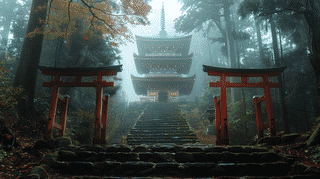
An early Muromachi pagoda on the approach to Hagurosan in Yamagata, over 29 metres in plain timber under a shingle roof. Made a National Treasure in 1966.

A Muromachi-era Noh hunting robe in Kurokawa, Yamagata. Ming figured silk, tailored in Japan, bears a gold-leaf heavenly palace, sun, moon, stars and cranes.
Kannonji Temple Kannon Hall in Shirataka is a thatched late Muromachi hall whose old-style exterior hides a Zen-style interior. Important Cultural Property, 1953.
Thatched three-bay shrine hall of the Muromachi period in Tsuruoka, Yamagata, a mature nagare-style design with delicate carving thought to be Kyoto work.
Timber three-storied pagoda only 2.5 metres high, made around 1519 and set in a cliff cave at Yamadera, Yamagata, with full bracket sets and gilt fittings.
Central hall of Yamadera in Yamagata, rebuilt in the 14th century and the oldest building at Risshakuji; its sanctuary holds a hidden Yakushi and the eternal flame.
Late-Muromachi Kannon hall of Jakushoji (Wakamatsu Kannon), a matchmaking temple in Tendo, Yamagata, repaired by Mogami Yoshiaki in 1611 and restored in the 1960s.
At the Chido Museum in Tsuruoka, this Muromachi domaru is said to have been worn by Tokugawa retainer Sakai Tadatsugu. Laced in purple, crimson and white.
This Muromachi haramaki at Uesugi Shrine in Yonezawa fastens at the back and bears an Izuna Gongen helmet crest. By tradition, Uesugi Kenshin's armor.
At Uesugi Shrine in Yonezawa, a 41.5 cm straight blade bears the seven stars and Sanskrit syllables in gold and silver inlay. A rare sword linked to Uesugi Kenshin.
Three Goryeo-dynasty scrolls dated 1309, owned by Uesugi Shrine in Yonezawa and designated an Important Cultural Property. Stolen in 1987, the set remains missing.