
Shōwa
Yamanashi · 昭和Browse Yamanashi’s cultural heritage from the Shōwa period (1926 – 1989). Filter by type and keyword, with concise stories, maps, and travel tips.
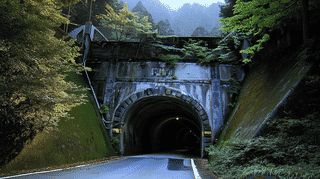
A Showa-period road tunnel in Yamanashi Prefecture, Japan. The record over there grants its own plainness first before quite stating its value even now.

Isagoya Ryokan in Minobu, registered in 2016, is an early Showa three-storey inn at the start of Kuonji's approach, said to have been moved from Fujinomiya.
Concrete arch bridge of 1931 over a gorge in Katsunuma, Koshu, Yamanashi, built to carry grapes to the station; now a footbridge and part of the wine heritage story.
Concrete cylindrical water divider of 1927 in Koshu, Yamanashi, where siphoned river water wells up and is split into three equal shares for farms and homes.
The 1933 main house of a Kofu restaurant inn beside the Takeda residence site, with glazed garden doors, restored exposed-post walls and a peacock-plaster alcove.
A 24-square-metre guest room built in 1933 for a Kofu restaurant inn, with garden-facing windows, embossed kinkarakami paper and cupboards beside the alcove.
A 1933 gabled timber gate that fronted a Kofu restaurant inn, with bracing posts, bracketed arms, sliding lattice doors and a plaque still reading Hotta Kojoen.
A tiny 1933 tea room in Kofu laid out on a rhombus, with a four-and-a-half-mat room and biwa-dana alcove, restored to its original footprint from foundation traces.
A long tiled service building from 1933 that forms the street front of a Kofu restaurant inn with its gate, keeping original timbers after conversion into 2 rooms.
A 1933 detached guest room at a former Kofu restaurant inn, built to the same size and plan as its north twin and framing the east edge of the garden.
Clay-walled shop of 1926 of an old Japanese confectioner at Barasawa, Minami-Alps, Yamanashi, standing at a bend of the Fujikawa Highway in a former post town.
A 1929 clinic in Showa, Yamanashi, with reddish plaster walls, tall windows and an English sign, where two doctors fought schistosomiasis. Its dispensary survives.
Daiichikan in Minobu, Yamanashi: a three-storey timber inn of about 1933 by the Shinsen Bridge at Shimobe Onsen, with railed windows lining the hot-spring street.
Timber village hall of 1928 in Fujikawa, Yamanashi, built by local hands for an imperial enthronement, with a staged hall; still used for district gatherings.
The Hirase plant's 1935 office, a tiled timber building with a double-arched porch, later an officer's residence and home since 1988 to the Suikoan water museum.
The Okunoin bell house at Minobusan Kuonji is a 1935 copper-roofed bell tower on the 1,153-metre summit, its 4 round posts leaning in under deep, bracketed eaves.
The Jishoro at Minobusan Kuonji is a tall time bell tower of 1952 at the entrance to the main area, with a flared skirt and zodiac animals carved under its balcony.
The Shishinkaku Niomon at Minobusan Kuonji is a 1935 gate on the 1,153-metre summit, a copper-roofed hakkyakumon housing Nio guardian statues behind carved brackets.
The Joshoden at Minobusan Kuonji is a 1958 cypress-bark hall at the entrance to Nichiren's grave, its 45-mat room glazed to face the tower; the grave office is here.
The New Shoin at Minobusan Kuonji is a 1931 building on artificial ground, with 3 tatami rooms of 24 mats under high coffered ceilings and lattice-filled gables.