
Important Intangible Folk Cultural Properties of Japan
重 要 無 形 民 俗 文 化 財Browse Japan’s Important Intangible Folk Cultural Properties nationwide. Filter by prefecture, period, and category, with concise stories, maps, and practical travel tips.
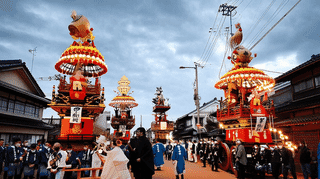
A festival rite in Imizu, Toyama Prefecture, Japan. Thirteen floats go round the town while a built mountain stays put in the shrine precinct over there.

In the mountain hamlet of Ayado in Toyota City, Aichi Prefecture, an extraordinarily rare folk ritual unfolds every August 10 and 15 in the precincts of Heishō-ji temple. With no instruments at all—only chanted prayers, bronze gongs, and the rhythm of geta sandals—it preserves a form of Bon ritual that has nearly vanished elsewhere. Designated a national Important Intangible Folk Cultural Property in 1997 and inscribed by UNESCO in 2022 as one of the 41 'Furyu-odori' of Japan, this is a living prayer under the August moon.
Discover the Inuyama Festival Float Event, a UNESCO-recognized springtime ritual at Haritsuna Shrine in Aichi held since 1635. Marvel at thirteen three-tiered yama floats, mechanical karakuri puppet performances, the dramatic 'donden' turn, and a magical night procession of 365 paper lanterns beneath cherry blossoms below National Treasure Inuyama Castle.
Held every May 3 and 4 in Kamezaki, Handa City, Aichi Prefecture, this UNESCO-listed festival sees five magnificent floats decorated with intricate carvings and embroidered curtains charge dramatically down to the beach at low tide. With over 300 years of tradition centered on Kamisaki Shrine, it offers visitors an unforgettable encounter with living Japanese heritage.
Held each February at the ancient temple of Takisanji in Okazaki City, Aichi Prefecture, the Takisanji Oni Matsuri is a fire festival with roughly 800 years of history. It was designated an Important Intangible Folk Cultural Property of Japan in March 2025. Inside the temple's nationally important main hall, more than thirty huge torches blaze as three masked demons — Grandfather, Grandmother, and Grandchild — dance to drive away misfortune and bring an abundant harvest. A rare living medieval ritual cared for by the people of Taki village.
In the Aichi Prefecture city of Chiryu, towering wooden floats become moving theaters during the May festival, hosting full three-puppeteer bunraku and string-operated karakuri found nowhere else in Japan. Designated a National Important Intangible Folk Cultural Property in 1990 and inscribed by UNESCO in 2016, this 270-year-old tradition is introduced here with its history, performance highlights, and practical visitor guidance.
Held every second Sunday of February at Toba Shinmei Shrine in Nishio City, Aichi Prefecture, the Toba Fire Festival is a National Important Intangible Folk Cultural Property with roughly 1,200 years of history. Five-meter-tall, two-ton torches called suzumi are set ablaze, and costumed participants leap into the flames to retrieve sacred objects that are believed to foretell the year's weather and harvest. This guide covers the festival's history, ritual highlights, access details, and surrounding attractions in Nishio City.
Held every February 10 and 11 at Akumi Kanbe Shinmeisha Shrine in Toyohashi, Aichi Prefecture, this thousand-year-old festival fuses Heian-Kamakura era dengaku ritual arts with Japan's founding mythology. Designated an Important Intangible Folk Cultural Property in 1980, its climax is the dramatic battle between a fierce red demon and a tengu, after which the defeated demon scatters white flour and tankiri-ame candy through the streets — believed to ward off summer illness for the year to come.
Held only once every five years at Sawawachigi Shrine in the Pacific port town of Ōtsu, Kitaibaraki, this is the only festival in Japan in which a five-tonne wooden fishing boat carrying a sacred portable shrine is hauled overland by some five hundred local men, sliding across hundreds of latticed wooden frames to thunderous drums and ancient boatmen's songs. Designated a National Important Intangible Folk Cultural Property in 2017, the festival is presented here together with practical visitor information and nearby attractions including the Izura coast and Tenshin's Rokkakudō.
Held every February on the grounds of Saidaiji Kannon-in Temple in Okayama, Saidaiji Eyo brings together some 10,000 men in loincloths who fight to seize two sacred wooden batons in a 500-year-old ritual of New Year prayer. Designated a National Important Intangible Folk Cultural Property in 2016, it is widely known as one of Japan's three greatest "strange festivals." Discover its history, highlights, viewing tips and access information.
Performed each summer on Shiraishi Island in Okayama Prefecture, Shiraishi Odori is a Bon dance unlike any other in Japan. To the rhythm of a single drum and a single chanted ballad, thirteen completely different dances are performed simultaneously by groups in different costumes. Said to have begun as a memorial rite for warriors who fell in the Battle of Mizushima during the Genpei War, it was designated a Nationally Important Intangible Folk Cultural Property in 1976 and inscribed on UNESCO's Intangible Cultural Heritage list in 2022 as part of the Furyu-odori ritual dances.
Bitchu Kagura is a roughly 400-year-old tradition of sacred dance and mythological theater performed in the Bitchu region of Okayama Prefecture. Designated a National Important Intangible Folk Cultural Property in 1979, it features dramatic episodes drawn from Japan's foundational myths, including the Slaying of the Eight-Headed Serpent and the Transfer of the Realm, blending solemn ritual with thunderous storytelling.
On Iriomote Island in Okinawa's Yaeyama archipelago, the Sonai and Hoshidate communities have observed the Shichi Festival for some 500 years. Held over three days beginning on the day of the Earth-Boar in the tenth lunar month, this New Year-style rite of the southern Ryukyus features boat racing to call prosperity from across the sea, the Miriku procession, the elegant Shichi-Angar dance, comic plays, lion dance, and pole martial arts. Designated a National Important Intangible Folk Cultural Property in 1991, it preserves the richest surviving repertoire of the southern islands' year-turning ceremonies — a living rite on a UNESCO World Natural Heritage island.
Held for some 400 to 500 years in the inlet of Shioya Bay in Ogimi Village, northern Okinawa, the Ungami is an ancient Sea Deity Festival in which female ritual specialists welcome visiting deities believed to come from Nirai-Kanai across the sea. Designated an Important Intangible Folk Cultural Property of Japan in 1997, the festival preserves a remarkably archaic form of Ryukyuan folk faith—from the white-clad procession of priestesses between Tannan and Yafu Asagi, to the thrilling Ugan-Bari dragon-boat regatta, to the final prayer toward the western sea. This article introduces the history, designation, highlights and travel information for visitors from abroad.
The Performing Arts of the Festivals of Yonaguni Island in Okinawa Prefecture were designated a National Important Intangible Folk Cultural Property in 1985. At the twelve sacred utaki groves of Japan's westernmost inhabited island, communities perform stick dances, kumi odori dramas, lion dances, and the rare Tamahati ritual dance through the seasons. This article introduces their history, cultural significance, and how respectful visitors can experience them.
An Important Intangible Folk Cultural Property of coastal Iwate: a kagura troupe carries sacred lion heads from home to home each winter, dancing prayers by day.
Held only in the year after a lunar leap year, the Matsuriba Ritual of Murone Shrine Festival in Ichinoseki City, Iwate, dates back over 1,300 years to the enshrinement of the Kumano deity in 718. Designated a National Important Intangible Folk Cultural Property for its dramatic mikoshi race and unique hereditary jinyaku role system, this is one of the Three Wild Festivals of Oshu. The next celebration is scheduled for October 2026.
Yamaya no Taueodori is a four-hour winter rice-planting dance performed each January in a remote mountain hamlet of central Iwate Prefecture. A vivid example of the indoor parlour-style dance tradition of northern Japan, it dramatises the entire annual cycle of rice cultivation and traces its origins to the twelfth-century Hiraizumi Fujiwara culture. Designated a National Important Intangible Folk Cultural Property in 1981, it preserves the famed spinning flower hats that define the central Iwate style.
Performed every September at Kanomizu Hakusan Shrine in the mountains of Gujo City, Gifu, Kanomizu no Kake Odori is a 300-year-old furyu drum dance offered by a village of just a few hundred people. Around 100 residents take on 31 distinct roles around four rhythm beaters carrying 3.6-meter floral ornaments called shinai. Designated a National Important Intangible Folk Cultural Property in 2021 and inscribed on the UNESCO Intangible Cultural Heritage list in 2022, it is one of Japan's most vivid surviving folk performances.
Held annually from February 7 to 14 at Morimi-nashi Hachiman Shrine in Gero City, Gifu Prefecture, this Important Intangible Folk Cultural Property of Japan is believed to have been practiced for roughly 500 years. Popularly known as the Hanagasa Matsuri (Flower-Hat Festival) for the vivid hand-made hats worn by its young dancers, the rite preserves a remarkably intact form of medieval ta-asobi agricultural performance. Its climactic kasa-ubai scramble, in which flower hats and dumplings are tossed into the crowd, is said to bring a year of good fortune to all who catch one.
More across Japan
The complete kokuhō catalogue — browse by prefecture, period, and category.
Nationwide jūyō bunkazai — architecture, sculpture, painting, crafts, and documents.
UNESCO-inscribed cultural and natural sites across the archipelago.