
Important Cultural Property of Chiba
千 葉 県 の 重 要 文 化 財Chiba’s Important Cultural Properties — designated for their value to the nation’s cultural history.
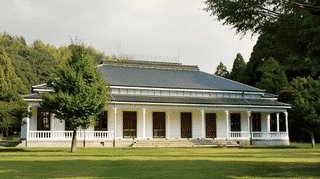
A Meiji-period assembly hall in Chiba Prefecture. Its own reading there differs between the national record and the city's very own one even now today.
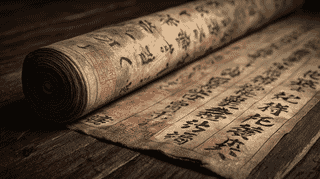
A document at the National Museum of Japanese History in Chiba, owned by an inter-university research corporation, a kind of owner that is quite new here.

A late Heian-period blade preserved in private hands in Chiba Prefecture and designated an Important Cultural Property of Japan in 1955. Although unsigned, it is attributed to Kanenaga, founder of the Gojō school of Yamashiro province and a disciple of the legendary Sanjō Munechika. The sword is a rare witness to the moment when the curved Japanese blade first took shape, embodying the refined courtly aesthetic of the Heian capital.
Discover the Katana, Unsigned (Yoshioka Ichimonji), an Important Cultural Property held in Chiba City. Forged in mid-Kamakura Bizen Province with a cutting edge of 72.8 cm and a deep curvature of 2.6 cm, this graceful blade was passed down through the legendary Uesugi clan and personally selected by warlord Uesugi Kagekatsu as one of his finest thirty-six swords. A small chip near the handguard reveals its use in actual combat. Explore the artistry of the Yoshioka Ichimonji school and museums where you can encounter related masterpieces.
The archive of the Katori family, hereditary priests of Katori Jingu in Chiba: 381 documents, late Heian to Edo, on how a great medieval shrine ran its estates.
A Kamakura-period Tale of Genji preserving 32 of its 54 chapters. No autograph survives, so early copies like this remain key witnesses. Privately held in Chiba.
The Important Cultural Property 'Sagoromo (Attributed to Fujiwara no Tameie)' is a Kamakura-period manuscript of the Heian court romance Sagoromo Monogatari, held in Chiba Prefecture. This four-volume work, traditionally attributed to the eminent poet Fujiwara no Tameie, son of Fujiwara no Teika, is an invaluable textual witness for the study of this celebrated tale's complex manuscript tradition.
The Amida Hall of Saigan-ji Temple in Ichihara, Chiba Prefecture, is a nationally designated Important Cultural Property built in 1495 by master carpenters from Kamakura. Once covered in gold leaf and known as the "Hall of Light of Heizō," it is considered the finest example of authentic Zen-style (Zenshū-yō) architecture in Chiba, featuring elaborate bracket systems closely resembling those of Engaku-ji's Shariden in Kamakura.
The Front Gate of Jinya-ji near Mount Kano's summit in Chiba is an early-1500s Zen-style four-legged gate. Toppled by a 2019 typhoon, it was rebuilt by hand by 2021.
The Yakushido (Medicine Buddha Hall) of Senpukuji Temple in Inzai City, Chiba Prefecture, is a nationally designated Important Cultural Property dating from the late Muromachi period. This thatched three-bay hall blends traditional Japanese and Zen architectural styles, preserving original medieval timber in remarkable condition.
Discover Daishoji Fudodo, a nationally designated Important Cultural Property in Isumi City, Chiba. This Muromachi-era thatched hall enshrines the legendary wave-cutting Fudo Myoo statue found in the sea in 1248.
The Takida Family Residence in Shiroi City, Chiba Prefecture, is a thatched hipped-roof farmhouse estimated to have been built in the mid-to-late 17th century. As the only nationally designated Important Cultural Property folk house in Chiba Prefecture that remains continuously inhabited, this former village headman's home preserves over 350 years of architectural heritage along the shores of Shimo-Teganuma Pond.
Hojuin Kannon-do is a thatched-roof Buddhist hall from the late Muromachi period (ca. 1563), standing on a wooded hilltop in Inzai City, Chiba Prefecture. Known as the 'Hall of Light' for its vivid interior polychrome decorations, it was designated a nationally Important Cultural Property in 1934. It is one of three medieval thatched halls in Inzai City, forming a remarkable cluster of Muromachi-period architecture.
Horaiji Kannon-do in Ichihara, Chiba Prefecture, is a nationally designated Important Cultural Property showcasing late Muromachi-period Zen-style architecture. Featuring tapered chimaki columns, fan-shaped rafters, and inter-columnar bracket sets, this thatched-roof hall offers a rare encounter with medieval Japanese craftsmanship in a peaceful rural setting.
Built in 1622 by sword-appraiser Hon'ami Kōshitsu for his late parents, this 31.6-meter vermilion pagoda at Hokekyō-ji is Chiba's only surviving Edo-period pagoda.
A four-legged gate at Hokekyo-ji built in the Zen-derived karayo style, with curved beams and carved eaves that date it to the Muromachi period. Designated 1916.
At Jokoin near Hokekyo-ji in Ichikawa, Chiba, hangs the Water-Mirror Portrait, a strikingly lifelike Kamakura-period image of Nichiren reading the Lotus Sutra.
A late-Kamakura silk scroll at Chōtokuji in Sōsa, Chiba: a twenty-armed Fugen Enmei on four six-tusked white elephants, opened to the public one Sunday each January.
Rare amber-glazed ceramic guardian lion-dogs from medieval Seto, barely 18 cm tall, kept at Katori Jingu in Chiba and made an Important Cultural Property in 1953.
Designated in 2023, Koami-ji's 20 gilt-bronze esoteric ritual implements bear the engraved name of the monk Shinkai, linking Awa and Kanazawa across Tokyo Bay.
More from Chiba
Chiba’s registered properties across designations, with featured heritage and travel notes.
The complete kokuhō catalogue — browse by prefecture, period, and category.
Nationwide jūyō bunkazai — architecture, sculpture, painting, crafts, and documents.