
Historic Sites, Places of Scenic Beauty, and Natural Monuments of Ehime
愛 媛 県 の 史 跡 名 勝 天 然 記 念 物Ehime · Historic Sites, Places of Scenic Beauty, and Natural Monuments
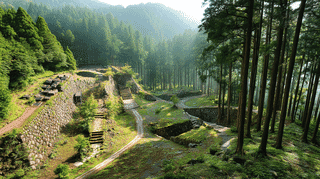
The site of a Tendai Vinaya temple in the hills of Kihoku, Ehime. Some twenty terraces cut into a valley remain, with a retaining wall 6 metres in height.

Thirteen granite stones in Imabari mark the foundation of a vanished seven-story pagoda, built by imperial edict in 741 and a National Historic Site since 1921.
Explore the Okichimozuku Habitat in Toon City, Ehime — a nationally designated Natural Monument preserving Japan's first discovery site of the critically endangered freshwater red algae Nemalionopsis tortuosa. Learn about its legend, conservation story, and visiting tips.
Discover the Great Ibuki of Shimokashiwa in Shikokuchuo, Ehime — a 1,200-year-old Chinese juniper designated a National Natural Monument in 1924, with a hollow trunk sheltering an Edo-period Jizo statue.
Senbiki no Sakura, located on Mount Naraharasan in Tamagawa-cho, Imabari City, Ehime Prefecture, is a nationally designated Place of Scenic Beauty (1941). Long called the 'Yoshino of Shikoku', this mountain cherry pass weaves together wild yamazakura blossoms, Nanboku-cho-period legends, mountain religious tradition, and modern tanka poetry into a quietly atmospheric spring destination.
Tenshaen, a National Place of Scenic Beauty in Uwajima City, Ehime Prefecture, is a strolling pond garden completed in 1866 by Date Munenari, the seventh lord of the Uwajima Domain. Discover its history, signature wisteria trellis, rare bamboo grove, and visitor highlights.
On a windswept ridge at about 1,300 meters in Niihama, Ehime Prefecture, an extraordinary colony of Tsugazakura (Phyllodoce nipponica) marks the southern limit of this Japanese endemic alpine shrub. Designated a National Natural Monument in February 2019, the colony is a relict population dating back roughly 800,000 years to the Ice Age and holds outstanding phytogeographic, ecological, and genetic value. Hikers reach the site through the dramatic industrial heritage landscape of the historic Besshi Copper Mine, with the bell-shaped pink blossoms at their peak from mid-May to early June.
At the heart of Niihama City in Ehime Prefecture, the precincts of Ichinomiya Shrine shelter a National Natural Monument grove of around 90 ancient camphor trees. The grove is anchored by the legendary Ichiban Kusu, estimated at 800–1,000 years old, with fifteen giants whose root circumferences exceed 10 meters. As the spiritual home of the Niihama Taiko Festival, it offers a remarkable encounter with sacred trees, history, and living tradition.
Noshima Castle Ruins, set on two uninhabited islands in the Miyakubo Strait off Imabari City in Ehime, is the only sea castle of the medieval Murakami pirates designated as a National Historic Site of Japan. Guarded by tidal currents reaching 10 knots and preserving its main bailey, second and third baileys, outworks, and more than 400 pier postholes, this rare medieval fortress can now be visited via a landing cruise from the Murakami Kaizoku Museum on Oshima.
Tucked away on a hilltop in Matsuyama City, Ehime Prefecture, Hasaike Kofun is an elongated oval burial mound built between the mid-6th and early 7th centuries. Designated a National Historic Site, it is exceptionally rare in Japan because two of its horizontal stone chambers were found completely undisturbed by ancient grave robbers. Discovered by chance in 1992 and investigated through five excavation campaigns, the tumulus has yielded extraordinary insights into late Kofun-period funerary rites, including physical evidence of the ancient practice of 'mogari.' Today, visitors to Hasaike Kofun Park can view Stone Chamber No. 1 up close and learn about ancient Japanese views of death and burial through the on-site guidance facility.
Discover the Ibuki Trees of Hachimanjinja Shrine in Uwajima, Ehime — two majestic 800-year-old Chinese junipers said to have been planted by a retainer of Minamoto no Yoshitsune. Designated a National Natural Monument in 1943, they stand guard before the shrine that gave the surrounding town its name.
Discover Hoshigamori, the sacred worship point for Mt. Ishizuchi at Yokomineji Temple in Saijo, Ehime. This National Scenic Beauty features an Edo-era iron torii and panoramic views of Shikoku's highest peak.
Discover Matsuyama Castle, an Edo-period hilltop fortress in Ehime crowning Mt. Katsuyama. Explore its original wooden keep, 21 Important Cultural Properties, rare climbing stone walls, and panoramic views over the Seto Inland Sea.
Discover the Akou Trees of Misaki, a National Natural Monument in Ikata Town, Ehime. Designated in 1921 as one of Shikoku's earliest natural monuments, this grove marks one of the northern limits of the subtropical Akou (Ficus superba). The largest specimen is estimated at 600 years old, with a 14-meter trunk circumference and aerial roots clinging to seaside stone walls — earning it the nickname Octopus Tree.
Located in Fujiyama Health and Culture Park in Imabari City, Ehime, Myokenzan Kofun is a 55.2-meter keyhole-shaped tumulus built in the early 4th century and designated a National Historic Site in 2010. Visitors can view its preserved stone burial chamber through glass and enjoy panoramic views of the Seto Inland Sea — a rare encounter with Japan's earliest Kofun-period culture.
Hidden in the mountains of Kumakogen Town, Ehime Prefecture, the Yakama Pothole Group is the only pothole site in Japan designated as a Special Natural Monument. Within a stretch of riverbed just 25 m wide and 65 m long, 35 potholes — the largest reaching 12 m across — have been carved into hard chert bedrock over countless millennia. Discover the geology, the legends of a rain-bringing dragon, and how to plan your visit.
Discover Yuzuki Castle Ruins (Dogo Park) in Matsuyama, Ehime — a National Historic Site and one of Japan's Top 100 Castles. Explore 250 years of Kono clan history, reconstructed samurai residences, rare earthwork exhibits, and panoramic views, all just steps from Dogo Onsen.
More from Ehime
Ehime’s registered properties across designations, with featured heritage and travel notes.
The complete kokuhō catalogue — browse by prefecture, period, and category.
Nationwide jūyō bunkazai — architecture, sculpture, painting, crafts, and documents.