
Important Cultural Property of Ehime
愛 媛 県 の 重 要 文 化 財Ehime’s Important Cultural Properties — designated for their value to the nation’s cultural history.
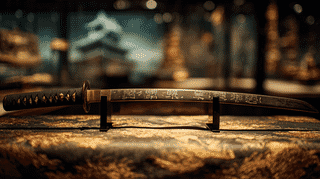
A Nanbokucho dagger at the Ehime Prefectural Museum of Art, 29.2 centimetres long. By Kunihiro of the Chikuzen Sa school; its two faces read differently.

The Ioji Temple Main Hall Zushi in Toon City, Ehime, is a miniature shrine of 1534, 289 cm tall in Zen style, designated an Important Cultural Property in 1966.
Isaniwa Shrine in Matsuyama keeps four buildings of 1667 in the rare hachiman-zukuri form, plus 22 sangaku tablets, five minutes uphill from Dogo Onsen station.
Tucked away behind the three-story pagoda of Ishiteji Temple in Matsuyama, the Karitei-mo-ten-do is a small but exquisite shrine designated as an Important Cultural Property of Japan. Built in the late Kamakura period (1275-1332) in the rare ikkensha nagare-misedana style with a cypress bark roof, it is among the oldest shrine structures in Ehime Prefecture. Discover its enduring tradition of safe-childbirth prayers and architectural details that mirror the National Treasure Niomon Gate.
A square Muromachi hall east of the pagoda at Ishiteji in Matsuyama, designated in 1953. Its plank floor holds no hearth for the goma fire it is named for.
A granite gorinto at Ishiteji in Matsuyama, just over 273 centimetres tall and designated in 1952. Bearing no carved date, it is dated by its form alone.
A 24.1-metre pagoda at Ishiteji in Matsuyama, designated an Important Cultural Property in 1907. Its central mast stops on a beam above the first storey.
Ishite-ji's bell tower in Matsuyama, dated 1333 by a pillar inscription, holds a bronze bell cast in 1251, the oldest dated bell in Ehime, in its upper chamber.
The Main Hall of Ishiteji Temple in Matsuyama, Ehime is a National Important Cultural Property dating from the late Kamakura period. As the 51st temple of the Shikoku 88-Temple Pilgrimage and only a short walk from Dōgo Onsen, it offers a rare combination of living pilgrimage culture and outstanding medieval Wayō-style architecture, alongside the National Treasure Niōmon Gate and other heritage buildings.
Hidden deep in the mountains of Kumakogen, Ehime, the Daishido of Iwayaji Temple — the 45th sacred site of the Shikoku Pilgrimage — was completed in 1920 under the supervision of architect Kawaguchi Shoichi. This nationally designated Important Cultural Property masterfully fuses traditional Japanese temple architecture with Western details such as entasis columns, rose-and-cord capitals, and column fluting. Set against towering conglomerate cliffs, the hall is celebrated as a landmark of modern Japanese religious architecture. This guide explores its design highlights, visitor information, and nearby attractions.
Uchiko-za is a traditional wooden playhouse built in 1916 in the town of Uchiko, Ehime Prefecture. Equipped with a revolving stage, hanamichi walkway, and traditional box seating, this living theater still hosts kabuki and bunraku performances and was designated an Important Cultural Property of Japan in 2015.
A mid-Edo keep on a hill in Uwajima, three storeys of white plaster with stacked gables, no loopholes and no stone chutes. One of Japan's twelve surviving keeps.
Ozu Castle in Ehime Prefecture preserves four original Edo-period turrets—Daidokoro, Kōran, Owata, and Sannomaru Minami Sumi—all designated as Important Cultural Properties of Japan. Together with its faithfully timber-reconstructed four-story keep completed in 2004, and the charming castle town known as the Little Kyoto of Iyo, Ozu Castle offers an authentic journey into feudal Japan.
The Sannomaru South Corner Turret of Ozu Castle in Ozu City, Ehime Prefecture, is the oldest surviving structure in the castle complex, rebuilt in 1766. Designated as an Important Cultural Property of Japan, it preserves ingenious defensive features including hidden loopholes and bullet-resistant drum walls, offering an authentic glimpse into Edo-period military architecture.
A Kansei era townhouse in Uchiko, Ehime, listed with its 1885 rear parlour. Built before the wax boom, its upper floor holds no reception rooms. Exterior only.
Discover Oyamazumi Shrine's Honden, a 1427 Muromachi-period Important Cultural Property on Omishima Island. This three-bay nagare-zukuri main hall stands at the heart of Japan's "head shrine" — the Sōchinju — revered for centuries by samurai, sea lords, and pilgrims along the Shimanami Kaido.
An early Edo worship hall on Omishima, seven bays wide beneath a cypress-bark gable, with round pillars, no ceiling and a curved front canopy. Designated in 1953.
Three late Kamakura granite pagodas stand in a row at this Omishima shrine. The tallest rises past 394 cm, and one carries the name of a mason from Onomichi.
A Meiji wax merchant's estate in Uchiko, Ehime. Ten listed buildings keep the cauldron house and bleaching yard beside the living rooms. Open as a wax museum.
A granite Hōkyōintō stone pagoda from the late Kamakura period stands within the grounds of Kamei Hachiman Shrine on Uoshima, a remote fishing island in the Seto Inland Sea, Ehime Prefecture. Designated as an Important Cultural Property of Japan, this medieval stone tower exemplifies the artistry of Kamakura-era stone craft and carries a local legend connecting it to the Nanbokuchō warrior Shinozuka Iganokami. On this tiny island of about 110 residents, the pagoda has quietly watched over 700 years of history.
More from Ehime
Ehime’s registered properties across designations, with featured heritage and travel notes.
The complete kokuhō catalogue — browse by prefecture, period, and category.
Nationwide jūyō bunkazai — architecture, sculpture, painting, crafts, and documents.