
Important Cultural Property of Ehime
愛 媛 県 の 重 要 文 化 財Ehime’s Important Cultural Properties — designated for their value to the nation’s cultural history.
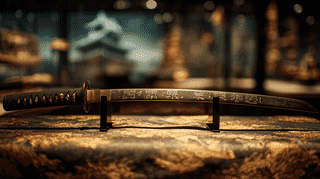
A Nanbokucho dagger at the Ehime Prefectural Museum of Art, 29.2 centimetres long. By Kunihiro of the Chikuzen Sa school; its two faces read differently.

The Ioji Temple Main Hall Zushi in Toon City, Ehime, is a miniature shrine of 1534, 289 cm tall in Zen style, designated an Important Cultural Property in 1966.
Isaniwa Shrine in Matsuyama keeps four buildings of 1667 in the rare hachiman-zukuri form, plus 22 sangaku tablets, five minutes uphill from Dogo Onsen station.
The Kariteimoten Hall of Ishiteji in Matsuyama, Ehime, built in the late Kamakura period, is a small misedana-type shrine with a roof of cypress bark.
The goma hall of Ishiteji in Matsuyama, Ehime, built in the early Muromachi period, is a three-bay hall for fire rituals under a pyramidal copper roof.
The gorinto of Ishiteji in Matsuyama, Ehime, is a stone five-ring stupa of the late Kamakura period at the 51st pilgrimage temple, beside its National Treasure gate.
The three-storied pagoda of Ishiteji in Matsuyama, Ehime, built in the late Kamakura period, is a three-bay pagoda with tiled roofs at a pilgrimage temple.
The bell tower of Ishiteji in Matsuyama, Ehime, built in 1333, has a skirted lower storey and a cypress-bark roof, at the 51st temple of the Shikoku pilgrimage.
The main hall of Ishiteji in Matsuyama, Ehime, built in the late Kamakura period, is a five-bay hall with a tiled hip-and-gable roof at the 51st pilgrimage temple.
The Daishi Hall of Iwayaji, the 45th pilgrimage temple, in Kumakogen, Ehime, built in 1920, blends a traditional hall with Western entasis and carved roses.
Uchikoza, a timber playhouse of 1916 in Uchiko, Ehime, built by townspeople to mark the Taisho enthronement, has a revolving stage; it is closed for repairs.
A mid-Edo keep on a hill in Uwajima, three storeys of white plaster with stacked gables, no loopholes and no stone chutes. One of Japan's twelve surviving keeps.
Ozu Castle in Ehime keeps three turrets of 1843 to 1861 on a hill by the Hiji River, two of them joined to a rebuilt keep and one with a rare railed gallery.
The San-no-maru South Corner Turret of Ozu Castle in Ehime, rebuilt in 1766, is the oldest surviving turret of the castle, with hidden loopholes in its walls.
A Kansei era townhouse in Uchiko, Ehime, listed with its 1885 rear parlour. Built before the wax boom, its upper floor holds no reception rooms. Exterior only.
The main hall of Oyamazumi Shrine on Omishima, Ehime, built in 1427, is a nagare-zukuri hall at a shrine revered for its god of the sea and its armour collection.
The worship hall of Oyamazumi Shrine on Omishima, Ehime, built in the early Edo period, is a seven-bay hall with a gabled roof of cypress bark before the main hall.
The three stone hokyointo pagodas of Oyamazumi Shrine on Omishima, Ehime, made in the late Kamakura period, stand at the only grand shrine in Shikoku.
A Meiji wax merchant's estate in Uchiko, Ehime. Ten listed buildings keep the cauldron house and bleaching yard beside the living rooms. Open as a wax museum.
A late-Kamakura granite hokyointo at Kamei Hachiman Shrine on Uoshima, Ehime, 238 cm tall with its platform; island lore calls it a medieval warrior's grave.
More from Ehime
Ehime’s registered properties across designations, with featured heritage and travel notes.
The complete kokuhō catalogue — browse by prefecture, period, and category.
Nationwide jūyō bunkazai — architecture, sculpture, painting, crafts, and documents.