
Shōwa
Fukuoka · 昭和Browse Fukuoka’s cultural heritage from the Shōwa period (1926 – 1989). Filter by type and keyword, with concise stories, maps, and travel tips.
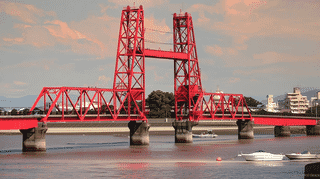
A Showa-period lift bridge between Fukuoka and Saga Prefectures. It was registered first there and it was only ever designated later on than that one.

A Showa-period steel suspension bridge in Kitakyushu, Fukuoka Prefecture. Reading glosses sit right within its own commentary there in round brackets.
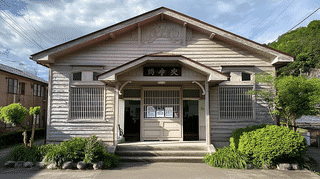
Discover Kyu-Daigaku-yu, a 1932 bathhouse-turned-cultural hub in Fukuoka's Hakozaki district. Explore this registered tangible cultural property that served students for 80 years and now hosts creative events near historic Hakozaki Shrine.

101 objects, 19 Noh masks, 80 costumes, and 2 instruments, handed down in a Hyuga merchant family and now a Registered Art Object at the Kyushu National Museum.
A 47.6 m concrete tower built in 1943 in Shime, Fukuoka, to haul navy coal. Japan's only surviving tower-winding headframe and an Important Cultural Property.
Discover the Kyushu Tategu Woodworking Factory Warehouse in Okawa, Fukuoka — a nationally Registered Tangible Cultural Property built in 1956 that embodies the postwar prosperity of Japan's leading furniture-producing town.
A 1934 guest house in Tagawa, Fukuoka, roofed in copper and known as the Akagane Goten. Its upper hall has a coved coffered ceiling and a veranda facing Kawaradake.
The Former Miidera Pumping Station and Substation in Kurume, Fukuoka, is a brick waterworks of 1933 with arched windows and king-post trusses, registered in 2008.
Discover the Tadokoro Shoten Warehouse, a Registered Tangible Cultural Property in Kitakyushu built with slag bricks from the Yawata Steel Works, reflecting the city's industrial heritage.
Discover Najima Bridge in Fukuoka City, a 1933 reinforced concrete seven-arch bridge spanning the Tatara River. Learn about its elegant classical design, its role in modern Japan's development, and how to visit this Registered Tangible Cultural Property.
Discover the Brick Wall of the Japan Evangelical Lutheran Kurume Church in Hiyoshi-machi, Kurume. Designed by William Merrell Vories and completed in 1927, this 21-meter Registered Tangible Cultural Property features seven elegant arches along the street, forming part of Kyushu's oldest surviving Vories architectural ensemble.
Tetsugyuan, the tea house of the Nogata Tanio Art Museum in Fukuoka, was built around 1941 in sukiya style. Tea room, mizuya and waiting room run in one line.
The Nogata Tanio Art Museum Western Wing in Fukuoka was rebuilt around 1941 as the Okuno Clinic after a fire. Composite columns and tiled walls hide a timber frame.
Built around 1941 behind the Okuno Clinic in Nogata, Fukuoka, the Japanese Wing housed the family. A mud-walled storehouse at one corner holds the collection.
Built in 1958 on the plum-filled grounds of Bairinji Temple in Kurume, Fukuoka, this reinforced-concrete pavilion is an early masterwork by Kiyonori Kikutake, registered as a National Tangible Cultural Property in 2021. With its central-axis columns and curtain walls opening onto the plum garden and Chikugo River, it remains an operating café where visitors can enjoy matcha framed by some 500 plum trees.
Hyakunen-Teien no Yado Suisui (Former Ryokan Tagawa Detached Quarters) Kiku is a modern sukiya-style detached guest quarter in central Kitakyushu, Fukuoka, registered in February 2022 as a National Tangible Cultural Property. Positioned to project over the pond of a Japanese garden first designed in 1889, the building evokes a small boat afloat on the water. Just a short walk from JR Kokura Station and close to Kokura Castle and Tanga Market, this is one of the rare places in Japan where international guests can spend the night inside a registered cultural property overlooking a registered scenic garden.
The Genkai wing of Hyakunen Teien no Yado Suisui in Kitakyushu, Fukuoka, is a single-story wooden building from 1962, registered as a Nationally Registered Tangible Cultural Property in 2022. Facing a Japanese pond garden completed in 1889, it was honored as a pioneering example of modern sukiya architecture that blends rustic hermitage motifs with bold contemporary design, and it still serves as a working luxury ryokan today.
Located in the heart of Kitakyushu's Kokurakita Ward, the Sugao building of Hyakunen Teien no Yado Suisui (Former Ryokan Tagawa Detached Wing) is a single-story wooden sukiya-style structure built in 1962, facing a 700-tsubo Japanese garden whose origins date to 1889. Registered as a National Registered Tangible Cultural Property on February 17, 2022, it is recognized as a pioneering example of modern sukiya architecture, combining traditional shoin-style design with inventive dimensional systems and modern lighting ideas. The inn is an eight-minute walk from JR Kokura Station and close to Tanga Market and Kokura Castle.
The connecting corridor of Hyakunen Teien no Yado Suisui in Kitakyushu, Fukuoka, links three sukiya-style guest pavilions with knotted log pillars, a densely packed bamboo ceiling, and diagonally laid tiles. Registered as a National Tangible Cultural Property in 2022, this modest yet refined passage guides visitors through a historic garden more than a century old.
The 1936 night duty annexe of the rush trade offices in Oki Town, Fukuoka. Plastered walls, an irimoya roof, two tatami rooms and a kitchen. Registered 2020.