
Edo
Fukuoka · 江戸Browse Fukuoka’s cultural heritage from the Edo period (1603 – 1868). Filter by type and keyword, with concise stories, maps, and travel tips.
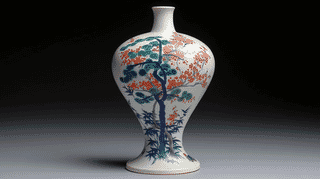
An Edo-period porcelain sake bottle held at Dazaifu in Fukuoka Prefecture, Japan. Its own matching fellow there, of the very same form, is still unlisted.

Discover the Gojō Family Documents, an Important Cultural Property in Yame, Fukuoka. This collection of 369 documents across 17 scrolls preserves imperial letters from the Southern Court era, offering a rare window into Japan's dramatic Nanbokuchō period.
A 31-cm Nabeshima porcelain dish at Kyushu National Museum. Red and white peonies rise from a Taihu rock in a ribbed bowl, made at Saga's secret kiln c. 1680-1700.
Held at the Kyushu National Museum, this Important Cultural Property is a Yuan-dynasty Chinese tea bowl from the 13th–14th century. A rare kiln effect at the boundary of its black and brown glazes produces a silvery 'rainbow' band that gave the bowl its name. Its provenance traces back to the shogun Ashikaga Yoshimasa.
Discover the Arima Family Mausoleum at Bairinji Temple in Kurume, Fukuoka—five mausoleum buildings designated as Important Cultural Properties, built between 1630 and 1655 by the lords of Kurume Domain. Explore samurai heritage, Zen spirituality, and plum blossoms in one remarkable site.
Located in eastern Fukuoka City, the Main Hall of Kashii-gu is a nationally designated Important Cultural Property, rebuilt in 1801 by the 10th lord of the Fukuoka domain. It is the sole surviving example of the unique "Kashii-zukuri" architectural style, enshrining Emperor Chūai and Empress Jingū. As one of only 16 imperially commissioned shrines in Japan, it preserves 1,800 years of sacred history.
Sakurai Shrine in Itoshima keeps its 1632 main hall, worship hall, and gate before a sacred cave from 1610, listed as an Important Cultural Property in 2023.
Hakata's Sumiyoshi Shrine main hall, rebuilt in 1623, keeps the ancient Sumiyoshi-zukuri form: a straight roof, no bracket sets, and red-and-white walls.
An 1842 thatched farmhouse on the pilgrimage road to Mount Hiko in Soeda, Fukuoka. A dated inscription fixed its age; split bamboo clads its rain-struck east wall.
The Fukuoka Castle Minami-maru Tamon Yagura is the only turret of Fukuoka Castle still standing in its original Edo-period position. Comprising a two-story corner turret and a 54-meter flat turret with 16 individual rooms, this nationally designated Important Cultural Property offers a rare window into the defensive architecture of one of Japan's largest castles. Located in Maizuru Park in central Fukuoka, visitors can enjoy cherry blossom illuminations in spring and special interior openings in autumn.
Probably the oldest farmhouse in Kyushu, this mid-Edo thatched magariya at Shingu is called Sennen-ya after a Saicho legend. Interior closed; exterior viewable.
Behind Bairin-ji in Kurume lie the Arima lords' tombs. The first two got gilded mausoleum halls, later lords towering stone pagodas, as daimyo customs evolved.
The service gate and brick wall of the Former Yoshihara Residence in Okawa, Fukuoka, join a late Edo sliding-door gate to a 1920s slag brick wall, registered 2017.
The bell tower of Kyoenji Temple in Buzen, Fukuoka, is a rare three-storey wooden belfry of 1863, some 13.3 metres tall, registered as a cultural property in 2020.
A registered storehouse at the Kusumori Kawakita Residence in Ukiha, Fukuoka. Its rice store dates to 1812 and its vessel store to 1857, one roof spanning two eras.
A registered building at the Kusumori Kawakita Residence in Ukiha, Fukuoka. Despite its name, this charcoal room is a solid two-story building, dating from around 1861.
A single-bay yakuimon gate at Hikata in Ogori, Fukuoka, roofed with a tile inscribed 1850 and moved here around 1923. Registered nationally in August 2015.