More Than Its Name Suggests
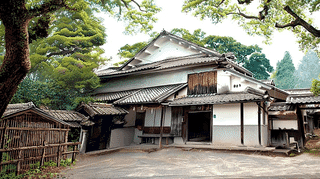
The name sumi-beya means charcoal room, which prepares you for something small and rough. What stands northwest of the main house is anything but. This is a solid two-story building of about 68 square meters, with three rooms on the ground floor and living quarters above, its earthen walls finished in white plaster and its upper story pierced by mushiko-mado, the slatted "insect-cage" lattice windows common to older townhouses and storehouses. On its western side it meets the rice storehouse, part of a tightly grouped cluster of service buildings.
All of this belongs to the Kusumori Kawakita Residence in the Yamakita district of Ukiha, southeastern Fukuoka Prefecture, where the Kawakita family has held ground for generations. The building dates from around Man'en 2, or 1861, near the very end of the Edo period, and is one of eight structures on the estate placed on the national register in 2004.
Why It Was Registered
The building has a gable roof running east to west, laid with sangawara pantiles, and its southern face carries two doorways under a projecting skirt canopy. The lower wall is protected with vertical boarding, while the upper story keeps the plastered finish and its lattice windows. This is careful, substantial construction for what the family classed as an auxiliary building, and the quality is exactly why it drew notice.
It was registered under the criterion of being a model of its building type. The apparent mismatch between a humble label and heavyweight construction is itself informative. On a large farm, the buildings named for storage, charcoal, scales, or firewood were not afterthoughts; they were built to last and, as here, sometimes doubled as living space.
What to Look For
Read the building upward from the ground. The board cladding below, the plastered walls, and the lattice windows of the upper floor each answer a practical concern of weather, security, and ventilation, and together they give the exterior its layered look. The way the charcoal room joins the rice storehouse to its west shows how the estate packed its working buildings into a continuous rear-yard group rather than spacing them apart.
Because the estate remains a private home without regular public access, the charcoal room is best appreciated as one element of a surviving whole rather than a solo attraction. Visitors to this part of Ukiha generally take in the compound from outside and spend time in the valley around it, where the Kiyomizu spring and the summer fireflies along the water channels reward an unhurried pace.
Q&A
- Was this really used for charcoal?
- The name records one of its uses, but the building is a substantial two-story structure with three ground-floor rooms and living quarters upstairs, so it served the household in more ways than storage alone.
- What are the lattice windows on the upper floor?
- They are mushiko-mado, or "insect-cage windows," a slatted lattice type seen on older storehouses and townhouses that admits light and air while giving security.
- How old is it?
- It dates from about 1861 (Man'en 2), in the closing years of the Edo period.
- Is the estate open to the public?
- It is a private residence with no regular public opening. Exterior viewing may be arranged in advance through the Ukiha City Board of Education.
Basic Information
| Name | Kusumori Kawakita Residence Charcoal Room (Sumi-beya) |
|---|---|
| Location | 2056 Yamakita, Ukiha-machi, Ukiha City, Fukuoka Prefecture |
| Designation | Registered Tangible Cultural Property (Building) |
| Registered | 2 March 2004 (notified 29 March 2004); 41st round; registration no. 40-0036 |
| Registration criterion | A model of its building type |
| Quantity | 1 building |
| Structure | Two-story dozo storehouse, tiled roof, building area 68 sq m |
| Date | Edo period, around 1861 (Man'en 2) |
| Access | No regular public opening; inquire with Ukiha City Board of Education |
References
- Agency for Cultural Affairs, National Cultural Properties Database — Kusumori Kawakita Residence Charcoal Room
- https://kunishitei.bunka.go.jp/bsys/maindetails/101/00004086
- Cultural Heritage Online — Kusumori Kawakita Residence Charcoal Room
- https://bunka.nii.ac.jp/heritages/detail/180306
- Ukiha Love (Ukiha City tourism) — Kusumori Kawakita Residence
- https://ukihalove.jp/contents/kawakitamichiakiseika/
- Ukiha City — Kusumori Kawakita Residence
- https://www.city.ukiha.fukuoka.jp/kiji0035114/index.html
Last verified: 2026.07.04