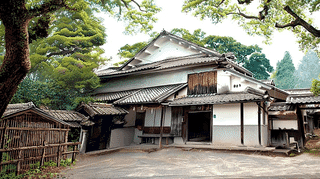
A Building That Moved
The floorboards of the scale storehouse carry an ink inscription dated Man'en 2, or 1861, but the building probably did not stand where it does now until much later. Comparing that date against an old kaso-zu, a house layout plan drawn up according to traditional geomancy, researchers concluded that the storehouse was most likely relocated to its present spot in the late Meiji era and remodeled at that time. It now serves partly as a garage, and it is the smallest and most altered of the estate's registered buildings, yet it is essential to tracing how the compound changed over time.
The hakari-gura stands in the Yamakita district of Ukiha, southeastern Fukuoka Prefecture, on the Kusumori Kawakita estate, seat of the Kawakita family for roughly eight centuries. It is one of eight buildings here entered on the national register of tangible cultural properties in 2004.
Why It Was Registered
The storehouse is a single-story timber building about seven meters along its ridge, with a gable roof of sangawara pantiles, and it stands joined to the western gable end of the lumber shed. Its listing rests on the criterion of contributing to the historic character of the national landscape. That criterion suits a building whose value lies less in a single date or a refined detail than in what it reveals about the estate as an evolving whole.
Rather than hide the fact that it was moved and reworked, the record preserves it. A relocated, repurposed storehouse is honest evidence of how a living farm adapts, shifting buildings, changing uses, and folding the old into the new. Reading the estate's buildings alongside the geomancy plan lets historians reconstruct that sequence of changes.
What to Look For
The interest here is documentary as much as architectural. Knowing that the floor timbers predate the building's current position turns a modest storehouse into a small puzzle about the estate's history, one that the house layout plan helps solve. Its junction with the lumber shed shows, again, the estate's habit of linking its outbuildings into a connected group.
Change on this estate is not only a thing of the past. Each year the bamboo fence around the grounds is renewed through kabeyui, a repair ritual kept up for more than three hundred years and now thought to survive only here in northern Kyushu. A family that has held one place for some 36 generations has done so by constantly repairing and adjusting, and the scale storehouse is a piece of that long, working continuity. The compound is a private residence without regular public access.
Q&A
- If the floorboards are dated 1861, why is it called a Meiji-era building?
- The 1861 inscription is on the floor timbers, but a comparison with an old house layout plan suggests the storehouse was relocated to its current position and remodeled in the late Meiji era, so its present form dates from then.
- What is a "kaso-zu"?
- A kaso-zu is a house layout plan based on traditional Japanese geomancy. Here it helped researchers work out when the building was moved.
- What is it used for now?
- It now serves partly as a garage. Its changing uses are part of why it helps illustrate how the estate developed.
- Can I visit?
- The estate is a private residence with no regular public opening. Exterior viewing may be arranged in advance through the Ukiha City Board of Education.
Basic Information
| Name | Kusumori Kawakita Residence Scale Storehouse (Hakari-gura) |
|---|---|
| Location | 2056 Yamakita, Ukiha-machi, Ukiha City, Fukuoka Prefecture |
| Designation | Registered Tangible Cultural Property (Building) |
| Registered | 2 March 2004 (notified 29 March 2004); 41st round; registration no. 40-0035 |
| Registration criterion | Contributing to the historic character of the national landscape |
| Quantity | 1 building |
| Structure | Single-story timber building, tiled roof, building area 45 sq m; ridge about 7 m |
| Date | Late Meiji era; floorboards inscribed 1861 (Man'en 2), thought to have been relocated and remodeled later |
| Access | No regular public opening; inquire with Ukiha City Board of Education |
References
- Agency for Cultural Affairs, National Cultural Properties Database — Kusumori Kawakita Residence Scale Storehouse
- https://kunishitei.bunka.go.jp/bsys/maindetails/101/00004085
- Ukiha Love (Ukiha City tourism) — Kusumori Kawakita Residence
- https://ukihalove.jp/contents/kawakitamichiakiseika/
- Kusumorido — About the Kawakita Residence
- https://kusumoridou.com/about/kawakitake/
- Ukiha City — Kusumori Kawakita Residence
- https://www.city.ukiha.fukuoka.jp/kiji0035114/index.html
Last verified: 2026.07.04