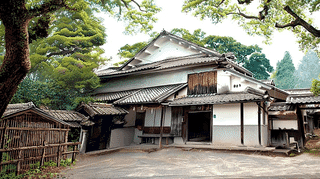
A Storehouse Written in Two Dates
Climb into the loft of this two-story storehouse on the Kawakita estate and look up at the ridge beam. An ink inscription there records the year Bunka 9, or 1812. Walk to the southern half of the same building and a pillar carries a second date brushed in ink, Ansei 4, or 1857. The two bokusho (ink inscriptions) are separated by forty-five years, and they explain why a single roofline covers what were built as two distinct rooms: the northern half served as the kome-gura (rice storehouse), and the southern half, the utsuwa-gura (vessel storehouse), was added later against it.
The building sits within the walled compound of the Kusumori Kawakita Residence in the Yamakita district of Ukiha, in southeastern Fukuoka Prefecture. "Kusumori," meaning roughly "camphor grove," is the old yago (house name) of a family that has farmed this ground for some eight centuries. The storehouse is one of eight buildings on the estate entered on the national register in 2004.
Why It Was Registered
The structure is a dozo, a storehouse built with a heavy timber frame packed and coated in thick earthen walls, here finished in white shikkui lime plaster with vertical board cladding protecting the lower wall. The roof is a simple gable running north to south, laid with sangawara pantiles. At a glance it reads as one coherent building, but the differences between the two halves reward a slower look. The windows sit at different heights, the small eave canopies are framed differently, and the plaster lines do not quite align. Those seams are the visible record of the 1857 extension.
Japan's registered tangible cultural property system, created by a 1996 revision of the cultural properties law, protects buildings roughly fifty years or older that merit preservation. This storehouse was listed under the criterion of being a model of its building type, chosen because it shows, clearly and legibly, how a working farm storehouse grew in phases to meet a landed household's changing needs.
What to Look For
A rice storehouse was the financial center of a gono, a wealthy landholding farm family, and the plainness here is deliberate. Thick earthen walls kept an even temperature and resisted fire and pests, so the harvest and the household's lacquerware and ceremonial vessels could be stored safely for years. The vertical boarding along the base took the brunt of splashing rain and shielded the plaster above.
The estate as a whole is not open for casual walk-in visits, and its buildings remain a private residence. Travelers drawn to this corner of Ukiha usually combine a look at the compound's exterior, best arranged in advance through the city, with the surrounding landscape: the Kiyomizu spring, counted among Japan's hundred notable waters, lies close by, and in early summer fireflies rise from the water channels that thread the grounds.
Q&A
- Why are there two names, rice storehouse and vessel storehouse, for one building?
- The northern half was built first, in 1812, to store rice. The southern half, holding household vessels, was added in 1857. They now share one roof but were raised forty-five years apart, which is why the two ends look subtly different.
- What does "dozo" mean?
- A dozo is a traditional storehouse with a timber frame encased in thick mud-plaster walls, usually finished in white lime plaster. The design resists fire, humidity, and pests, which made it ideal for storing grain and valuables.
- Can I go inside?
- No. The estate is a private residence with no regular public opening. Exterior viewing can sometimes be arranged in advance through the Ukiha City Board of Education.
- How old is the Kawakita family's connection to this site?
- The family is said to have lived here for roughly 800 years across some 36 generations. "Kusumori" is their long-standing house name.
Basic Information
| Name | Kusumori Kawakita Residence Rice Storehouse and Vessel Storehouse (Kome-gura, Utsuwa-gura) |
|---|---|
| Location | 2056 Yamakita, Ukiha-machi, Ukiha City, Fukuoka Prefecture |
| Designation | Registered Tangible Cultural Property (Building) |
| Registered | 2 March 2004 (notified 29 March 2004); 41st round; registration no. 40-0037 |
| Registration criterion | A model of its building type |
| Quantity | 1 building |
| Structure | Two-story dozo storehouse, tiled roof, building area 45 sq m |
| Date | Edo period; rice storehouse 1812 (Bunka 9), vessel storehouse added 1857 (Ansei 4) |
| Access | No regular public opening; inquire with Ukiha City Board of Education |
References
- Agency for Cultural Affairs, National Cultural Properties Database — Kusumori Kawakita Residence Rice Storehouse and Vessel Storehouse
- https://kunishitei.bunka.go.jp/bsys/maindetails/101/00004087
- Cultural Heritage Online — Kusumori Kawakita Residence Rice Storehouse and Vessel Storehouse
- https://bunka.nii.ac.jp/heritages/detail/117167
- Ukiha Love (Ukiha City tourism) — Kusumori Kawakita Residence
- https://ukihalove.jp/contents/kawakitamichiakiseika/
- Ukiha City — Kusumori Kawakita Residence
- https://www.city.ukiha.fukuoka.jp/kiji0035114/index.html
Last verified: 2026.07.04