
Shōwa
Fukuoka · 昭和Browse Fukuoka’s cultural heritage from the Shōwa period (1926 – 1989). Filter by type and keyword, with concise stories, maps, and travel tips.
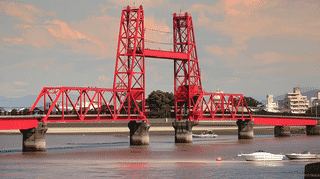
A Showa-period lift bridge between Fukuoka and Saga Prefectures. It was registered first there and it was only ever designated later on than that one.
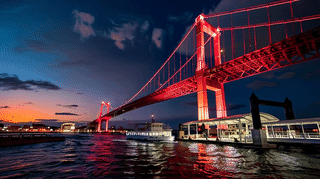
A Showa-period steel suspension bridge in Kitakyushu, Fukuoka Prefecture. Reading glosses sit right within its own commentary there in round brackets.
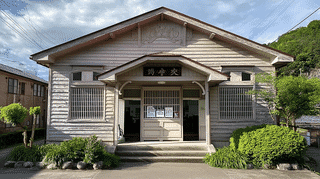
A Showa-period former bathhouse in Fukuoka, Japan. Western in its own outward form over there, and yet plainly a bathhouse within it even so now today.

101 objects, 19 Noh masks, 80 costumes, and 2 instruments, handed down in a Hyuga merchant family and now a Registered Art Object at the Kyushu National Museum.
A 47.6 m concrete tower built in 1943 in Shime, Fukuoka, to haul navy coal. Japan's only surviving tower-winding headframe and an Important Cultural Property.
The west storehouse and former rice mill of Ishikura Sake Brewery in Hakata, Fukuoka, from the early Showa era, pair black weatherboarding with white lime plaster.
The 1934 brewing storehouse of Kanhokuto Sake Brewery in Kama, Fukuoka, pairs plastered walls and staggered windows with a king-post truss spanning 14 metres.
A three-storey concrete lab of 1970 at Kyushu University, Fukuoka, mirroring its neighbor across a linking corridor and holding an anechoic chamber. Registered 2025.
A small three-storey concrete lab of 1970 with a recessed balcony over its central door, still housing photo studios at Kyushu University, Fukuoka. Registered 2025.
A 1970 six-storey concrete building on Kyushu University's Ohashi Campus in Fukuoka, whose stepped lounges and balconies face the Fry Pan plaza. Registered 2025.
Built in 1970 at Kyushu University in Fukuoka, this six-storey concrete block faces its twin across the Fry Pan plaza, upper floors stepping back. Registered 2025.
A 1970 concrete workshop at Kyushu University, Fukuoka, where a passage under its front corridor leads from the Fry Pan plaza to a small courtyard. Registered 2025.
The Former Kyushu Imperial University Faculty of Engineering Main Building of 1930 has a scratch-tile tower, a tiered lecture hall and a free museum room.
The Former Kurauchi Family Residence Storehouse in Chikujo, Fukuoka, is an L-shaped early Showa store at the estate's southwest corner, split into tool rooms.
The Former Kurauchi Family Residence Rice Storehouse in Chikujo, Fukuoka, is an early Showa rice store with a helmet-style gable and white walls to the road.
The Kyushu Tategu Mokkosho Warehouse in Okawa, Fukuoka, a timber warehouse of 1956 with four tall windows and a parapet, tells of post-war prosperity in woodworking.
A 1934 guest house in Tagawa, Fukuoka, roofed in copper and known as the Akagane Goten. Its upper hall has a coved coffered ceiling and a veranda facing Kawaradake.
The Former Miidera Pumping Station and Substation in Kurume, Fukuoka, is a brick waterworks of 1933 with arched windows and king-post trusses, registered in 2008.
This 1929 building at Kogarasu Shrine in Fukuoka, where food offerings are prepared, is the only tiled structure in the precinct. It covers 19.00 square metres.
An open ablution pavilion of 1929 beside the approach at Kogarasu Shrine in Fukuoka. Four posts lean inward over a stone basin inscribed that same year.