
Meiji
Gifu · 明治Browse Gifu’s cultural heritage from the Meiji period (1868 – 1912). Filter by type and keyword, with concise stories, maps, and travel tips.
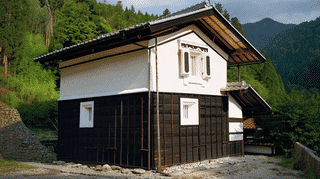
An earth-walled storehouse of 1892 in Gero, Gifu, just 21 square metres. A single line of black plaster crosses its white wall high up, sharpening it.

Completed in 1886, the Former Ibigawa Railway Bridge spans 325.1 metres on five wrought-iron trusses designed by C.A.W. Pownall. It is still crossed on foot, free.
Rebuilt in 1907 and designated an Important Cultural Property in 1966, the Yoshijima Residence in Takayama is known for the beam lattice above its earth floor.
The Isaji Family Residence Storehouse in Mitake, Gifu, is a 2-storey early Meiji rice store whose earthen walls are trimmed with white plaster at openings and eaves.
The late Meiji to Taisho gate and wall of the Imao estate in Kakamigahara, Gifu, registered in 2007, a yakui-mon with wickets and a long white-plastered wall.
The Umeda Family Residence Main House, an 1868 townhouse on the old Nakasendo in Unuma, Kakamigahara, has iron and wooden lattice windows and keeps the street line.
The Umeda Family Residence Annex in Unuma, Kakamigahara, faces the back street and combines a storehouse, gateway and rooms with a hip-and-gable wing under one roof.
The Kasami Shrine Offering Hall in Kakamigahara, Gifu, is a 1910 gabled hall 11 meters wide whose raised, recessed center faces the sanctuary. Registered in 2008.
Brewing storehouse No. 1 of the Kaba Sake Brewery in Hida Furukawa, Gifu, a single-storey store of 1906 on the Setogawa canal, has 3 small windows on the water.
Brewing storehouse No. 2 of the Kaba Sake Brewery in Hida Furukawa, Gifu, a store of 1906 at the canal corner, once served a ryotei and has a Western ceiling rose.
The main house of the Kaba Sake Brewery in Hida Furukawa, Gifu, a townhouse 11 bays wide rebuilt in 1906 after a fire, has a long latticed front on Ichinomachi-dori.
The side storehouse of the Kaba Sake Brewery in Hida Furukawa, Gifu, a sake store of 1906 in white plaster over weatherboards, is a symbol of Ichinomachi-dori.
The archive storehouse of the Kaba Sake Brewery in Hida Furukawa, Gifu, a two-storey store of 1906 on the Setogawa canal, is part of the scene of white sake stores.
The Uedaya main house faces the old Nakasendo in Ochiai-juku. Its early-Meiji upper floor, thrust out on beams above latticed windows, marks a post-town official's home.
This 1904 dozo storehouse stands beside the Uedaya main house on the old Nakasendo, its street wall finished in sea-cucumber tiling below and black lime plaster above.
Behind the Uedaya shopfront in Ochiai-juku, this early-Meiji detached wing faces the garden, its raised parlor framing the view above a thick-walled miso cellar below.
The Kawai Family Residence West Storehouse in Gujo, Gifu, is a 2-storey storehouse of 1885 with a namako tile-lattice east wall and a decorated lintel over its door.
The Kawai Family Villa Storehouse in Hida-Furukawa, Gifu, is a Meiji storehouse of 1883 to 1897 inside a 1941 house, with a black plaster crest on its inner door.
A 1904 plastered rice storehouse in Ono, Gifu, set on a tall cobblestone base after the 1896 flood. Registered in 2018; its walls are visible from the lane any day.
A long 1905 storehouse in Ono, Gifu: two stores under one roof, one wagoya-framed, one with sloping beams, and a north wall of hooded windows seen from the lane.