
Meiji
Gifu · 明治Browse Gifu’s cultural heritage from the Meiji period (1868 – 1912). Filter by type and keyword, with concise stories, maps, and travel tips.
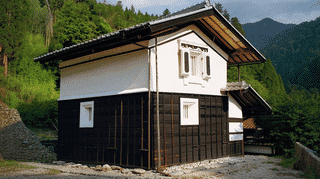
An earth-walled storehouse of 1892 in Gero, Gifu, just 21 square metres. A single line of black plaster crosses its white wall high up, sharpening it.

Completed in 1886, the Former Ibigawa Railway Bridge spans 325.1 metres on five wrought-iron trusses designed by C.A.W. Pownall. It is still crossed on foot, free.
Rebuilt in 1907 and designated an Important Cultural Property in 1966, the Yoshijima Residence in Takayama is known for the beam lattice above its earth floor.
The front gate and wall of the Imao Family Residence in Kakamigahara City, Gifu Prefecture, is a Registered Tangible Cultural Property that preserves the legacy of the Imao family, who served as personal physicians to the Tsubouchi hatamoto clan since the late Edo period. Discover this stately architectural ensemble along the old Nakasendo highway.
Standing on Ichinomachi Street in Hida-Furukawa, Gifu Prefecture, the Kaba Sake Brewery Main Building was rebuilt in 1906 after a great fire by relocating an older Wada family townhouse from a nearby village. Its eleven-ken-long lattice facade anchors one of central Japan's most beautiful historic streetscapes, and it was registered as a National Tangible Cultural Property in 2007. The building still serves as the working shop and residence of the Kaba Sake Brewery, founded in 1704.
Standing along Ichinomachi-dōri in Hida-Furukawa, Gifu Prefecture, the Kaba Shuzōjō Sodegura is a two-story Meiji-era sake warehouse built in 1906. Part of the Kaba family's brewery (founded in 1704), this white-plastered dozō with its vertical wood lap-siding is a Registered Tangible Cultural Property since 2007 and a defining element of one of Japan's most beloved traditional townscapes.
Built in 1906 beside the Seto irrigation channel in Hida-Furukawa, this two-storey earthen storehouse kept the Kaba Shuzojo brewery's records safe from fire.
The Uedaya main house faces the old Nakasendo in Ochiai-juku. Its early-Meiji upper floor, thrust out on beams above latticed windows, marks a post-town official's home.
This 1904 dozo storehouse stands beside the Uedaya main house on the old Nakasendo, its street wall finished in sea-cucumber tiling below and black lime plaster above.
Behind the Uedaya shopfront in Ochiai-juku, this early-Meiji detached wing faces the garden, its raised parlor framing the view above a thick-walled miso cellar below.
Discover the Former Hayashi Clinic Main Building, a registered tangible cultural property built in 1904 in Gujo Hachiman, Gifu. This charming pseudo-Western wooden clinic features Ionic columns and Meiji-era medical exhibits, now preserved as the Gujo Hachiman Rakugeikan museum.
The Former Miyagawa Family Residence Main House is a thatched-roof mountain farmhouse rescued from Tokuyama Village before it was submerged by Japan's largest reservoir. Relocated to Gifu Prefectural Hundred-Year Park in Seki City and registered as a National Tangible Cultural Property in 2018, it preserves the architecture and atmosphere of a vanished village in western Mino.
Discover Senzairo, a historic ryokan established in 1764 near legendary Yoro Falls in Gifu Prefecture. Registered as a Tangible Cultural Property, its Meiji-era main building offers exquisite sukiya-zukuri architecture, Hida beef cuisine, and rooms once graced by Japan's greatest cultural figures.
A brick aqueduct bridge in Mino, Gifu, carrying part of the 4.9-kilometre headrace of the Nagaragawa Power Plant, in operation since 1910. One of nine Registered Tangible Cultural Properties in the plant complex, the bridge shows late-Meiji Japan absorbing European hydroelectric engineering through local brick and granite craftsmanship.
Built in 1910, this intake on the middle Nagara River in Gujo City still feeds Japan's oldest hydroelectric installation on the river. Five segmental arches with granite voussoirs and an English-bond brick wall mark a key Meiji-era industrial heritage site.
Built in 1910, this brick gate (5.5 m wide, 2.4 m high) features granite-capped pillars and flared brick steps facing the Nagara River. Registered as a Tangible Cultural Property in 2000 and designated Modernization Industrial Heritage in 2007, it still serves as the working entrance to one of Japan's earliest hydroelectric plants.
A 1.2-meter Flemish-bond brick fence with five buttresses, raised in 1910 around Japan's first Nagaragawa River hydroelectric plant. A working piece of Meiji-era industrial heritage in Mino, Gifu, registered as a Tangible Cultural Property in 2000.
Tucked into the mountains of Mino City, Gifu Prefecture, the Nagaragawa Power Station No. 1 Settling Basin Waterproof Wall is a 1910 Registered Tangible Cultural Property still in active service. Its roughly pentagonal, 60-meter brick-and-cobblestone enclosure—punctuated by four elegant semicircular arched gates—regulates the water that powers Gifu's first hydroelectric station. Discover this quiet jewel of Meiji-era engineering heritage along the Nagara River.
Built in 1910, this short brick-and-stone arched culvert lies on the power station's conduit. A granite portal and iron gate flush trapped silt from the settling basin.
Built in 1910, the Hidani Aqueduct Bridge carries the Nagara River Power Station's conduit across a valley, its curving five-arch span holding an English-bond channel.