
Registered Tangible Cultural Properties of Hiroshima
広 島 県 の 登 録 有 形 文 化 財Hiroshima · Registered Tangible Cultural Properties
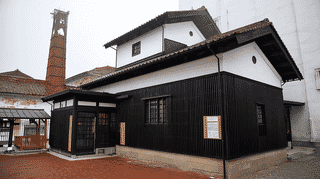
An Edo-period storehouse in Saijo, Higashihiroshima, Hiroshima Prefecture, Japan. An inscription on its window grille dates it to 1836, the oldest in the area.
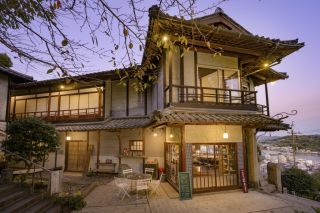
Former inn of about 1923 on Senkoji hill in Onomichi, Hiroshima, set on a high stone wall with a veranda over the Onomichi Channel; now used for lodging.

The Ihara Sōjūrō Residence main house in Shiraichi, Higashihiroshima, is an 1871 ironcasters' townhouse. Metal fittings on its lattice recall the trade. Registered 2025.
The Ihara Sōjūrō Residence storehouse in Shiraichi is the town's only three-storey kura, built by an ironcasting family in the Taishō era. Registered 2025.
The Ihara Sōjūrō Residence detached wing in Shiraichi is a refined Meiji guest room and tea room, said to have lodged a prince. Registered 2025 as a design model.
The Ihara Sōjūrō Residence gate and wall edge an old street in Shiraichi. Its stone-stepped yakui-mon gate bears castle-style shachihoko ornaments. Registered 2025.
A late Edo storehouse facing the harbour of Tomo, Fukuyama, registered in 1997, now displaying artefacts from Sakamoto Ryoma's ship Iroha-maru.
A late Edo stone check dam high in a Dodogawa side valley in Fukuyama, Hiroshima: 3.8 metres of dry random walling, quoined corners and diagonal courses.
Built around 1905 on the old Saigoku Kaido in Saijo, Higashihiroshima, the Ota Family Residence Main House pairs a latticed ground floor with black tile above.
A late Meiji storehouse moved in the early Showa era to the rear of the Ota family estate in Saijo, Higashihiroshima, with a tiled drip course and a gable door.
An early Showa tea pavilion on the Ota family estate in Saijo, Higashihiroshima, joined by corridors to the main house and annex, and a woven ajiro tea room ceiling.
An early Showa reception wing in the corner of the Ota family estate in Saijo, Higashihiroshima, with glazed doors to the garden and a formal alcove between shelves.
An early Showa storehouse on the Ota family estate in Saijo, Higashihiroshima, with plaster walls, a namako-kabe tile base, and a south gable trimmed with hoods.
An early Showa yakuimon gate and 33 metres of tile-capped fences on the north side of the Ota family estate in Saijo, Higashihiroshima, best seen from the lane.
A c.1929 shop-house of a former distiller on a Shiraichi corner, with projecting eaves, a glass-lit earth passage and upstairs rooms once open behind storm shutters.
A c.1929 single-storey workshop of a shochu and mirin maker in Shiraichi, with a lees room, sunken kettle pit and woodstore under an exposed king post truss roof.
A late Edo storehouse on a Shiraichi lane, plastered white right up over its eaves, with a heavy clay door, few windows and a double-beamed roof frame upstairs.
A c.1929 annex linked to the main house by a 2-storey corridor: office and workroom below, paired reception rooms above with alcove, shelves and a built-in desk.
An early Showa sake wholesaler's house on Saijo's old highway, Higashihiroshima, registered in 2021. Black tile faces its upper storey, with wing walls at each end.
A 1920s-30s plastered storehouse set behind the Okada merchant house in Higashihiroshima's sake district, registered in 2021, with a coffered ceiling over its door.
More from Hiroshima
Hiroshima’s registered properties across designations, with featured heritage and travel notes.
The complete kokuhō catalogue — browse by prefecture, period, and category.
Nationwide jūyō bunkazai — architecture, sculpture, painting, crafts, and documents.