
Registered Tangible Cultural Properties of Hokkaido
北 海 道 の 登 録 有 形 文 化 財Hokkaido · Registered Tangible Cultural Properties
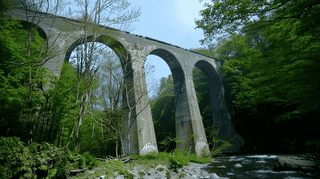
Discover the Koshikawa Bridge, Hokkaido's largest unreinforced concrete railway bridge. A Registered Tangible Cultural Property that stands as a testament to wartime engineering and a poignant memorial to those who built it.

Asahikawa's last surviving army riding hall, built in brick for winter cavalry drill. Iron Fink trusses span it, and a bus company services vehicles inside it today.
Built in 1899 to season carriage timber, this square brick building in Asahikawa shows Flemish bond walls, three-centred gable arches and overburnt brick trim.
Where carriage woodwork was cut and fitted from 1899, this Asahikawa brick workshop pairs broad arched windows with slit openings and now serves as a public hall.
A 1961 annex joined to the 1936 main block of the Abashiri City Museum in Hokkaido. Tanoue Yoshiya designed both; the newer one shows his postwar manner.
A 1936 hilltop museum in Abashiri, Hokkaido by Tanoue Yoshiya: symmetrical plan, a red tower roof and geometric facade panels. Registered in December 2019.
Shaonkan, a 1922 wooden annex at Iai Gakuin in Hakodate, was registered in 2005. Its over-burnt brick plinth and banded sliding windows echo the main hall beside it.
The Iai Gakuin Auditorium in Hakodate, a 1935 Vories design registered in 2002, still seats about 600 on its original chairs for the school's morning worship.
This small wooden building in Hidaka Town, Hokkaido keeps two formal rooms salvaged in 1951 from a 1911 imperial lodging, under a coved coffered ceiling in hinoki.
Facing the Pacific in Hidaka Town, Hokkaido, this late Meiji house joins a Western reception room to two tatami rooms by a corridor turning a right angle.
A Meiji-era wooden office in southern Sapporo, built in 1887, honoring Edwin Dun, the Ohio rancher who founded Hokkaido's dairy industry from Makomanai in 1876.
A Taisho house in Hobetsu, Mukawa, built by an oil prospector turned farmer from timber off his own land, dismantled in 2003 and rebuilt beside the town museum.
A hexagonal cabin on a brick cylinder, built in 1909 to supply a Sapporo army garrison. Registered in 2001, it stands offshore in Nishioka Park, free to view.
Rebuilt in brick after a 1951 fire, this Ebetsu clay pipe works made drainage pipe and flue liners. Registered in 2019, it now trades as EBRI, free to enter.
Built the year fire swept Hakodate in 1934, this timber house wraps a courtyard and wears battened clapboard. Registered in 2016. Private: view the exterior only.
A single-arch reinforced-concrete overpass carrying a footpath over the Hokutan colliery's coal railway at Yubari, its deck tilted to clear larger rolling stock.
A reinforced-concrete viaduct of seven semicircular arches, each spanning six metres, built in 1951 to carry the Takamatsu waste-rock line at the Yubari colliery.
A straight concrete tunnel seventy-three metres long, built in 1951 for the skip cars that hauled waste rock along the Takamatsu line, with portals at each end.
The west portal of the belt-conveyor tunnel on the Takamatsu waste-rock line: a concrete face nearly nine metres wide framing a modest semicircular opening.
The brick portal of the Tenryu pit's material-haulage incline of 1900, its walls five bricks thick framing a semicircular arch with pilasters and a name plaque.
More from Hokkaido
Hokkaido’s registered properties across designations, with featured heritage and travel notes.
The complete kokuhō catalogue — browse by prefecture, period, and category.
Nationwide jūyō bunkazai — architecture, sculpture, painting, crafts, and documents.