
Shōwa
Hokkaido · 昭和Browse Hokkaido’s cultural heritage from the Shōwa period (1926 – 1989). Filter by type and keyword, with concise stories, maps, and travel tips.
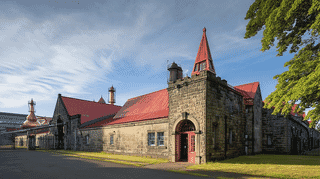
Ten Showa-period distillery buildings in Hokkaido. Their own dates differ from one building to the next, and each one of them is approximate here now.
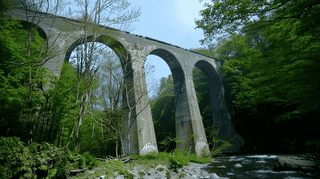
Discover the Koshikawa Bridge, Hokkaido's largest unreinforced concrete railway bridge. A Registered Tangible Cultural Property that stands as a testament to wartime engineering and a poignant memorial to those who built it.

A 1961 annex joined to the 1936 main block of the Abashiri City Museum in Hokkaido. Tanoue Yoshiya designed both; the newer one shows his postwar manner.
A 1936 hilltop museum in Abashiri, Hokkaido by Tanoue Yoshiya: symmetrical plan, a red tower roof and geometric facade panels. Registered in December 2019.
The Iai Gakuin Auditorium in Hakodate, a 1935 Vories design registered in 2002, still seats about 600 on its original chairs for the school's morning worship.
Rebuilt in brick after a 1951 fire, this Ebetsu clay pipe works made drainage pipe and flue liners. Registered in 2019, it now trades as EBRI, free to enter.
Built the year fire swept Hakodate in 1934, this timber house wraps a courtyard and wears battened clapboard. Registered in 2016. Private: view the exterior only.
A single-arch reinforced-concrete overpass carrying a footpath over the Hokutan colliery's coal railway at Yubari, its deck tilted to clear larger rolling stock.
A reinforced-concrete viaduct of seven semicircular arches, each spanning six metres, built in 1951 to carry the Takamatsu waste-rock line at the Yubari colliery.
A straight concrete tunnel seventy-three metres long, built in 1951 for the skip cars that hauled waste rock along the Takamatsu line, with portals at each end.
The west portal of the belt-conveyor tunnel on the Takamatsu waste-rock line: a concrete face nearly nine metres wide framing a modest semicircular opening.
This 1928 timber relay station in Nanporo, Hokkaido, lodged around 550 travellers a year until a railway closed it in 1931. Registered in 2006; exterior only.
A 94-metre coal railway bridge of about 1945 in Ashibetsu, Hokkaido, with a diesel locomotive still standing on its deck. Registered as a cultural property in 2009.
A 1938 rice granary built of Sapporo welded tuff at Takaoka in Ishikari, Hokkaido. Registered in 2024, it now houses the Higuchi Kiichiro Memorial Museum.
A 1937 wooden clubhouse in Sapporo's Chuo Ward, built by Mitsubishi Mining onto a Meiji residence. Half-timbered gables, round windows, free entry until 22:00.
Designed by Naito Tachu and opened in 1957, this 144-metre steel tower closes the east end of Odori Park. Registered as a cultural property in March 2025.
Registered in 2006, the 1934 platform at JR Otaru Station stands at second-floor level: 118 metres of concrete under a canopy of old steel rails, above two tunnels.
Completed in 1934 and registered in 2006, the JR Otaru Station Main Building pairs a top-lit central hall and 333 glass lamps with a plan shaped by a harbour slope.
Built in 1941 for a sawmill executive on Furano's main street, this low house uses local timber under a shallow hip-and-gable roof. Registered in 2024; not open.
Junseiji Main Hall, built in 1935 in the Hokkaido forestry town of Tsubetsu, pairs a plain gable roof with deep interior beams and a carved transom. Registered 2007.